A range fails as two systems sharing one cabinet
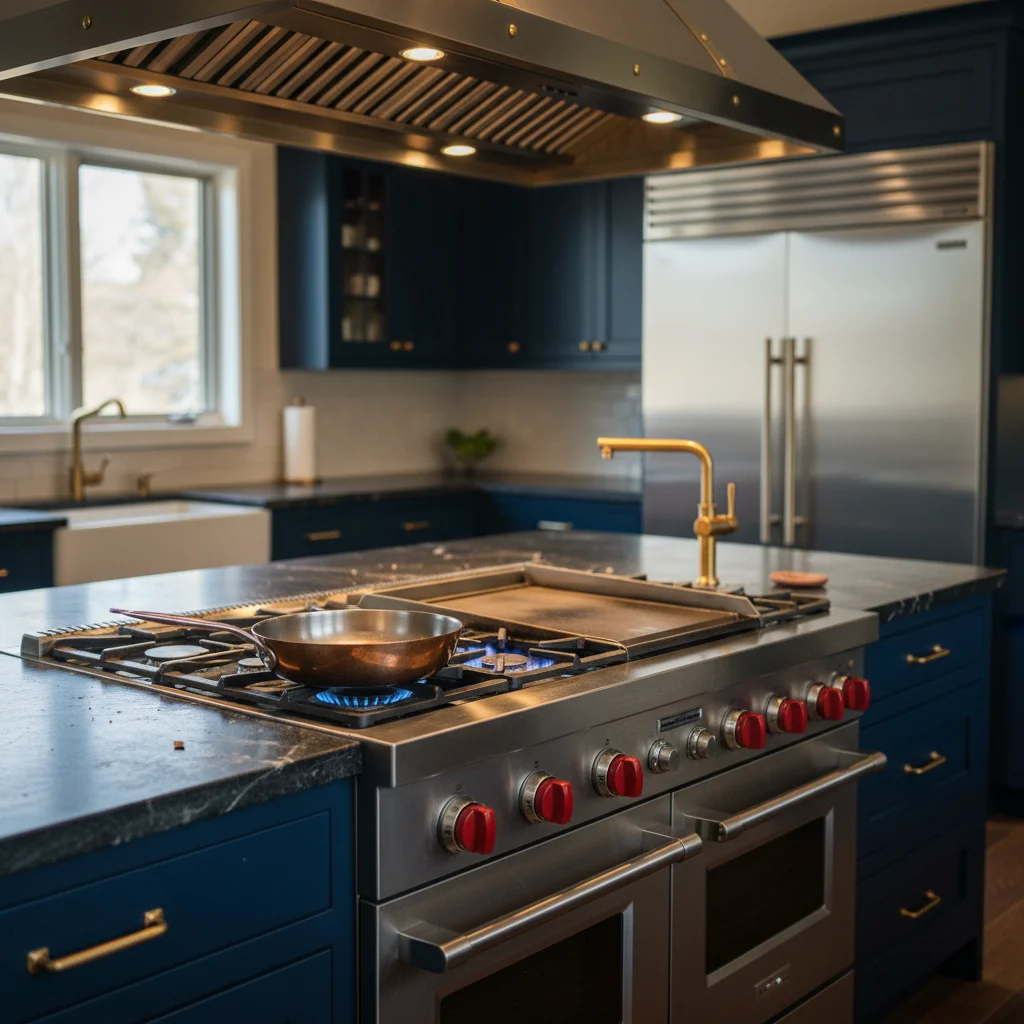
Most people think of a range as a single appliance, but it behaves like two cooperating machines bolted into one frame. Up top is the cooktop — open gas burners, electric coils, a radiant glass surface, or induction coils — each delivering heat directly to a pan. Below is a full oven cavity with its own igniter or elements, sensor, and door. A range can run flawlessly on top while the oven quietly bakes cool, or hold a perfect 350 degrees while a front-left burner refuses to light. Because the two halves often share a control board, a gas line, or a single spark module, the way they fail — and which half fails — tells us where to look before we ever pull a panel.
That is why we diagnose a range as a whole unit, not just the symptom you called about. A control board that’s dropping the oven relay can also be the reason a surface burner spark won’t stop clicking. A gas pressure problem upstream can starve both the cooktop and the oven at once. Treating the appliance as one connected system is what keeps us from replacing a good part and leaving the real fault in place — a distinction that matters most on premium ranges, where a single board may orchestrate every burner, the oven, convection, and self-clean, and where parts are far too costly to swap on a hunch.
We work across the full range of configurations: 30-inch and 36-inch freestanding ranges, slide-in models with sealed controls, professional-style ranges with six or more burners and a griddle, all-gas and all-electric units, induction tops, and dual-fuel designs that marry a gas cooktop to an electric oven for cooks who want flame control above and steady electric heat below.
What separates a luxury range from a builder-grade one isn’t the badge — it’s the tolerances. High-end ranges hold tighter temperature bands, use heavier burner castings and sealed-flame designs, and lean on more capable electronics to manage simmer and high-output settings. That precision is exactly why a small fault is so visible: when a burner is engineered to hold a true low simmer, an igniter switch that sticks or a valve that’s gummed turns a superb cooktop into a frustrating one.
The range faults we see most, and what actually causes them
Ranges announce trouble in a fairly predictable vocabulary. Here are the patterns we trace most often across Denver kitchens, with the root causes behind each:
- One surface burner won’t light (gas) — a clogged burner port, a worn spark electrode, a cracked ceramic insulator, or moisture shorting the igniter switch so the spark grounds out before it reaches the burner.
- All burners click but none ignite — a failed spark module, a tripped or unplugged ignition harness, or a power-supply fault feeding the whole cooktop.
- Burner clicks continuously even when off — a stuck igniter switch, water trapped under a sealed burner cap, or a cracked spark electrode that keeps arcing.
- Weak, yellow, or lazy flame — an air-shutter or orifice mixture running rich for the altitude, a partially blocked port, or low gas pressure at the appliance.
- Burner won’t hold a low simmer — a worn gas valve, a sticking valve stem, or on sealed burners a cap that’s seated wrong and disrupting the flame.
- Electric coil or radiant element won’t heat — a burned-out surface element, a failed infinite-switch (the dial that pulses the element), or a corroded terminal block where the element plugs in.
- Induction cooktop won’t recognize a pan or shuts off — a failed power module, an overheated coil, a cooling-fan fault, or a control board that’s lost communication with the user interface.
- Oven half won’t heat while the cooktop works — a weak glow-bar igniter, a failed bake element, a separate oven relay on the control board, or a temperature sensor reading high.
- Whole range is dead — a tripped breaker, a failed power cord or terminal block, or a main control board with no output.
- Fault or error codes on the display — sensor open/short faults, a board communication error, or a relay that no longer closes.
- Gas odor during use — a valve that isn’t sealing, delayed ignition letting gas pool before it lights, or a loose supply connection that needs prompt attention.
If your range is doing something that isn’t on this list, that’s still squarely our work — these are the common shapes of failure, not the boundary of what we fix.
Why Denver’s environment is uniquely hard on a range
This is where local knowledge pays for itself. Denver sits at 5,280 feet, where the air is roughly 15% thinner than at sea level, and on a range that single fact reaches into both halves of the appliance at once.
For the gas cooktop, leaner air means less oxygen reaching every burner port. Orifice sizes and air-shutter settings dialed in at a factory near sea level tend to run rich at altitude — the flame goes lazy and yellow-tipped, ports soot up, and a burner that was healthy starts to struggle. There’s also less combustion margin for a spark igniter to work with, so an electrode or switch that had begun to weaken crosses from “lights on the second click” to “won’t light at all” sooner than it would lower down. When we service a gas range, we tune to how it should combust at Denver elevation, not at sea level.
The same thin air follows down into the oven cavity: combustion and heat rejection both shift, so a glow-bar igniter near the end of its life, or a burner slightly out of tune, shows up as slow preheats and uneven baking faster here. On the electric and induction side, altitude matters less, but Denver’s very dry climate becomes the bigger enemy — low humidity bakes the oven door gasket and any inner-glass seal brittle, so heat leaks, the cavity runs cool, and elements cycle harder to compensate. High-altitude UV and wide day-to-night temperature swings add to that seal fatigue over the years.
Then there’s water. Denver’s hard water, commonly 150 to 250 parts per million, doesn’t trouble a basic gas burner, but it absolutely reaches any range tied to a steam-assist or water feature, leaving the same scale in lines and valves that clogs ice makers and dishwashers across the metro. Even on a standard range, that mineral-heavy water shows up as crusty deposits around burner bases and under caps that, left alone, can disrupt the flame pattern. We flag scale before it becomes a no-light call.
None of this is exotic — it’s the difference between a repair that holds and one that drifts back out of spec by next season. We’ve been diagnosing appliances at this altitude across the Denver metro since 2012, and the local conditions are built into how we work.
How we diagnose a range, step by step
Every visit follows the same disciplined path, because range symptoms are deceptive and guessing is expensive. Here’s the order we work in:
- Confirm the symptom with you and split the appliance. We establish exactly which burners, which heat settings, and whether the oven half is involved — narrowing the problem to the cooktop, the oven, or the shared control before touching a tool.
- Pull stored fault codes. On electronically controlled ranges we read what the board has logged, which often points straight at a sensor, relay, or communication fault.
- Test the ignition or heating path under load. For gas we check spark at each electrode, gas pressure at the appliance, and valve operation; a glow-bar oven igniter is tested under current draw, because it can glow bright and still be too weak to open the safety valve. For electric we measure each element and its infinite switch; for induction we check the power modules, coils, and cooling.
- Verify the controls and switches. Infinite switches, igniter switches, the spark module, and the main board are checked for the continuity and output they’re supposed to deliver, not assumed good.
- Inspect the gas and electrical connections. Burner ports, orifices, the terminal block, the power cord, and supply fittings get a direct look — many “mystery” range faults live in a sooted port or a heat-darkened terminal.
- Check the secondary wear items. Door gaskets, hinges, burner caps, and sealed-burner seating are inspected so we can flag what’s heading toward next month’s service call while the panels are already open.
- Explain the cause and quote a firm price. You get a plain-language diagnosis and an up-front repair price before any work begins.
This order matters because a range that “won’t heat on top” can have flawless burners and a single failed spark module, and an oven that “runs cool” can have a perfect heating system and one sensor reading high. We test our way to the cause so the part we replace is the part that’s genuinely broken.
Components we routinely service
On a range, that one diagnosis can land on a wide spread of parts spanning both halves of the appliance:
- Gas surface burners, caps, and sealed-burner assemblies
- Spark igniters, electrodes, and igniter switches
- The central spark module and ignition harness
- Gas valves, orifices, and air shutters (altitude-tuned)
- Electric surface elements and radiant-glass burners
- Infinite switches and burner control knobs
- Induction power modules, coils, and cooling fans
- Oven bake and broil elements, or the glow-bar igniter
- Oven temperature sensors (RTD probes) and thermostats
- Electronic control boards and relay boards governing the whole unit
- Door gaskets, hinges, and inner-glass seals on the oven
- Power cords, terminal blocks, and heat-stressed wiring connections
For the parts that decide how long a repair lasts, we use OEM-grade and manufacturer-compatible components from verified suppliers, matched to your model and serial — not generic stand-ins that drift out of spec.
Premium range brands we handle
Across the Denver metro we service high-end ranges from the major luxury and professional-style makers — including Sub-Zero and Wolf, Thermador, Viking, Miele, Bosch, Gaggenau, JennAir, KitchenAid, GE Monogram and Café, Dacor, Fisher & Paykel, Frigidaire Professional, and LG and Samsung’s premium lines. Denver Sub-Zero Repair is an independent service and is not affiliated with, endorsed by, or sponsored by any of these manufacturers; we simply repair their ranges. If your range carries a badge that isn’t listed, call and ask — the brands above cover most of what’s in Denver’s high-end kitchens, but they aren’t the whole of what we’ll work on.
Same-day and next-day scheduling across the metro
If your range won’t light, won’t hold a simmer, won’t bake right, or is throwing a code you don’t recognize, the next step is a proper diagnosis of the whole appliance — not a parts-cannon guess at one half of it. Call (720) 770-4189 any time; the phone is answered 24/7 and on-site repairs run daily from 8 AM to 6 PM, with same-day or next-day appointments available throughout Denver and the surrounding suburbs. Prefer to set it up yourself? Use our online booking and we’ll confirm your visit. The $89 service call covers a full inspection of both the cooktop and the oven, and it goes straight toward the repair when you decide to move forward.