The call we get most often
It’s usually a Saturday morning, the oven is preheating for something that matters, and the bake comes out scorched on one side and pale on the other. Or a front burner that lit cleanly last week now clicks four or five times before it catches, then settles into a lazy orange flame instead of a tight blue cone. On a Dacor range these two complaints sound unrelated, but they share a root cause more often than people expect: a precise machine drifting out of the narrow band it was tuned to hold. That’s the whole reason a Dacor rewards a tech who knows the brand instead of a generic dispatch visit.
This page is about the range specifically — the dual-fuel and all-gas models, the gas surface burners, and the oven below them — and how those parts fail in a Denver kitchen. If you’d rather skip straight to scheduling, call (720) 770-4189, answered 24/7, or use the online booking link at the bottom.
What a Dacor range actually is
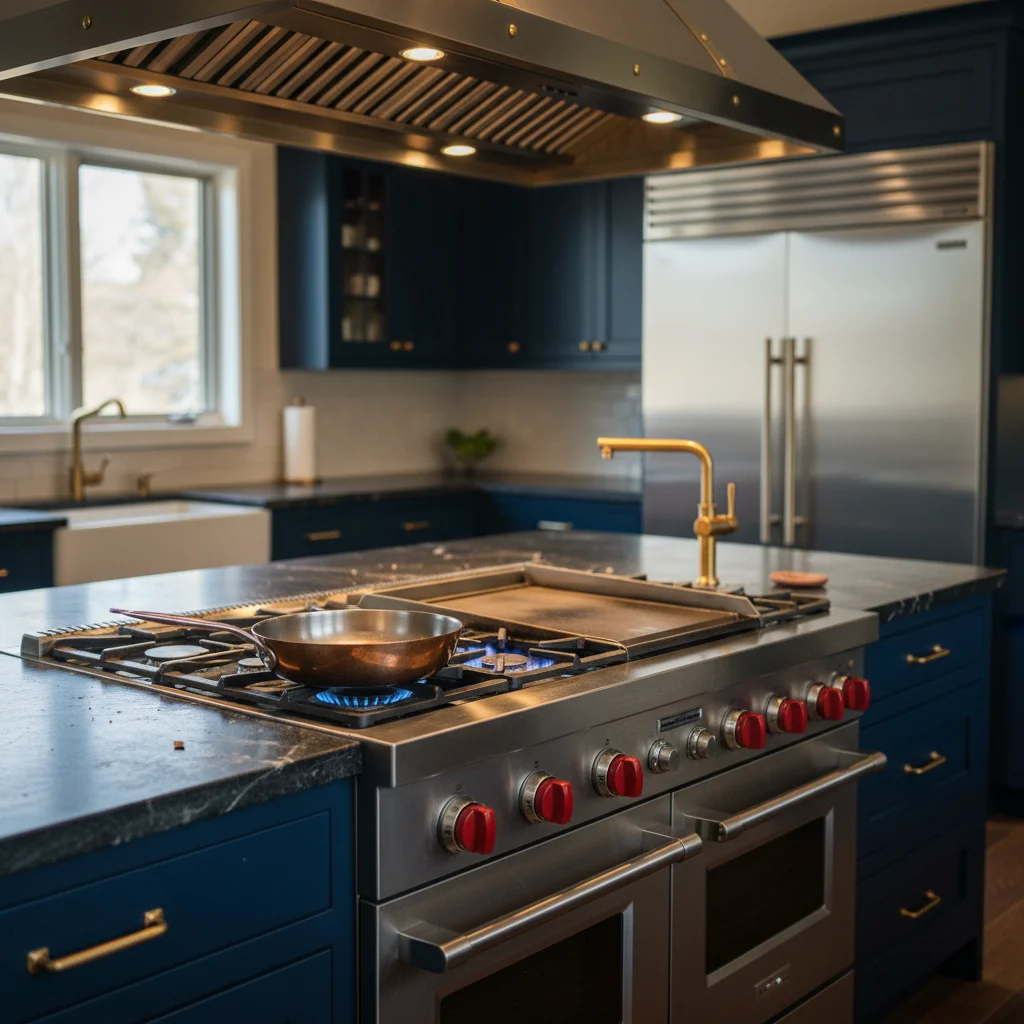
It helps to picture the range as two appliances bolted into one cabinet. Up top sits a sealed gas cooktop with pro-style burners that Dacor engineers to swirl flame outward for broader, more even pan coverage than a plain ring burner. Below sits the oven — and here the two model families split. An all-gas range heats the cavity with a gas bake burner and a hot-surface igniter. A dual-fuel range keeps the gas burners on top but switches the oven to electric convection, which lets it hold temperature more tightly and run Dacor’s multi-fan Pure Convection system for even airflow on multiple racks.
Newer Modernist and Heritage ranges layer a large iQ touchscreen and the connected platform over all of it, so the control system that decides when a burner sparks or an element fires now has a software and wiring dimension a knob-and-dial range never had. Older pre-Samsung Dacor ranges are simpler and more mechanical, but they’re still built around tight tolerances. Either way, the surface symptom you notice is frequently a step or two removed from the part that genuinely failed, and reaching for the obvious component is how a repair ends up coming back.
Faults we chase down most on Dacor ranges
No two ranges fail the same way, but certain patterns show up often enough on Dacor equipment that an experienced tech can usually narrow the field before the cooktop comes apart. These are the ones we trace most:
- Burner won’t light or clicks repeatedly. Spark electrodes foul with spillover, igniter ceramics crack, and burner caps drift off their locating pins after cleaning. A burner that sparks but never catches often has a partly blocked port or moisture trapped under the cap rather than a failed valve.
- Lazy, yellow, or sooty flames. The classic altitude symptom. A burner running rich deposits soot, heats slowly, and wastes gas. The cause is usually mixture — orifice and air-shutter tuning — not a broken burner.
- Simmer won’t hold. Dacor’s low-flame settings ride a narrow window, and at altitude that window shrinks. A simmer that lights then dies points to a fouled electrode, a marginal valve, or a shutter mistuned for elevation.
- Oven bakes unevenly or off-temperature. A drifting temperature sensor, a tired bake or broil element, or a slowed convection fan motor will throw a Dacor oven 25 to 40 degrees off without ever setting a code. On Pure Convection models, one weak fan among several shows up as a hot or cold zone.
- Long preheats or an oven that won’t hold heat. Often a worn door gasket, a failing igniter on a gas oven, or an element that draws current but no longer heats fully. Dry Denver air is hard on the door seal specifically.
- iQ touchscreen dark, frozen, or unresponsive. The display assembly, a control board, a power or wiring fault, or a connectivity setting can each produce a similar dead screen. These get separated before any board is quoted.
- Oven won’t reach temperature or trips a fault code. Relay boards, sensors, and wiring harnesses degrade with heat cycling over years. The code points to a circuit, not always to a specific part.
- Gas smell, a burner that won’t shut off, or a stuck valve. These are safety calls. Stop using the range, shut the gas off if you can do so safely, and call us right away.
How we run the diagnosis
Our method is deliberate, not fast — on a range this well engineered, the expensive mistake is swapping a control board when a $40 sensor or a corroded connector was the real fault. The sequence looks like this:
- Reproduce the actual symptom. “The oven is slow” and “the oven runs cold” point to different parts, and “it won’t light” can mean spark, gas, or a safety lockout. We confirm what’s really happening before forming a theory.
- Read what the range reports. On iQ models we pull stored codes and check the connected platform’s status. On every model we inspect the gas path and the electrical circuit tied to the complaint.
- Measure, don’t assume. Sensor resistance, element draw, spark-module output, gas pressure, and — critically in Denver — flame quality and color all get checked against spec, not eyeballed.
- Separate altitude from failure. A rich, yellow flame or a dropping simmer is often a mixture issue, not a broken burner. We tell you which it is so you’re not paying to replace a healthy part.
- Quote one firm price. You get a plain explanation of the single component at fault and a written number before any work begins. The $89 service call covers this on-site diagnosis and folds into the repair if you proceed.
That discipline is the difference between fixing a Dacor once and chasing the same complaint twice.
Why Denver is hard on a Dacor range
Servicing a range at a mile high genuinely parts ways with servicing one at sea level, and it’s the piece an out-of-town tech routinely misses.
Thin air at 5,280 feet. Denver’s air is roughly 15 percent less dense than at the coast, and that single fact reshapes both halves of the range. Gas burns leaner of oxygen up here, so unless orifices and air shutters are sized for altitude the mixture skews rich — which is exactly why a Dacor burner that held a tight blue flame in California turns lazy and yellow after a move to Colorado, and why a delicate simmer struggles to stay lit. The same thin air changes how the oven sheds and circulates heat, so a convection fan that’s a touch tired or a sensor drifting a few degrees bakes noticeably worse here than it would near sea level. On a sensor-driven Dacor oven, that margin is the whole ballgame. We fold altitude into the diagnosis from the first minute instead of treating it as a footnote.
Hard water, 150 to 250 ppm. Much of the metro runs hard, and that mineral load scales up anything on the range that touches water — most often a paired dishwasher or a plumbed feature in the surrounding kitchen rather than the range itself. Where it matters, scale builds quietly until a line clogs or a valve slows. We flag it when we see it and suggest a maintenance interval that fits local water.
A very dry climate. Denver’s low humidity is quietly tough on rubber. Oven door gaskets dry out, stiffen, and crack sooner here than in humid regions, which shows up as an oven that won’t hold heat, longer preheats, and uneven results. A door complaint that looks cosmetic is frequently an early seal failure worth catching before it drives up your gas or electric bill.
Strong UV and hard dry-cold winters round things out, accelerating wear on exposed trim, control overlays, and any externally routed components. None of this is exotic — it’s local reality, and building it into the diagnosis is precisely what an altitude-aware specialist brings that a national call center can’t.
Dacor’s lineup and the brands beside it
We service Dacor dual-fuel and all-gas pro-style ranges in their common widths, from the older pre-Samsung units to the current Modernist and Heritage collections with the iQ touchscreen and Pure Convection oven. The same techs who know Dacor’s flame geometry and connected controls also work on the brands that share a Denver kitchen and many of the same failure modes — Wolf, Thermador, Viking, BlueStar, Bertazzoni, Bosch, Miele, KitchenAid, Monogram, and others across our brand pages. If you have a Dacor range and a Dacor wall oven, cooktop, or built-in refrigerator, mention it when you book and we’ll come prepared to look at all of it.
A range is the appliance a kitchen revolves around, and a Dacor is precise enough that a careful, brand-aware repair pays for itself in not having to do it twice.
Book your Dacor range repair
When you’re ready, here’s how to reach us:
- Call (720) 770-4189 — answered 24/7, with most jobs booked same-day or next-day. Repairs run daily from 8 a.m. to 6 p.m.
- Book online at the link on this site, anytime.
- The $89 service call covers a full on-site diagnosis and a written, up-front price, and it’s credited toward the repair if you go ahead.
We’ve served the Denver metro since 2012 as an independent appliance-repair company — not affiliated with, endorsed by, or sponsored by Dacor, Sub-Zero Group, Inc., or any manufacturer. Tell us what your Dacor range is doing, and we’ll tell you straight what it’ll take to fix it. Call (720) 770-4189 to get on the schedule.