What this repair covers
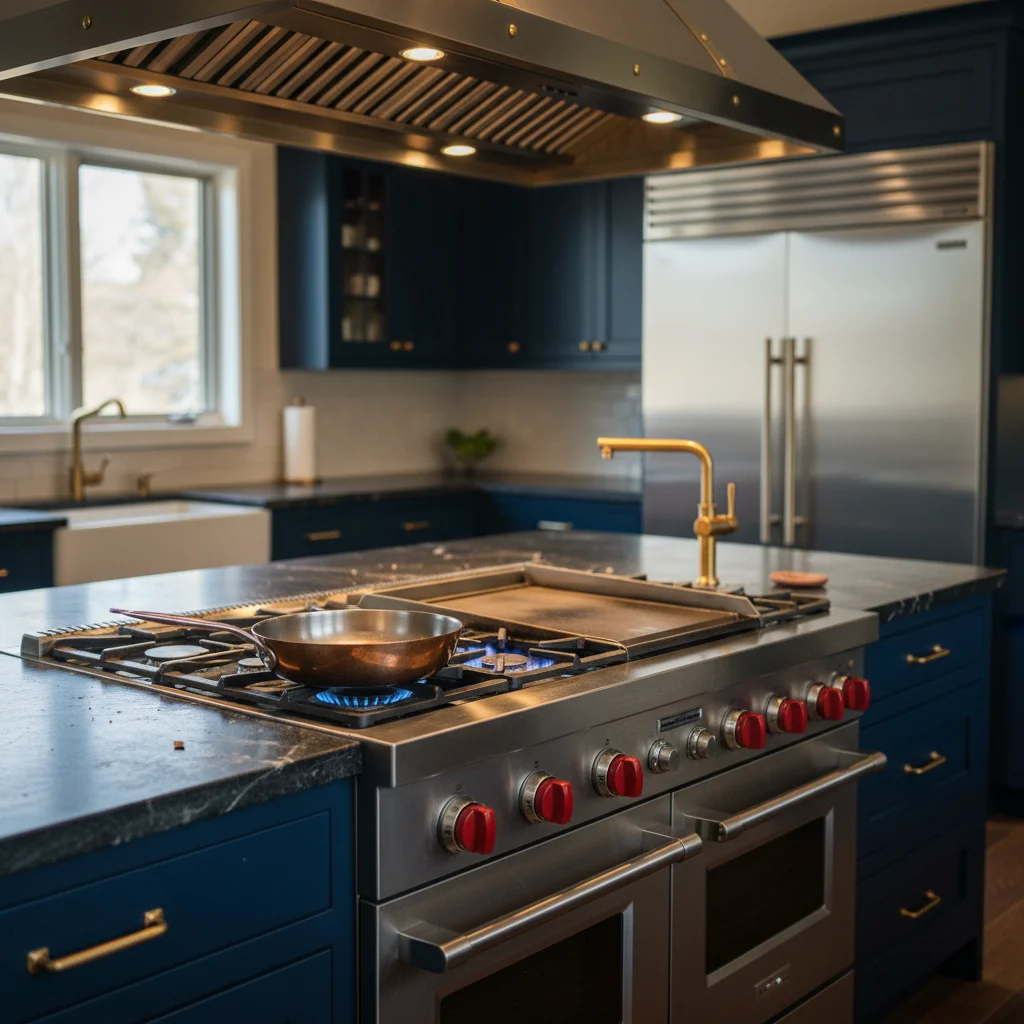
When you call us for a Thermador range, we treat it as the two-appliance machine it actually is: a sealed Star Burner cooktop sitting on top of a convection oven, with a shared control system tying them together. A service visit means we reproduce the exact complaint, read whatever the range reports through its sensors and stored codes, and follow the gas path or the electrical circuit to the one part that is out of spec. Then you get a plain explanation and a firm number before any work begins. The $89 service call covers that on-site diagnosis and folds into the repair if you go ahead.
We work on the Pro Grand and Pro Harmony ranges in their common 30-, 36-, and 48-inch widths, the all-gas configurations, and the dual-fuel layouts that pair gas surface burners with an electric convection oven. Whether the trouble is a burner that won’t light, a simmer that won’t hold, an oven baking off-temperature, or a control panel gone unresponsive, the goal is the same — find what truly failed and fix that, not whatever part is easiest to reach.
Faults we diagnose most on Thermador ranges
Every range tells its own story, but certain failures recur often enough on Thermador equipment that an experienced tech can usually narrow the field before the cooktop comes apart. Here are the ones we see and chase down most:
- Star Burner that clicks but won’t catch — most often a spark electrode fouled by boil-over, a cracked igniter ceramic, trapped moisture under the cap, or a burner cap sitting off its locating pins. Because the star geometry spreads flame across more of the pan, a single blocked port is more noticeable here than on a round burner.
- ExtraLow simmer that won’t stay lit — Thermador’s signature low-heat burners pulse the flame to hold a gentle simmer, and when that cycling falters the culprit is usually a mistuned air shutter, a partly clogged orifice, or a weak spark re-light. Denver’s thin air makes this worse, since the mixture already skews rich against the factory baseline.
- Burner that lights only on high — a worn electrode, a blocked port, or a gas valve needing adjustment, where the flame catches at full throttle but drops out as you turn it down.
- Yellow, lazy, or sooting flames — a classic altitude symptom on a range set up at a lower elevation, pointing to air shutters and orifices that were never tuned for 5,280 feet.
- Oven runs off-temperature or bakes unevenly — a drifting oven temperature sensor, a fatigued bake or broil element, or a convection fan motor that has slowed. The telltale is a range that runs noticeably cool or hot without throwing a hard code.
- Oven won’t ignite or is slow to heat (gas models) — usually a weak or cracked hot-surface igniter that no longer draws enough current to open the gas valve safely.
- Self-clean cycle faults — a stuck or failed door lock, a tripped thermal limit, or a panel that errors out partway through the high-heat cycle.
- Convection that doesn’t circulate — a seized fan motor or a failed element behind the rear baffle, leaving the oven baking like a conventional one.
- Control panel, knob, and display quirks — unresponsive touch zones, a dark display segment, a failed oven lamp, or knobs that no longer track the valve position.
- Door, hinge, and gasket complaints — a sagging oven door, worn hinges, or a brittle gasket leaking heat. Denver’s dry air accelerates seal wear, which we cover below.
How a Thermador diagnosis actually runs
- Reproduce the complaint. “The oven is slow” and “the oven runs cold” point to different parts, so we confirm what you’re actually seeing rather than take the description at face value.
- Read the range. Stored fault codes, oven sensor resistance, igniter glow and current draw, spark-module behavior, ExtraLow cycling, and gas pressure where it applies.
- Trace to one source. We follow the circuit or the gas path to the single component that’s out of spec, not the first part that’s easy to swap.
- Quote before we touch it. You hear the cause, the part, and the total up front — nothing proceeds without your approval.
Inspection and honest pricing
The diagnostic is a flat $89, and it buys a real inspection — not a guess from the doorway. A technician comes out, reproduces the fault, takes the measurements that matter, and identifies the actual failed part. You then get a single up-front price for the repair, and if you approve it that $89 is credited toward the total. There are no surprise add-ons after the fact.
We quote only after we’ve inspected the range because Thermador models and faults vary too much to price blind. A burner that won’t light might be a fifteen-dollar electrode or a more involved spark-module job; an oven baking cool might be a modest sensor or a full element. Putting a number on it before opening the unit would be a guess, and guesses are how people end up paying for parts they never needed. Our approach is the opposite — diagnose deliberately, replace the one thing that failed, and respect that a Thermador is built to anchor a kitchen for fifteen or twenty years.
That longevity is also why fitment matters. We install OEM-grade and manufacturer-compatible parts from verified suppliers, matched to your exact model and serial number, and we focus that care on the components that decide whether a repair lasts: spark modules, ExtraLow valves, oven temperature sensors, hot-surface igniters, and convection motors. A bargain igniter that doesn’t match the original spec might light cleanly on day one and quit by the next holiday. A correctly matched part is what keeps you from calling us back for the same complaint.
To call or book:
- Phone: (720) 770-4189, answered 24/7, so you can reach a real person whenever it suits you. Repairs themselves run daily from 8:00 AM to 6:00 PM.
- Online booking through our scheduler, where you can pick a window that works for you.
Why Denver’s altitude and water change a Thermador repair
This is where servicing a Thermador range in Denver genuinely diverges from servicing one at sea level — and it’s the part an out-of-town dispatch tech tends to miss entirely.
Thinner air at 5,280 feet. Denver’s air is roughly 15 percent less dense than at sea level, and gas burns differently up here. The air-fuel mixture skews rich unless orifices and air shutters are sized for altitude, which is exactly why a Star Burner that ran a crisp blue flame at a lower elevation can burn lazy and yellow after a move to Colorado, and why the ExtraLow simmer can struggle to stay lit at its lowest setting. The same thin air changes how the oven sheds and circulates heat, so a marginal convection fan or a slightly drifting sensor produces noticeably worse baking here than it would near the coast. We build all of this into the diagnosis from the first minute instead of treating it as an afterthought — a range complaint that looks like a failed part is sometimes a tuning issue, and the reverse is also true.
Hard water, roughly 150 to 250 ppm. Much of the metro runs hard. A range itself doesn’t plumb to water, but if your Thermador range lives in a suite with a steam oven or a plumbed refrigerator, the same mineral load that scales those appliances is worth flagging while we’re on site. On the range proper, mineral residue from spills and hard-water cleaning can build up around burner bases and igniters, which is one more reason a thorough cleaning is part of how we diagnose ignition faults.
A very dry climate. Denver’s low humidity is quietly hard on rubber. Oven door gaskets dry out, stiffen, and crack sooner here than in humid regions, and that shows up as a door that won’t hold heat, longer preheats, and uneven baking — symptoms people often blame on the element or the sensor. A door or hinge complaint that looks merely cosmetic is frequently an early gasket failure worth catching before it costs you energy and even baking.
Strong UV and a punishing dry-cold winter round out the picture, accelerating wear on exposed trim and any externally routed components. None of this is exotic; it’s simply local reality, and folding it into a Thermador diagnosis is what an altitude-aware specialist offers that a national call center cannot.
Independent specialist, not the factory channel
Going through a manufacturer channel for a premium range usually means a longer wait and a rigid script. As an independent specialist who has worked on high-end cooking equipment across the Denver metro since 2012, we offer a different deal: same-day or next-day scheduling, a genuine diagnosis instead of a parts-cannon approach, OEM-grade parts matched to your model, and up-front pricing you approve before work begins. Because we concentrate on premium brands, a Star Burner range with an ExtraLow simmer system isn’t an unfamiliar unit we’re learning on your time. To be clear, independent means independent — we are not affiliated with, endorsed by, or sponsored by Thermador or any manufacturer. For most Denver homeowners, the speed and the straight talk are the better trade.
Related Thermador repairs
A range rarely fails in isolation, and many Thermador kitchens are full suites. If your trouble is somewhere other than the range, we cover the rest of the lineup too:
- Thermador cooktop repair — Masterpiece and Professional gas cooktops, Freedom induction cooktops with full-surface pan placement, and electric radiant tops.
- Thermador wall oven repair — single and double convection ovens, steam and combination-steam ovens, and speed convection microwave ovens.
- Thermador rangetop repair — sealed Star Burner rangetops installed above a separate wall oven.
- Thermador refrigeration — Freedom built-in and column refrigerators, freezers, and wine columns.
If you’re not certain whether the fault is on the cooktop or the oven side of your range, describe both symptoms when you call and we’ll arrive ready for either.
Get your Thermador range running again
Whether it’s a Star Burner that won’t catch, an ExtraLow simmer that keeps dropping out, an oven baking off-temperature before a dinner party, or a control panel that’s gone dark, we’ll find what actually failed and tell you the price before we fix it. The $89 service call covers a full on-site diagnosis and is credited toward the repair when you proceed.
Ready when you are — call (720) 770-4189, answered 24/7, or book online to get your Thermador range back in service across the Denver metro. Repairs run daily from 8:00 AM to 6:00 PM, and most appointments are same-day or next-day.