Quick orientation: what a Wolf range really is
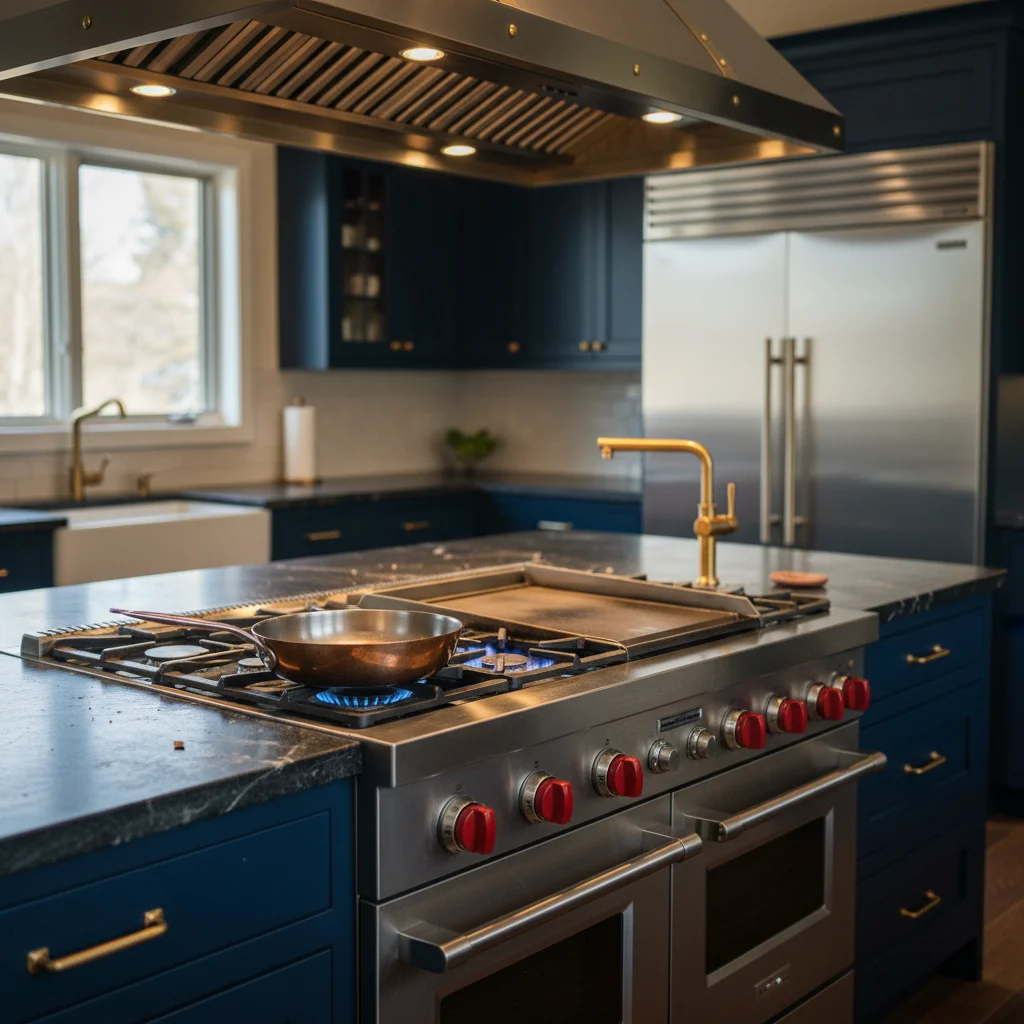
A Wolf range looks like one appliance, but it behaves like two machines bolted together — a high-output sealed-burner cooktop sitting on top of a full oven cavity. When something goes wrong, the first job is figuring out which of those two systems is actually at fault, because a “my range isn’t working” call can mean a fouled spark igniter, a tired oven sensor, or a control problem that touches both halves.
We’re an independent appliance repair company that has worked Denver-metro kitchens since 2012, and high-end ranges like Wolf’s are squarely in our lane. To be clear up front: we are not affiliated with, endorsed by, or sponsored by Wolf or Sub-Zero Group, Inc. We’re technicians who understand how these ranges are engineered — and how the mile-high climate quietly changes the way they run.
Wolf builds the range around a few distinct platforms, and knowing which one is in your kitchen shapes the entire diagnosis:
- All-gas ranges use dual-stacked sealed brass burners over a gas oven that lights with a hot-surface igniter. Everything from cooktop to cavity is combustion, which means altitude touches the whole appliance.
- Dual-fuel ranges keep the sealed gas burners up top but run an electric oven below. The cooktop faults look like gas faults; the oven faults look like electric-oven faults — on the same machine.
- The French Top and griddle/charbroiler modules add a heavy cast surface or an infrared element that holds and spreads heat differently, so their complaints (slow to come up to temperature, uneven zones) aren’t the same as a standard burner’s.
- Sealed dual-stacked burners are the signature — engineered to roar at high BTU and still hold a genuine low simmer. That wide range is exactly why a worn electrode or a slightly blocked port is so noticeable when it shows up.
Every visit starts the same way: confirm the platform, confirm the real symptom, then measure before replacing anything. The $89 diagnostic service call covers that work and is applied to the repair.
Most common Wolf range faults we see
Across the Wolf ranges in Denver homes, the same handful of failure patterns turn up over and over. Here’s what actually walks through the door:
- Burner clicks but won’t light. Endless clicking with no flame is usually a spark igniter coated in boil-over, a cracked ceramic, a burner cap knocked out of alignment, or moisture trapped after a spill or a cleaning. Sometimes it’s the spark module firing weakly to every burner at once.
- Lights on high, dies on simmer. A burner that catches at full flame but drops out when you turn it down points to a worn spark electrode, a partially clogged burner port, or a gas valve that’s drifted out of adjustment — and at altitude that adjustment matters more.
- Lazy yellow or uneven flames. Wolf burners should burn a crisp blue. Yellow, sooty, or floppy flames usually mean the air-fuel mix is off — a partly blocked port, a misseated cap, or air-shutter and orifice settings that don’t suit Denver’s thin air.
- Burner won’t shut off or stays on the igniter. A stuck switch or a failed valve can leave a burner running or the spark ticking continuously. This one’s worth a same-day call.
- Oven won’t reach or hold temperature. On gas ovens, a weakening hot-surface igniter that no longer pulls enough current to open the safety valve. On dual-fuel ovens, a drifting temperature sensor, a failed bake or broil element, or a control board that’s lost calibration.
- Convection runs uneven. A slow, noisy, or seized convection fan motor leaves hot and cold spots even when the cavity reports it’s at temperature — a “wrong temperature” complaint that isn’t a heating fault at all.
- Self-clean door lock issues. The lock motor, switch, or a thermal limit tripped by the high-heat cycle can leave the door stuck shut or refusing to latch for a clean cycle.
- Control panel and display faults. Unresponsive knobs or touch controls, a dim or dead display, or a board that reboots — sometimes a single relay, sometimes the board itself.
- Fault codes and lock-outs logged by the oven control, pointing toward a sensor, relay, the door circuit, or convection hardware.
A safety note worth repeating: if you smell gas, shut the gas off and call before running the range. We’d far rather diagnose a cold appliance than have anyone chase a combustion problem by trial and error.
How we actually run the diagnosis
Swapping parts on a hunch is how a modest repair balloons into an expensive one, so we work the problem in order:
- Pin down the platform and the symptom. All-gas, dual-fuel, or French Top — and is the complaint on the cooktop, the oven, or both?
- Read any stored oven fault codes. The control board keeps a history. We use it as a lead, not a verdict.
- Test the ignition system directly. On the cooktop, that means inspecting and gapping each spark electrode, checking the cap seating, and watching the spark module fire. On a gas oven, we measure hot-surface igniter current draw against the valve’s response.
- Measure the heat path. We compare the oven sensor’s resistance and reported reading against the real cavity temperature, check element continuity on dual-fuel models, and verify gas valve behavior on the burners.
- Check flame quality and airflow. Flame color and shape tell us whether combustion is tuned for the altitude; the convection fan tells us whether “uneven baking” is really an airflow problem.
- Explain it plainly and quote up front. Before any repair begins, you get the cause in plain language and a firm price — quoted only after the inspection, never before.
Parts and longevity
Wolf builds ranges to last decades, and most of what fails is a wear item rather than the whole appliance. The good news is that the parts most likely to need attention are also the ones most worth replacing well.
The components we replace most on Wolf ranges:
- Spark igniters and electrodes — the cooktop’s most common wear part, degraded by years of spillover, heat cycling, and Denver’s dry air on the ceramic.
- Spark/ignition modules — when every burner clicks at once or sparks weakly, the shared module is often the culprit.
- Sealed burner caps and heads — warped, corroded, or clogged caps that throw off the flame pattern.
- Gas valves and orifices — for burners that won’t simmer cleanly or need re-tuning for altitude.
- Hot-surface igniters (gas ovens) — the single most common gas-oven failure, and one the altitude tends to expose early.
- Oven temperature sensors and bake/broil elements (dual-fuel) — the precision parts behind a cavity that runs cold or won’t hold setpoint.
- Convection fan motors, door-lock assemblies, and control boards — less frequent, but the parts behind uneven baking, stuck self-clean cycles, and dead displays.
We use OEM-grade and manufacturer-compatible parts from verified suppliers, matched to your exact model. For anything tied to combustion, safety, or temperature accuracy — igniters, modules, valves, sensors — we source parts spec’d to your specific Wolf range rather than a generic substitute. A correctly matched igniter or sensor is the difference between a repair that holds for years and one that drifts back out of spec by next season.
A quick word on the rest of the kitchen: Wolf and Sub-Zero are sister brands under one parent and are frequently installed together. If a Wolf range, a Sub-Zero refrigerator, and a Cove dishwasher are all in the same room, one visit can often address more than one of them. Our technicians also regularly work ranges and ovens from Thermador, Viking, Miele, Gaggenau, Dacor, BlueStar, Jenn-Air, Bosch, KitchenAid, Monogram, and Fisher & Paykel, so we bring model-specific knowledge instead of treating every range the same.
The altitude and water angle
Most range troubleshooting you’ll find online was written for sea level. Denver is a mile up, and that difference shows up in Wolf ranges in concrete ways.
Thin air changes combustion. At 5,280 feet the air carries roughly 15% less oxygen per cubic foot than it does at the coast. That leaner mix has real consequences on a gas range: burners run closer to their air-fuel margin, so a marginal spark igniter or a slightly fouled port that would still light at sea level can sputter or fail here — usually on the coldest morning of the year. Orifice sizing and air-shutter settings also matter more at altitude. If a Wolf range was set up without that in mind, burners can show lazy yellow flames or soot, and the simmer never settles. We check flame quality on site and tell you what the elevation actually calls for.
Hot air rejects heat slowly. Thinner air pulls heat away less efficiently, so the range’s cooling fans, control-board electronics, and the oven’s own venting all run a touch hotter than their sea-level baseline. Over years, that extra thermal stress nudges relays and boards toward failure a little sooner than they’d fail in a denser, cooler climate.
Very dry air ages the seals. Denver’s low humidity is hard on rubber and silicone. Oven door gaskets stiffen, crack, and lose their seal faster up here, and a door that leaks heat reads as “slow to preheat” or “won’t hold temperature” even when the burners and elements are perfectly healthy.
Hard water leaves its mark. Denver’s supply commonly runs 150–250 ppm, and while scale is mostly a story for ice makers and dishwashers, it still touches a range. Mineral spotting and scale build up around burner bases, under caps, and in the seams where boil-over and steam collect, gradually fouling igniters and clogging ports. On a range, hard water is a slow contributor to the very ignition faults we get called about.
None of this is exotic — but it’s the line between a fix that lasts and one that comes back next summer. We diagnose for the conditions the range actually lives in, not for a sea-level manual.
How to book your Wolf range repair
You don’t have to cook around a burner that won’t simmer or an oven you can’t trust. Our technicians repair Wolf ranges across Denver and the surrounding suburbs, with same-day or next-day appointments in most cases. Every visit opens with the $89 diagnostic service call, applied toward the repair, and you’ll always have an up-front price before we start — we quote the work only after we’ve inspected the range in person.
Call (720) 770-4189 anytime; the phone is answered 24/7, and repairs run daily from 8:00 AM to 6:00 PM. Prefer to set it up yourself? Reserve a visit online at nexfield.pro, and let’s get your Wolf range back to the clean blue flame and dependable oven it was built to deliver.