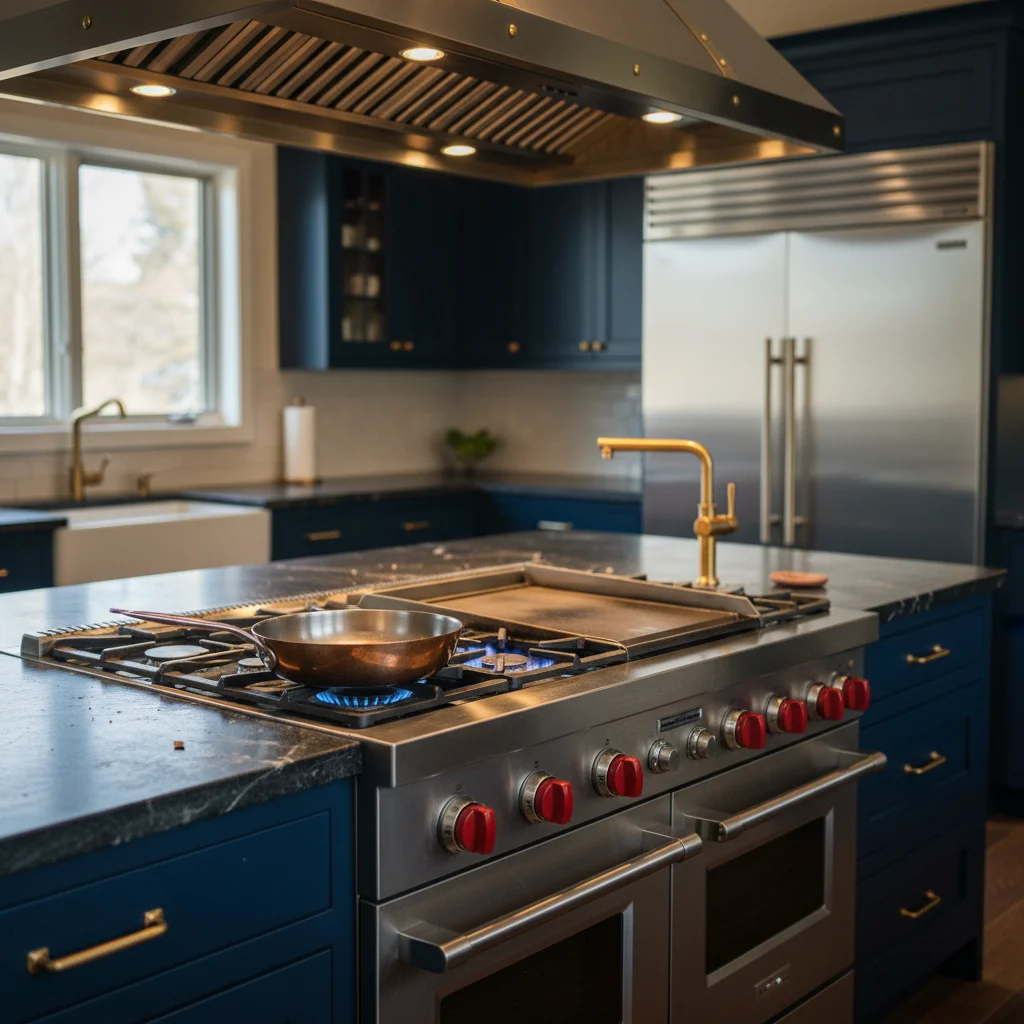
It’s a weeknight in Highlands Ranch, the family is gathering in a kitchen that fills half the main floor, and the range at the center of it has gone quiet. The cooktop sparks but won’t light, or the oven climbed to 200 and stalled there, and suddenly the appliance the whole room was designed around is the one thing not working. That moment — standing in a big two-story custom kitchen with a dead pro range — is where most of our Highlands Ranch range calls start.
What this page covers
Highlands Ranch is one of the largest master-planned communities in the metro, tens of thousands of substantial two-story homes laid out south of C-470 around Town Center, the Highlands Ranch Mansion, and the Backcountry. The kitchens here weren’t an afterthought — they were planned as the centerpiece, and the centerpiece is usually a professional gas or dual-fuel range set into custom millwork, with a built-in refrigeration column right beside it. We fix the range itself: burners that won’t simmer, an oven that bakes uneven, a broiler that won’t catch. We confirm the actual fault on site, then give you one clear number before any work begins. The $89 service call covers that inspection and comes off the total if you proceed.
Range faults we trace in these kitchens
- Sealed gas burners — clogged ports, worn electrodes, cracked ceramic insulators, or a valve that won’t hold a steady low simmer.
- Spark and ignition — a dead spark module, or a harness jarred loose when a heavy range was eased back into a snug custom alcove.
- Oven heating — fatigued bake igniters, drifting temperature sensors, and burned-out bake, broil, or convection elements.
- Griddle and grill sections — infrared burners and their igniters on the wide ranges these large kitchens favor.
- Induction and electric — failed coils or elements, worn infinite switches, and corroded terminal blocks.
- Control boards and relays — the electronics that time the oven and keep a surface igniter from clicking on its own.
How we inspect and price it
We watch the actual fault happen rather than reaching for the obvious part. On the cooktop we test the spark module, electrodes, valves, and flame quality, looking for the altitude-rich burn before anything comes off. On the oven we measure bake igniter draw, sensor resistance, and the elements under load, and on models that store them we pull fault codes to separate a real failure from a sensor feeding the board a bad number. Because so many of these ranges are boxed into custom cabinetry, we also check how the unit breathes inside its run, since a tight install can cook its own electronics. Then you get the cause in plain language, surrounding millwork protected, and one firm price before work starts.
What altitude and water do here
Three local forces shape every range diagnosis in Highlands Ranch:
- Thin air. The community climbs past 5,900 feet, where roughly 15% less oxygen leaves a sea-level-tuned burner running rich and a weak igniter short of its firing margin — often a tuning fix, not a swap.
- Very dry climate, strong UV. The arid, high-sun air hardens oven door gaskets early, letting heat leak so the oven cycles harder to hold temperature.
- Hard water. On any water-fed feature — a steam-assist oven or a pot filler over the range — the south metro’s 150–250 ppm water scales the valves and thin supply lines.
Brands and the rest of your kitchen
Wolf-style pro ranges are a core call, and we also service Viking, Thermador, Miele, Gaggenau, Dacor, Bosch, and Monogram. Since these kitchens rarely have just one premium unit acting up, we can diagnose the built-in refrigerator, wine cabinet, or integrated dishwasher in the same visit — no second trip.
Book your Highlands Ranch range repair
Call (720) 770-4189 any hour — the phone is answered 24/7 — or book online. On-site repairs run daily 8:00 AM to 6:00 PM, the diagnostic is a flat $89 applied toward the repair, and you’ll always have an up-front price before we begin. Independent and serving the Denver metro since 2012.