The oven that always preheated in minutes now takes its time, or a back burner that once dropped to a whisper-low simmer now sputters off the cap. That gap between “mostly works” and “works right” is where a Monogram earns a careful look — and where finding the real cause, then quoting one firm price, beats a swapped part that fixed nothing.
Quick orientation
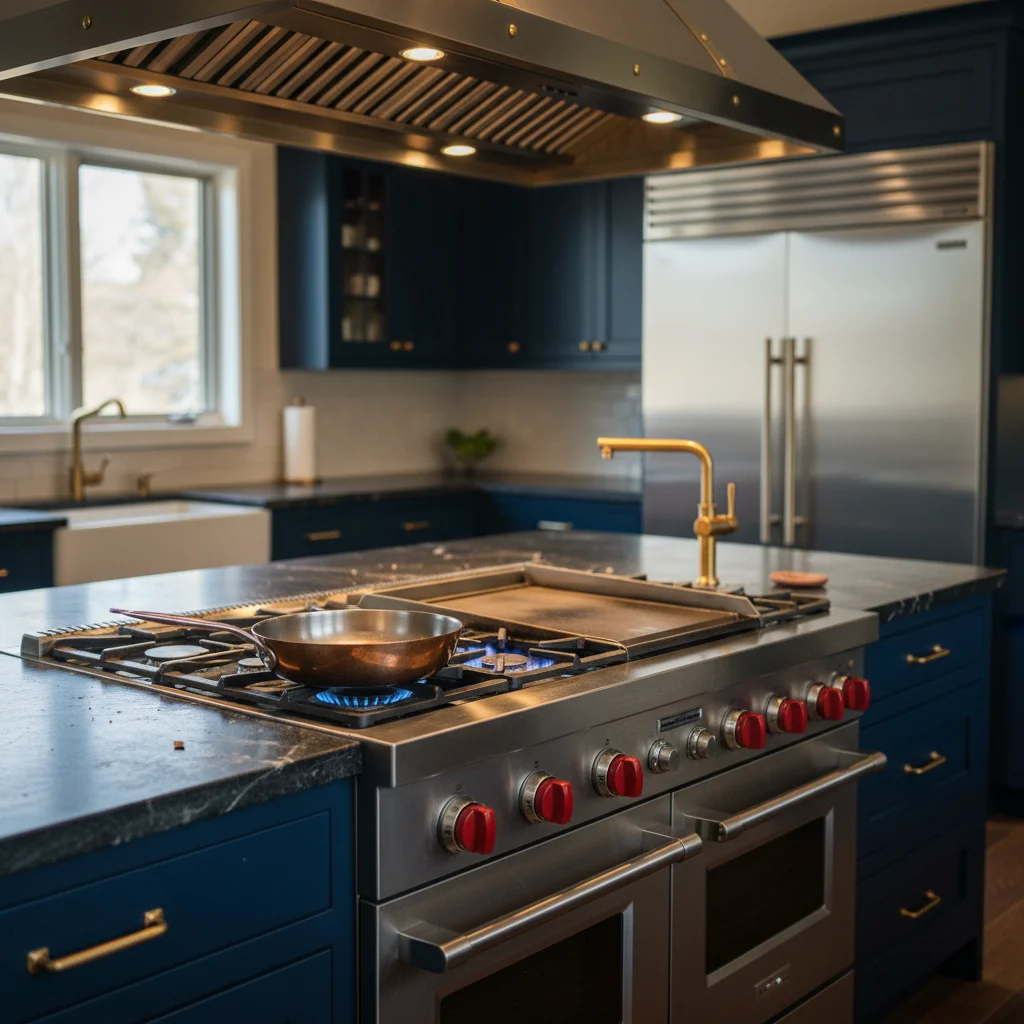
Monogram is General Electric’s flagship cooking line: sealed brass burners that climb to high BTU output and a convection oven tuned for serious baking, across 30, 36, and 48-inch all-gas ranges plus dual-fuel models, rangetops, and Hearth pieces. The gas geometry and oven logic are tuned tightly enough that the symptom in your kitchen often sits one step removed from the part that failed.
So we trace the fault to a single source before naming a price. The $89 service call covers that inspection and folds into the repair. We’re an independent Denver-metro company serving the area since 2012 — not affiliated with, endorsed by, or sponsored by the manufacturer.
Most common faults we see
- Burner clicks but won’t catch — a worn spark electrode, a cap seated off its pins, a fouled port, or post-spill moisture.
- Simmer won’t stay low and steady — usually an air-shutter or orifice issue that Denver’s thin air makes worse.
- Yellow or lazy flame — the air-fuel mix running rich, often a tuning matter at altitude, not a failed part.
- Oven off-temperature or baking unevenly — a drifting oven sensor, a tired bake or broil element, or a slowed convection fan motor.
- Slow preheat or weak ignition — a tired element or high-reading sensor on dual-fuel models, or a weak oven igniter no longer opening the safety valve on all-gas units.
- Heat leaking past a brittle door gasket or sagging hinge — surfacing as longer preheats and uneven baking.
Before quoting, we reproduce the symptom — “the oven is slow” and “the oven runs cold” point to different parts — then read sensors, igniter current draw, and gas pressure to isolate the one component at fault.
Parts and how long the fix lasts
A Monogram range is built to anchor a kitchen for fifteen to twenty years, and a repair should honor that. We install OEM-grade and manufacturer-compatible parts matched to your exact model and serial — which matters most on the pieces that decide whether a fix holds: oven igniters, spark modules, gas valves, temperature sensors, and convection motors. A cut-rate igniter can light cleanly on day one and quit by the next holiday. Longevity also depends on fixing the true cause: if a sensor reads high because its connector corroded, we replace the connector, not the sensor.
The altitude and water angle
Servicing a Monogram range in Denver differs from servicing one near the coast — the piece a national dispatch tech misses.
At 5,280 feet the air is roughly 15% thinner, so gas burns differently here. Unless orifices and air shutters are sized for altitude, the mixture skews rich — which is why a burner that ran a crisp blue flame at sea level can turn yellow and lazy after a move to Colorado, and why a simmer can struggle to stay lit. Thinner air also changes how the oven sheds heat, so a marginal convection fan or off sensor bakes noticeably worse.
Denver’s dry climate cracks oven door gaskets sooner than humid regions — heat leaks out, preheats run long. And on steam-assist ovens, our hard water (commonly 150 to 250 ppm) scales up any water-fed component, which we flag when we find it.
How to book
Getting a Monogram range serviced is quick:
- Call (720) 770-4189 — answered 24/7, so you reach a real person anytime. Repairs run daily from 8:00 AM to 6:00 PM.
- Or book online and pick a window that fits your day.
- Meet the technician, who finds the real cause on site and quotes a firm price. The $89 service call covers the visit and credits toward the repair.
Call (720) 770-4189 or book online to get your Monogram range back in service across the Denver metro.