It is a weekday evening in a Union Station loft, you open the built-in Sub-Zero for a cold drink, and the inside feels closer to room temperature than refrigerated. The compressor hums but the box is warming, the freezer drawer below is starting to sweat, and there is no service tech standing behind a wall of fixed cabinetry to ask. If that is roughly where you are right now, you are in exactly the situation we get called for most often downtown — a premium, panel-ready appliance failing in a kitchen with almost no room to work.
What makes Downtown Denver kitchens their own thing
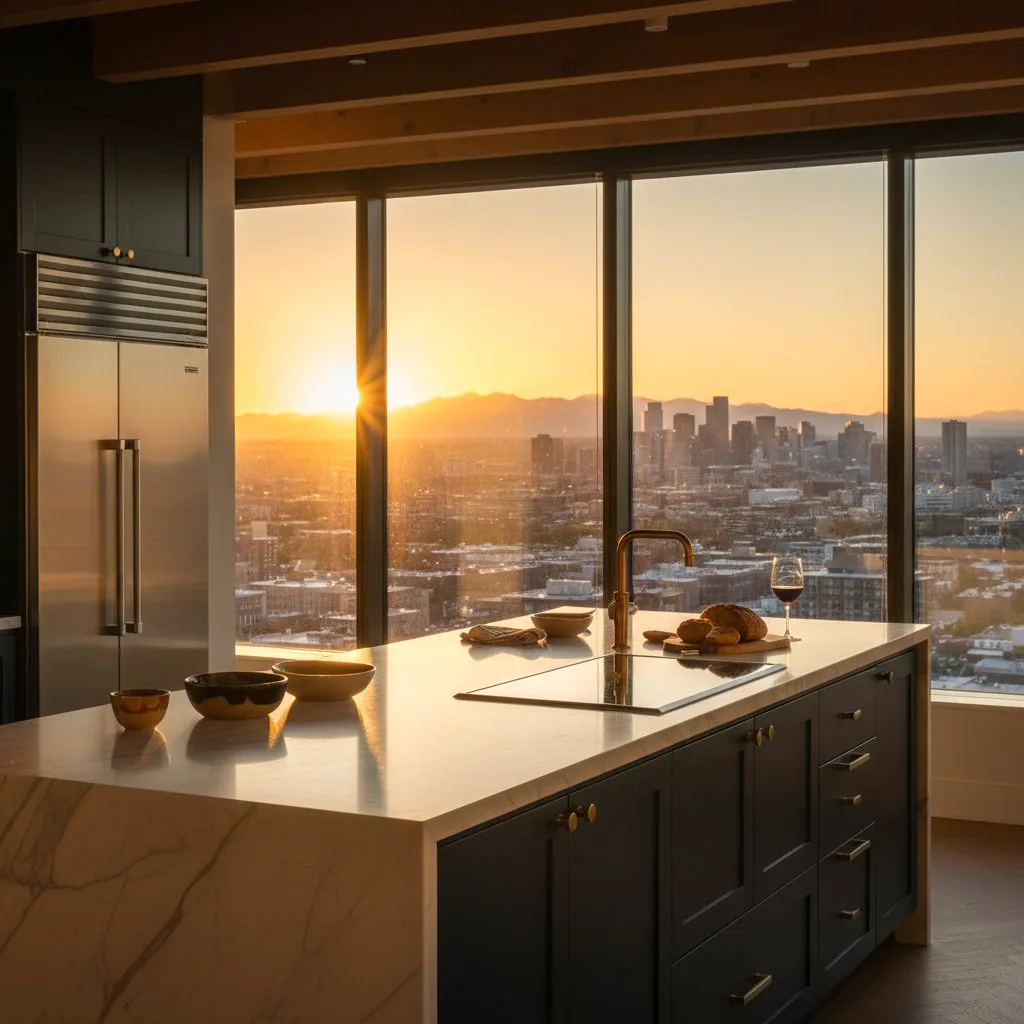
Downtown is not a suburb with a two-car garage and a sprawling kitchen. It is brick-and-timber loft conversions in LoDo, glass towers in the Central Business District, and design-forward condos in the Golden Triangle, all stacked vertically and built around square footage that gets used to the inch. The kitchens reflect that: compact footprints, clean sightlines, and integrated, panel-ready appliances chosen so the refrigeration disappears into the cabinetry instead of dominating the room.
That single design choice — hiding premium equipment behind matching panels in a small space — changes how repair works. When a built-in column is flush-fit between cabinets in a 19th-century warehouse conversion off Wynkoop, or slotted into a high-rise galley above the Platte, the appliance was installed before the surrounding millwork closed in around it. Pulling it forward, reaching a condenser, or getting at a service panel takes planning, not muscle. So the first job is never “swap a part.” It is to figure out what actually failed and how to reach it without scarring the cabinetry or the floor.
That is the whole approach. A warming Sub-Zero might be a tired fan, a dust-choked condenser, a failed start relay, or a sealed-system refrigerant problem — four different repairs at four different price points. We identify which one it is first, then give you a clear, up-front price before touching anything. The $89 diagnostic service call covers that inspection and is credited toward the repair if you proceed.
A quick map of the appliances downtown
The housing stock downtown sorts into a few recognizable kitchen types, and each tends to fail in its own way:
- LoDo loft conversions — old warehouse and mercantile buildings turned into open-plan residences. Exposed brick and timber up top, but the kitchens were modernized with built-in columns and under-counter drawers wedged into footprints the original floorplate never anticipated. Airflow around the cabinet is usually tight.
- Golden Triangle condos — newer mid- and high-rise construction below the Capitol, near the art museum and the cultural district. These often went in with fully integrated, panel-ready refrigeration and high-end cooktops selected to suit a compact but polished kitchen.
- Central Business District and Union Station towers — high-floor units where everything arrives and leaves through a freight elevator and a dock. Premium appliances, minimal clearance, and building logistics that have to be respected.
- Ballpark and river-edge buildings — a mix of newer condos and conversions near Coors Field and the Platte, frequently with wine and beverage columns added during the build.
The common thread across all of it is premium appliances in constrained, vertical living — the kind of work that rewards a specialist over a general handyman.
Common problems we diagnose downtown
Across loft conversions, towers, and Golden Triangle condos, a handful of failures come up over and over. Here is what we most often find:
- A built-in refrigerator drifting warm. Usually a clogged or dust-packed condenser, a failed evaporator or condenser fan, a weak start relay, or — less often — a sealed-system refrigerant fault. In a flush-fit downtown install, condensers load up with dust fast because airflow around the cabinet was tight to begin with.
- Frost or ice sheeting the back of the freezer. Typically a defrost heater, a defrost sensor, or a control board mistiming the defrost cycle.
- A compressor that runs constantly and never cycles off. Often a dirty condenser, a fading fan, or a door gasket that no longer seals — wear that Denver’s dry air tends to speed up.
- Ice makers that slow, jam, or turn out cloudy, undersized cubes. Extremely common here, and usually scale from the hard local water clogging the works.
- A gas cooktop or range with lazy, yellow-tipped, or uneven flames. Frequently an altitude-and-combustion issue rather than a broken burner — more on that below.
- An oven that drifts off its set temperature. Igniter, temperature sensor, or control-board faults are the usual suspects.
- Water pooling under the fridge or dishwasher. Often a blocked defrost drain, a cracked drain pan, or a scaled-up water line.
- Control panels throwing error codes. Sensor faults, or a board that needs reprogramming or replacement.
Services we offer in Downtown Denver
Within downtown, we regularly handle:
- Built-in and integrated refrigerator repair — panel-ready columns, under-counter drawers, and flush-fit units.
- Freezer and ice maker repair, including the scale-and-water problems that dominate here.
- Range, cooktop, and rangetop repair — gas and dual-fuel, with attention to altitude-affected combustion.
- Wall oven and built-in oven repair — temperature, igniter, and control faults.
- Dishwasher repair, where hard-water scale and drain blockages lead the list.
- Wine and beverage column service for the many downtown units that included one.
Our diagnostic process
We work the same disciplined sequence on every downtown call, because guessing wastes a freight-elevator slot and your evening:
- Confirm the symptom and the history. When did it start, what changed, what does the unit actually do now versus what it should. A fridge that warmed gradually points somewhere different than one that quit all at once.
- Read the model and serial, and the error codes. The exact build tells us which control board, sealed system, and parts the unit uses, so we arrive with the right approach instead of a generic one.
- Plan access before we move anything. In a flush-fit downtown install, that means mapping how the unit comes forward, where the condenser and service panel sit, and how to protect the cabinetry and floor — laid out before a single screw turns.
- Test the system, not just the obvious part. Airflow, the sealed refrigeration loop, fans, the defrost circuit, gaskets, and the control board — checked in order so we catch the root cause rather than the loudest symptom.
- Explain the finding and quote one price. You hear what failed, what it takes to fix, and the full cost in plain language. Nothing starts until you approve it, and the $89 diagnostic is credited toward that total.
This matters more downtown than almost anywhere. Pulling a built-in twice means re-booking the freight elevator, re-clearing the dock, and re-navigating a tight galley all over again. We would rather invest the time to get the diagnosis and the part right on the first visit than disturb your kitchen twice.
Denver-specific factors that change the repair
Downtown Denver sits at the city’s mile-high elevation, and that is not a slogan — it genuinely changes how these appliances behave. At 5,280 feet, the air is roughly 15% thinner than at sea level, and a few things follow directly from that:
- Refrigeration sheds heat differently. Condensers and cooling fans move less-dense air, so a built-in fridge that is even slightly dusty or short on clearance — exactly the case in a flush-fit loft or tower install — struggles here sooner than the identical unit would at the coast. Refrigerant charge and compressor heat rejection are both sensitive to thin air, which is why a downtown column packed into tight cabinetry runs hotter than its spec sheet suggests.
- Gas combustion shifts. Thinner air carries less oxygen per cubic foot, which changes how a gas range, cooktop, or oven actually burns. Orifice sizing and the air-to-fuel mixture that were dialed in at sea level can produce lazy, yellow-tipped, or sooty flames at this altitude. A burner that looks “broken” is sometimes a combustion-and-altitude problem we can correct rather than replace.
Then there is the water. Denver’s supply tends to run hard — commonly around 150 to 250 ppm — and that scale is rough on ice makers, dishwasher internals, and the slim water lines feeding built-in refrigerators. In high-rise condos where the same municipal water reaches every floor, it is one of the leading reasons ice output falls off or cubes come out small and cloudy downtown.
Finally, Denver’s very dry climate and strong high-altitude UV age door gaskets and seals faster than a humid place would. A gasket that hardens and cracks lets warm air leak past the seal, which forces the compressor to run longer and the whole system to work harder — and in a compact downtown kitchen with a built-in box already fighting for airflow, that early gasket wear shows up as a fridge that can’t hold temperature. We inspect seals on every refrigeration diagnosis specifically because this climate wears them out ahead of schedule.
Together, these are the factors a sea-level repair playbook tends to skip. They are built into how we diagnose every appliance downtown.
Brands and equipment we work on
Downtown kitchens lean heavily on the premium, built-in end of the market, and that is where we focus. We regularly service Sub-Zero built-in refrigeration and wine columns, and we are equally at home with the high-end ranges, cooktops, ovens, and dishwashers that fill these condos and lofts — the panel-ready and pro-style equipment chosen to fit a small, design-led kitchen.
A premium appliance is engineered as a system: a sealed refrigeration loop, a precise control board, and a set of airflow and water paths that all lean on one another. Drop in a generic component and you can be back chasing the same fault within a year. That is why we fit OEM-grade and manufacturer-compatible parts from verified suppliers, matched to your specific model and serial number. Downtown, where a second visit means another freight-elevator reservation and another trip through a tight galley, getting the right part in the first time is as much about not disturbing your home twice as it is about reliability.
When the technician finishes, you get a straight account of what failed, what was replaced, and why — not a vague line item. If a part has to be ordered for an older or less common model, we tell you on the first visit and set a clear expectation for the return rather than leaving you to wonder.
Book a Downtown Denver repair
Booking is straightforward, and we have set it up around how downtown actually lives:
- Call (720) 770-4189. The phone is answered 24/7, so you can reach a real person the moment a problem starts — late at night, first thing in the morning, or over the weekend.
- Or book online any time that suits you.
- Repairs are performed daily, 8:00 AM to 6:00 PM. We will confirm a window and check building logistics — freight elevator hours, dock or loading-zone access, concierge notice, and any flush-fit clearance issue — so the appointment runs without a snag.
- The $89 diagnostic service call covers a full on-site inspection and is applied toward your repair.
We have served the Denver metro since 2012, and Downtown Denver — with its loft conversions, high-rise condos, and premium appliances packed into compact, vertical kitchens — is exactly the kind of work we are built for.
Ready to get a built-in fridge, range, cooktop, or wine column back in service? Call (720) 770-4189 or book online today — same-day and next-day appointments are available across Downtown Denver and central Denver.