You open the cooler to pull a bottle for dinner and the glass feels closer to a cupboard than a cellar — the bottles near the top are noticeably warm, the display still glows its usual 55, and there is a faint new whir from behind the toe-kick that was not there last month. That gap between what the panel claims and what your hand feels is the classic early failure, and on a remodeled University Hills ranch it is worth catching fast, before a rack of bottles you have been laying down quietly cooks.
What’s going on
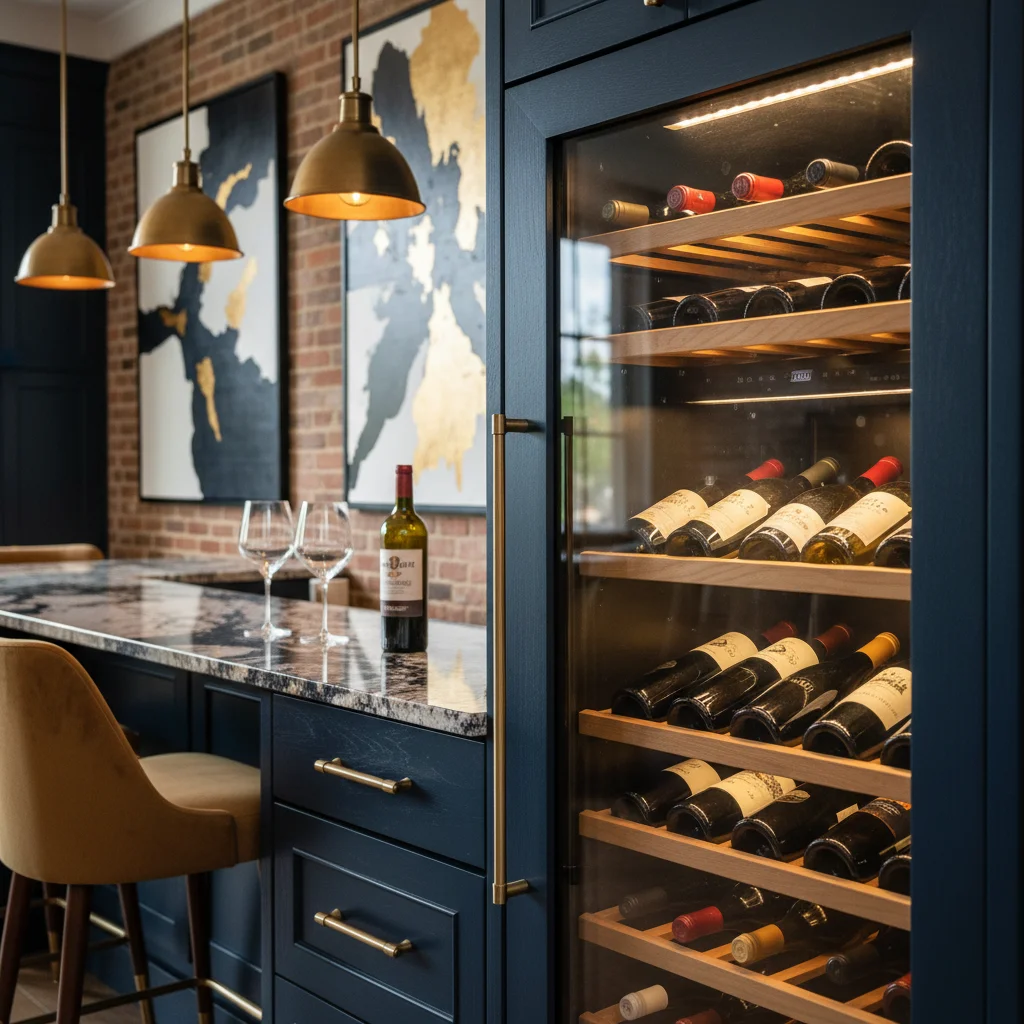
Drive the blocks east of Colorado between Yale and Hampden and you see the pattern: long, low brick ranches from the postwar boom, near DU and the Highline Canal, their original galley kitchens steadily reopened around premium refrigeration. The wine cooler that went into one of those rebuilds is rarely a freestanding box with room to breathe — it is a column or a bank of under-counter drawers framed into cabinetry that was never sized for it. So when the temperature wanders, there are really two questions at once: what failed inside the unit, and what the tight retrofit is doing to make it worse.
Faults we keep seeing here
Around the neighborhood’s rebuilt ranches, the complaints cluster into a short list:
- The cabinet won’t settle on its set point, or one side of a dual-zone runs warm while the other holds.
- A new hum, buzz, or rattle that carries through quiet custom millwork on a still evening.
- Frost spreading across the back wall, condensation beading on the glass, or water gathering at the base.
- Lights and display look normal, but the cooling stage never kicks in.
- Short-cycling — the compressor clicks on and off without ever pulling the cabinet down.
How we work the diagnosis
We work in a deliberate order rather than swapping parts and hoping:
- Read the install before the unit. In a University Hills retrofit, a choked front grille or an alcove with an inch of clearance can mimic a dying compressor exactly. We check airflow and how much heat the surrounding cabinetry is trapping first.
- Test it running, under load. Actual zone temperatures, stored fault codes, then the compressor, condenser and evaporator fans, thermostat, thermistors, and control board. On thermoelectric drawer coolers we test the Peltier stack instead.
- Trace the seal and the sealed circuit. A leak surfaces faster in thin air, and a dry-climate gasket is the single most overlooked reason a cooler runs warm.
- Explain and quote. You get the cause in plain language and a firm number before any work starts.
What Denver does to the diagnosis
Most repair advice online is written for sea-level kitchens, and it steers you wrong here. At 5,280 feet the air is about 15% thinner, so every condenser sheds less heat than its maker assumed — a penalty that hides in an open kitchen but bites hard in a column boxed into a tight ranch cabinet. That thin-air margin is often the whole gap between steady cellar storage and a slow climb out of range.
The dry climate and intense high-altitude UV are the next factor: gaskets here harden and crack early, which is why frost and a sweating door usually trace back to a seal that stopped sealing. And on any cooler with a beverage tap, the hard local water at roughly 150–250 ppm leaves scale in lines and valves worth checking before it strangles flow.
Units, zones, and brands
We service built-in wine columns, dual-zone cabinets, under-counter drawer coolers, and bar and beverage centers throughout University Hills and neighboring Wellshire, Cherry Hills Vista, and Goldsmith. We are a fully independent shop — not affiliated with any manufacturer — and we work across the premium and mainstream brands these remodels tend to feature. Longevity comes down to the part that goes back in, so we fit OEM-grade and manufacturer-compatible components from verified suppliers, matched to your model and serial: compressors, fan motors, thermostats, thermistors, control boards, dampers, and door gaskets.
Book the visit
Repairs run daily 8:00 AM to 6:00 PM, and the phone is answered 24/7, so same-day or next-day slots are usually open. Call (720) 770-4189 or book online whenever it suits you. The $89 diagnostic brings a technician to your University Hills door, pinpoints the true cause, and goes straight toward the repair the moment you approve it — no guesswork, no surprise line items. Ready to get your cooler holding cellar temperature again? Call today, and we will protect the kitchen built around it while we work.