Oven Repair in University Hills, Denver

The 1950s ranches between Yale and Hampden were drawn around a single 30-inch range against the wall. Now those galleys have grown into open kitchens with wall ovens and pro ranges that the original house never anticipated — and that is exactly the kind of oven we diagnose and quote honestly before anything comes apart.

Oven Repair in University Hills, Denver

Quick Answers

Who fixes wall ovens and ranges in University Hills, Denver?
Denver Sub-Zero Repair is an independent service covering University Hills, from the Highline Canal greenway to the blocks near Eisenhower Park and the streets bordering DU. We handle built-in wall ovens, stacked oven towers, and gas or dual-fuel pro ranges set into remodeled ranch cabinetry. Call (720) 770-4189, answered 24/7, for a same-day or next-day visit.
What does oven repair cost in University Hills?
The on-site diagnostic is $89 and is credited toward the repair once you approve it. An oven fault out here might be a single bake igniter or a full control board behind a retrofitted cavity, so the firm price comes only after a technician inspects the unit in person. Nothing is quoted blind over the phone.
Why does my University Hills oven bake unevenly or burn rich?
At Denver's 5,280 feet the air holds about 15% less oxygen, so a range oven dialed in at sea level burns rich with lazy, yellow-tipped flames. On an electric cavity, the dry climate hardens the door gasket early and warm air leaks out, forcing the thermostat to overshoot. We measure combustion, the sensor, and the seal before naming a part.

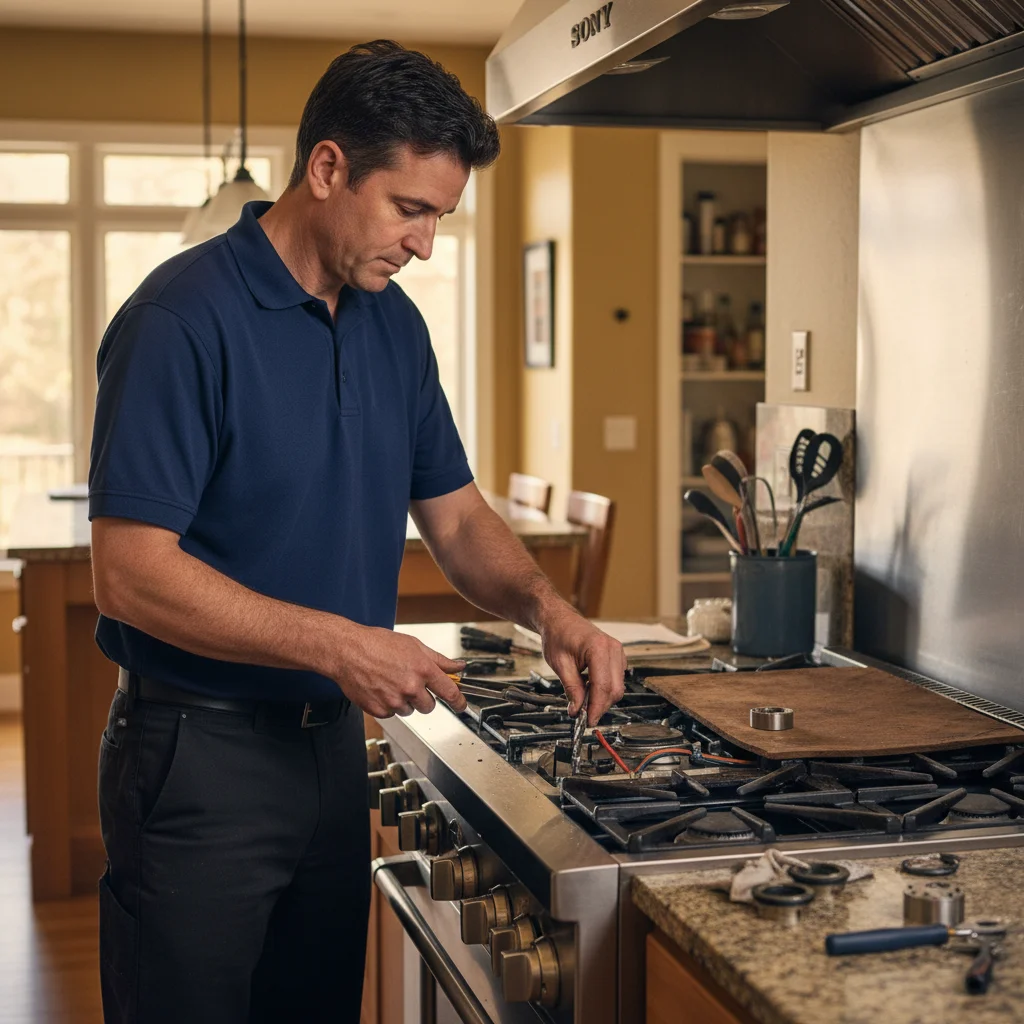
University Hills was platted as a planned mid-century subdivision, and the original kitchens told you so: a single wall of cabinets and a 30-inch range against the plaster. Those ovens are long gone. East of Colorado Boulevard, between Yale and Hampden and out toward the Highline Canal, owners have spent two decades reopening the galleys and dropping in equipment the floor plan never planned for — a built-in wall oven, a stacked tower, a pro gas range with far more burner than the old slide-in. Fixing one of those is a different errand than swapping a part in a builder-grade range.

What sets this oven repair apart

A wall oven slotted into a reworked ranch cabinet run is not the clean factory install a service manual assumes. The cavity vents into a footprint that began life around a 1955 stove, the service panel may be boxed in by added cabinetry, and the gas or electric feed might be original or redone in the remodel. So before anyone reaches for a part, the job is to read the install as carefully as the appliance — and to factor in the mile-high air national guides ignore.

Symptoms and what is behind them

The complaints we hear most in University Hills point to a handful of root causes:

  • Slow to light, with a gas whiff on ignition. A weak bake igniter lights late and dumps unburned gas into the cavity each cycle.
  • One half of the roast scorched, the other pale. Uneven bake usually traces to a drifting temperature sensor, a tired convection motor, or off-tune combustion.
  • A cavity that sails past its setpoint. A dry-climate-cracked gasket leaks heat until the thermostat overcompensates and runs away.
  • Lazy yellow flames on a pro range. Often combustion-and-altitude, not a failed burner — and correctable.
  • A stored fault code you ignore. On a control board, those are early warnings, not noise.

Why a specialist, not a handyman

Denver’s elevation rewrites how an oven behaves. At 5,280 feet the air carries about 15% less oxygen, so a range oven set with a sea-level orifice burns rich and heats unevenly — a symptom that mimics a broken part. Add Colorado’s dry air and strong UV, which harden door gaskets early, plus hard water around 150 to 250 ppm that scales up any steam-bake feature, and you have three local factors a sea-level playbook misses. A specialist weighs all of them before condemning a component — and knows the boards, probes, and self-clean latches on these units are model-specific and rarely cross-compatible.

What a visit looks like

  1. Confirm the model and serial, not always obvious on a retrofitted built-in.
  2. Reproduce the symptom and read any stored fault codes before assuming a cause.
  3. Work the heat source — measure igniter draw and combustion on gas with the altitude correction in mind, or test bake and broil elements on electric.
  4. Verify sensing and the seal, checking the probe against a reference and the gasket for dry-climate leaks that imitate a calibration fault.
  5. Quote before opening anything, with the $89 service call credited toward the work.

Straightforward pricing

The diagnostic is $89, applied to the repair the moment you approve it. Because an oven fault out here ranges from a single igniter to a full dual-cavity control board, the firm price is set only after an on-site inspection — never guessed over the phone. You see the complete number before a technician begins, and nothing is added afterward. We have served the Denver metro since 2012 and fit OEM-grade, manufacturer-compatible parts so the repair holds.

A few common questions, answered

Repairs run daily 8:00 AM to 6:00 PM, and the phone is answered 24/7 — useful when an oven quits the night before a dinner. Most University Hills visits land same-day or next-day. Mention a second oven or a misbehaving range burner when you book and we will cover it in one trip.

Ready to get your wall oven or range working again? Call (720) 770-4189 or book online today. We will find the real fault and credit your $89 service call toward the fix.

Frequently Asked Questions

My ranch kitchen was remodeled and the wall oven is built into custom cabinetry. Is that a problem?

Not at all — it is the typical job here. When a 1950s galley is reopened around a built-in oven or a stacked pair, the cavity often ends up in a tight, improvised cabinet run with its vents and service access boxed in. We confirm the install details when you book so we can plan the pull and protect the surrounding millwork.

Do you service both gas ranges and electric wall ovens?

Yes. The remodels in University Hills go both ways — some owners drop in a high-BTU gas or dual-fuel pro range where the old slide-in sat, others fit an electric wall oven into the cabinet wall. We diagnose igniters, burners, and orifices on gas units and bake or broil elements and sensors on electric cavities, all with Denver's altitude factored in.

How soon can a technician reach my University Hills home?

We usually offer same-day or next-day appointments across southeast Denver, and this neighborhood east of Colorado Boulevard is a quick area for us to cover. If you smell gas with the oven off, shut it down, ventilate, and call (720) 770-4189 right away so we can move your visit up.

Does Denver's hard water affect an oven?

It does on the steam-bake and self-steam features built into many higher-end ovens, and on the cooktop side of a range. Denver tap runs roughly 150 to 250 ppm, so scale collects in steam reservoirs, on burner caps, and at igniter tips. We descale or replace the affected part rather than only swapping the obvious one.

Do you install genuine oven parts?

We fit OEM-grade and manufacturer-compatible parts from verified suppliers, matched to your exact model and serial number. On the components that decide whether a repair holds — igniters, elements, gas valves, sensors, and control boards — the right part keeps you from pulling a built-in oven back out of remodeled cabinetry for a second trip.

Is the $89 service call really credited toward the repair?

Yes. The $89 covers a full on-site diagnosis, including reading stored fault codes and testing the burner or element circuit, and it comes off the repair total the moment you approve the work. You see the complete price before a technician begins, with nothing added at the end.

Your Sub-Zero Deserves Better

Denver's experienced independent repair specialists are standing by. Same-day appointments available throughout the metro area.