Oven repair, diagnosed by how your oven actually heats
A modern premium oven is a tightly coordinated heating system: a gas valve and igniter or a set of electric elements, a temperature sensor feeding a control board, a door seal holding the cavity tight, and — on convection models — a fan steering hot air across every rack. When any one of those drifts, the oven doesn’t fail loudly. It bakes cool, runs long, browns unevenly, or quietly throws an error nobody notices until a holiday roast comes out wrong.
Our approach is to find the specific point of failure instead of replacing the obvious part and hoping the symptom goes away. That distinction matters most on high-end wall ovens and ranges, where a single control board may govern bake, broil, convection, and self-clean, and where parts are too expensive to swap on a guess.
We work on gas, electric, and dual-fuel configurations: single and double wall ovens, slide-in and freestanding ranges, built-in combination microwave-and-oven units, and steam-assisted models where a water system and a heating system share the same cabinet.
What sets a premium oven apart from a budget unit isn’t just the badge — it’s the tighter tolerances. Luxury ovens hold temperature within a narrower band, use heavier-gauge elements and multi-pass convection, and lean on more sophisticated control electronics to do it. That precision is exactly why a small fault is so noticeable: when an oven is built to stay within a few degrees of the set point, a sensor that’s reading ten degrees off or a fan that’s slowed down turns a perfectly good machine into one that ruins a bake. Repairing that kind of oven well means respecting those tolerances, not just getting it “warm again.”
Oven problems we diagnose and repair
Ovens tend to announce trouble in a handful of recognizable ways. Here are the faults we see most often across Denver kitchens, with the causes we trace them back to:
- Oven won’t heat at all — a failed gas igniter that no longer glows hot enough to open the safety valve, a burned-out bake element, a tripped thermal fuse, or a control board that isn’t sending power.
- Heats but never reaches the set temperature — a weak igniter drawing too little current, a partially failed element, or a temperature sensor reading high and shutting the heat off early.
- Bakes unevenly or burns one side — a convection fan motor that has stopped circulating, a sooty or misaligned gas burner, or a sensor mounted where it no longer reads true cavity temperature.
- Temperature runs wildly off the dial — a miscalibrated or failing oven sensor, or a control board that has lost its calibration reference.
- Broiler is weak or dead — a failed broil element, a cracked igniter on the upper burner, or a relay on the control board that no longer closes.
- Self-clean cycle won’t start or won’t unlock — a faulty door-lock motor, a blown thermal fuse from a prior over-temperature event, or a control fault.
- Clicking with no ignition (gas) — a worn spark igniter, a clogged burner port, or a gas valve that isn’t opening fully.
- Error or fault codes on the display — sensor open/short faults, communication errors between control boards, or a relay board that needs replacement.
- Gas smell during operation — a valve that isn’t sealing, a delayed ignition allowing gas to pool, or a loose connection that needs immediate attention.
- Door won’t seal or glass is fogged — a worn door gasket, a sagging hinge, or a failed inner-glass seal letting heat escape.
If your oven is doing something not on this list, that’s still our job — these are the common patterns, not the limit of what we repair.
Inspection first, honest pricing second
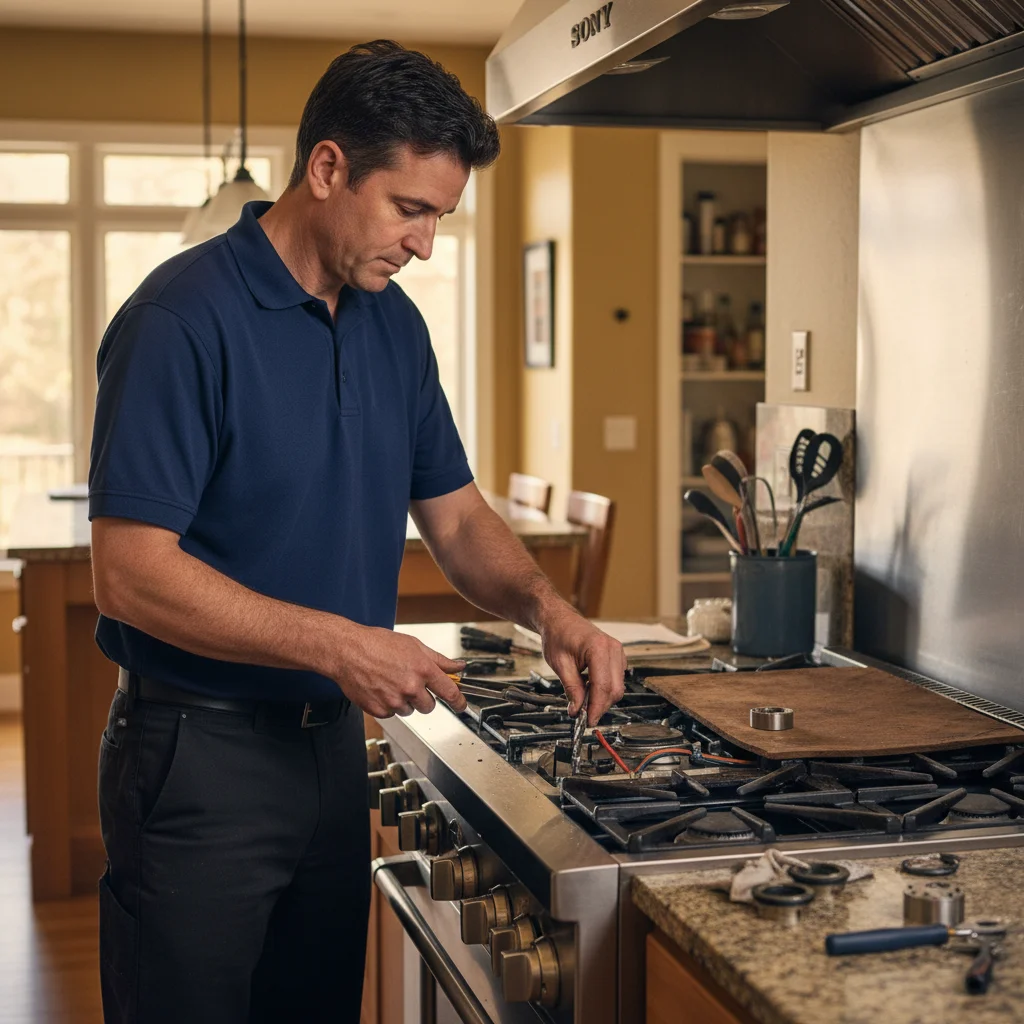
Every visit starts the same way. The technician confirms the symptom with you, pulls any stored fault codes, and then works methodically through the heating path — igniter or element current draw, sensor resistance, valve operation, relay continuity, and door seal integrity — rather than starting from a guess.
On a gas oven that means testing the igniter under load (a glow-bar igniter can look bright and still be too weak to open the valve), checking burner ports and flame quality, and verifying the safety valve responds. On an electric oven it means measuring each element, the sensor, and the relays that switch them. Convection models add a fan-motor and airflow check.
This methodical order matters because oven symptoms are deceptive. An oven that “won’t heat” can have a perfectly good element and a failed thermal fuse upstream of it; an oven that “runs cool” can have a flawless heating system and a single sensor reading high. Swapping the element in the first case or recalibrating the wrong way in the second wastes your money and leaves the real fault in place. We test our way to the cause so the part we replace is the part that’s actually broken.
We also use the visit to catch the secondary issues that turn into next month’s service call — a door gasket that’s started to compress unevenly, a hinge beginning to sag, terminal connections discolored from heat. Pointing those out lets you decide whether to handle them now while the panels are already open or wait, instead of being surprised by them later.
Then you get a plain-language explanation of what’s wrong and a firm, up-front price before any repair begins. The $89 diagnostic service call covers that full inspection, and it’s applied toward the repair if you choose to proceed. There are no charges tacked on afterward, and the exact repair quote always comes after we’ve seen the oven — not over the phone, where it would only be a guess.
Components we routinely service include:
- Bake and broil heating elements (electric)
- Glow-bar and spark igniters (gas)
- Gas safety valves and burner assemblies
- Oven temperature sensors (RTD probes) and thermostats
- Electronic control boards and relay boards
- Convection fan motors and circulation systems
- Door hinges, gaskets, and inner-glass seals
- Door-lock and self-clean latch mechanisms
- Thermal fuses and high-limit safety switches
- Wiring harnesses and terminal connections that fail under repeated heat cycling
Why Denver’s environment is hard on ovens
This is where local knowledge earns its keep. Denver sits at 5,280 feet, where the air is roughly 15% thinner than at sea level — and that single fact reaches deeper into oven performance than most people expect.
For gas ovens and ranges, thinner air means less oxygen per cubic foot reaching the burner. Orifice sizing and air-shutter mixtures that were dialed in at a factory near sea level can run rich at altitude, producing a lazy yellow-tipped flame, soot on the burner, slower preheats, and uneven baking. A burner that’s only slightly out of tune shows its problems faster here, and a glow-bar igniter that’s begun to weaken crosses the line from “still works” to “won’t light” sooner because there’s less margin to spare. When we service a gas oven, we account for how it should combust at Denver elevation, not at sea level.
For electric ovens, the altitude effect is gentler but still real: thinner air carries heat away from elements and sensors slightly differently, and Denver’s famously dry climate is the bigger enemy. Low humidity bakes door gaskets and inner-glass seals brittle faster than humid regions do, so heat escapes, cavities run cool, and elements cycle harder to compensate — accelerating their wear. Strong high-altitude UV and big day-to-night temperature swings add to that seal fatigue over the years.
And for any oven tied into a steam or water-assisted feature, Denver’s hard water — commonly 150 to 250 parts per million — leaves scale in water lines, steam generators, and valves, the same mineral buildup that plagues ice makers and dishwashers across the metro. We flag that scale before it turns into a clog.
None of this is exotic, but it’s the difference between a repair that holds and one that drifts back out of spec by next season. We’ve been diagnosing appliances at this altitude across the Denver metro since 2012, and the local conditions are baked into how we work.
Related repairs we handle
An oven rarely lives alone in a Denver kitchen. If you have a high-end suite, we also service:
- Cooktops and rangetops — burner ignition, simmer control, and altitude-sensitive flame tuning.
- Ranges — where the oven and surface burners share one cabinet and one set of controls.
- Refrigerators and freezers — built-in and freestanding sealed-system work.
- Dishwashers — including the hard-water scale issues common across the metro.
- Ice makers — where Denver’s mineral-heavy water causes the most trouble.
Bringing one technician who understands the whole premium suite — and the altitude and water conditions they all share — keeps your kitchen running as a system, not a pile of separate appliances.
Book your oven repair today
If your oven isn’t heating right, isn’t holding temperature, or is showing a fault you don’t recognize, the next step is a proper diagnosis — not a parts-cannon guess. Call (720) 770-4189 any time; the phone is answered 24/7 and on-site repairs run daily from 8 AM to 6 PM, with same-day or next-day appointments available across the Denver metro. Prefer to set it up online? Use our online booking and we’ll confirm your visit. The $89 service call covers a full inspection and goes straight toward the repair.