What sets this repair apart
A wine cooler looks like a small refrigerator and behaves like nothing of the sort. A kitchen fridge can wander a few degrees and no one notices; a wine cooler is built to hold a narrow cellar band — often between 50 and 65 degrees, sometimes split into two zones at once — and a stocked cabinet that slips out of that band is the whole problem. There is no alarm and no puddle to warn you: the light still glows and the fan still turns while the bottles slowly warm. So the repair begins the day the temperature stops holding.
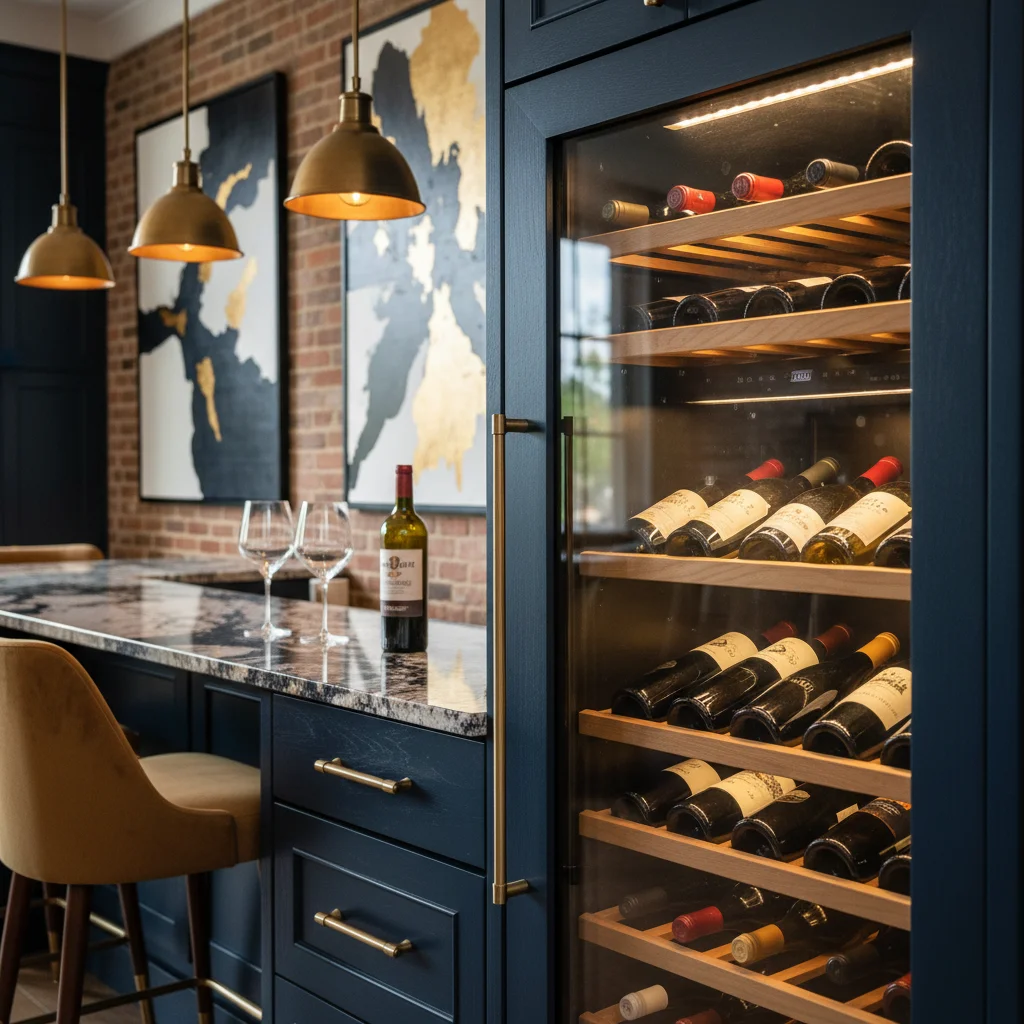
In Park Hill that cooler is almost always a retrofit. These are the shaded streets of brick Tudors, Denver four-squares, and bungalows running east from City Park and the zoo toward the old airport line — houses that predate built-in refrigeration by generations. When owners renovate, they drop a wine column or under-counter drawer into a kitchen whose footprint is far older than the appliance, and that history sits at the center of every call we take on these blocks.
Symptoms and what’s behind them
The same complaint reads differently in a flush-paneled column than in a freestanding box. The calls that come up most across South, Central, and North Park Hill:
- The cabinet won’t reach its set point, or one half of a dual-zone runs warm while the other holds.
- A new hum or vibration telegraphing through cabinet panels in an otherwise quiet kitchen.
- Frost on the rear wall, condensation sweating across the glass door, or water pooling at the base.
- A thermoelectric under-counter drawer that powers on but never pulls down to cellar temperature.
Behind them sits a short list of usual suspects: a drifting thermistor, a stuck zone damper, a failing evaporator or condenser fan, a shrunken door gasket, or a sealed-system fault in the compressor circuit.
Why a specialist matters here
Three local forces work on every cooler here, and a generalist tends to miss them. At roughly 5,280 feet the air is about 15% thinner, so every condenser rejects less heat than its maker assumed at sea level — and a column boxed flush into preserved Park Hill cabinetry, breathing through a narrow grille, loses that margin fastest. Denver’s bone-dry climate hardens door gaskets early, the usual story behind frost and a sweating glass door. And where a cooler humidifies through a water line, hard supply near 150–250 ppm scales the valve and tubing over time. We read the unit against altitude and local water, not a coastal baseline.
What a visit looks like
- Confirm the real cabinet temperature against the set point, separating a true cooling failure from a misreading sensor.
- Check the install — grille clearance and airflow around a column wedged into older cabinetry.
- Test the sealed system and compressor under load, watching how the unit sheds heat at altitude.
- On dual-zone cabinets, diagnose each chamber separately, since dampers, thermistors, and fans fail one side at a time.
- Inspect the door gasket for the dry-climate shrinkage that lets warm room air leak in.
We fit OEM-grade, manufacturer-compatible parts matched to your model and serial — and since the cooler often shares its kitchen with the original built-in suite, one visit can also cover the nearby fridge or ice maker.
Pricing
The on-site diagnostic is a flat $89, credited straight toward the repair the moment you approve the work. The exact repair price is set only after a technician inspects the unit, because a compressor-driven column and a thermoelectric drawer break along different lines. Whatever number you approve is the number on the bill — nothing padded later.
Quick answers and how to book
Can you reach a column tucked into preserved millwork? Yes — we plan the access path before pulling anything forward. Why is only one zone warm? Each chamber runs on its own controls and fails on its own. Is a humming, never-cold drawer worth fixing? Usually, since most are thermoelectric units we repair routinely.
Repairs run daily from 8:00 AM to 6:00 PM, and the phone is answered 24/7, so same-day or next-day slots are usually open. Call (720) 770-4189 or book online — the $89 diagnostic brings a technician to your Park Hill door, finds the true cause, and goes straight toward the repair once you approve it.