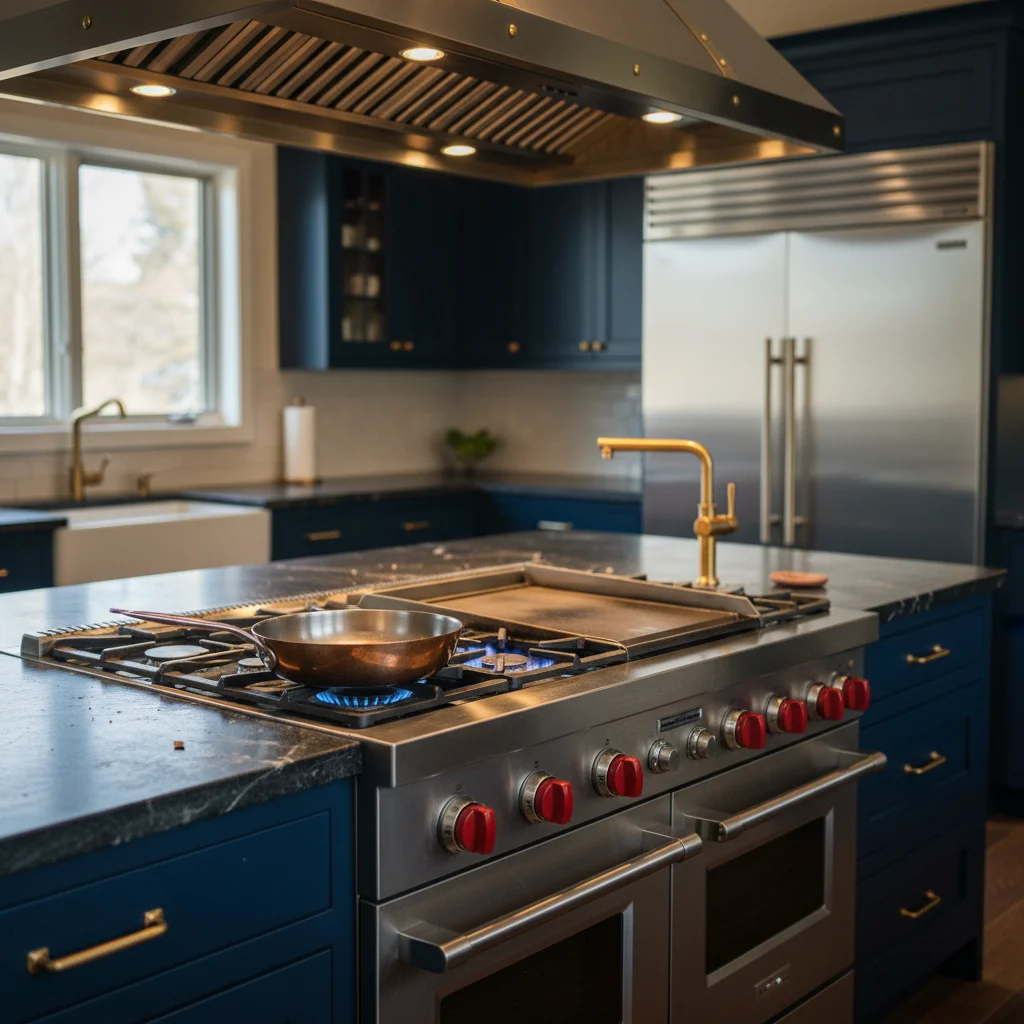
A range isn’t a single appliance — it’s two stacked into one steel frame, a cooktop above and an oven below, each able to drift out of spec while the other reads perfectly. In a Park Hill kitchen that distinction matters more than usual, because the range here is rarely a standalone freestanding unit. It’s a pro-style centerpiece dropped into a century-old footprint, and reading it correctly means accounting for both the appliance and the room around it.
The repair, explained
Park Hill runs in tree-shaded blocks from the green edge of City Park — the museum, the zoo, the lake — eastward toward the line of the old Stapleton airport, now the redeveloped Central Park area. The housing is early-twentieth-century Denver at its best: steep-gabled brick Tudors, broad American four-squares, and Denver bungalows under a canopy of mature elms.
Those kitchens weren’t built for modern cooking equipment. Over the last two decades owners here have opened cramped original layouts and installed serious ranges beside built-in refrigerator columns. So we diagnose the whole range, not just the burner you called about, and check clearance and venting first — trapped heat in a flush surround ages igniters and control boards long before the steel shows wear.
Symptoms & causes
The faults we trace most often in Park Hill kitchens:
- Yellow, sooty flames — almost always air-fuel settings tuned for denser air, not a dead burner. At altitude the fix is orifice and air-shutter correction.
- A burner that clicks but won’t catch — a clogged port, a cracked electrode insulator, lingering moisture, or a spent spark module.
- An oven that won’t hold its setpoint — typically a weak bake igniter, a sensor reading off, or a control board misjudging the cavity.
- Uneven baking across a wide oven — often a slowed convection fan or one element underperforming.
- A simmer that creeps up — a gummed gas valve or a burner cap seated slightly askew.
- Induction zones that won’t recognize a pan — overheating coils, a fan fault, or a failing power module.
Why a specialist
These are showpiece kitchens, not utility spaces. A range boxed into older cabinetry with the service panel in an awkward corner, sharing power or gas with a built-in fridge, doesn’t fail the way a catalog unit does — and shouldn’t be opened like one. We map access before we start, protect the millwork, and chase each fault to its root. An igniter that died because heat was trapped in a tight surround means a fresh one is simply next in line unless the real cause is fixed.
The altitude and water angle
Three local forces shape nearly every Park Hill range repair:
- Thin air rewrites combustion. Denver’s mile-high air carries about 15% less oxygen, so a burner or gas oven calibrated elsewhere runs rich and ignites harder here.
- Hard water scales anything plumbed. The local 150–250 ppm supply builds scale in the valves feeding steam ovens and griddles.
- Dry air and strong UV stiffen seals. Low humidity and intense Colorado sun harden oven door gaskets early, so the oven cycles harder to hold heat.
What a visit looks like
Repairs run daily, 8:00 AM to 6:00 PM, and the phone is answered 24/7. A technician inspects both halves of the range on-site, isolates the fault, and explains it in plain terms. We fit OEM-grade and manufacturer-compatible parts from verified suppliers, matched to your exact model and serial — never a generic stand-in. As an independent shop serving Denver since 2012, we’re not affiliated with any manufacturer; we just specialize in this equipment.
Pricing
The on-site diagnostic is a flat $89, credited toward the repair once you approve it. You’ll have a firm, up-front price before any part leaves the truck — nothing guessed over the phone, nothing tacked on later.
A few quick answers
When food’s at risk or a burner won’t behave, you don’t have to wait. Call (720) 770-4189 any hour or book online. Most Park Hill visits land same-day or next-day, and the $89 diagnostic comes off your repair the moment you say go.