
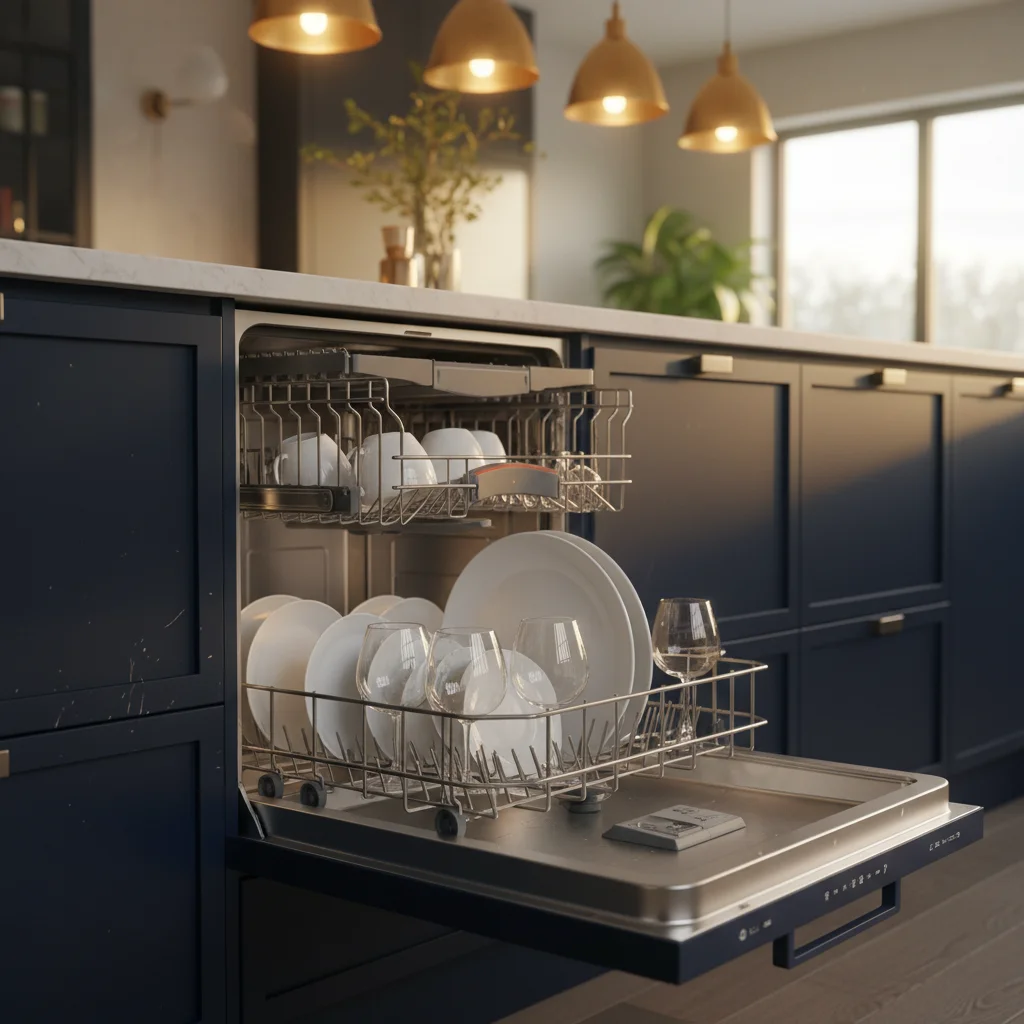
A dishwasher in Park Hill rarely announces its trouble. It shows up as a film on your water glasses, a load that finishes lukewarm and damp, or a thin dark line at the toe-kick you almost step past. In these old brick homes near City Park, that quiet stage is when to call, because the floors below are exactly the kind a slow leak ruins.
What usually goes wrong here
Park Hill kitchens are a study in old meeting new. Solid Tudors with gabled roofs, broad American four-squares, and Denver bungalows built between the 1900s and the 1940s have spent the last two decades getting their kitchens reworked, and a dishwasher tucked into that century-old cabinetry takes on the neighborhood’s particular wear. The faults we answer most:
- Standing water in the tub, or a slow seep creeping onto the kitchen floor
- Glassware coming out chalky, gritty, or still soaked
- A cycle that won’t start, quits midway, or trips the breaker
- Grinding, humming, or a drain that gurgles and backs up
- A door that refuses to latch, or detergent that never fully dissolves
Denver factors first
The local environment shapes the diagnosis more than most homeowners expect, and skipping it is how a sea-level repair ends up back on the call sheet a season later.
- Hard water, roughly 150 to 250 ppm. Scale is the quiet wrecker of dishwashers across northeast Denver. It plugs the spray-arm jets, cakes the heating element, and tightens the inlet valve until water flow weakens. A great deal of what reads as “poor wash” or “won’t dry” is really mineral buildup, and descaling outlasts a part swap that just crusts over again.
- Thin, dry air at 5,280 feet. About 15% less air pressure leaves heated-dry and condensation cycles with less to work with, so dishes finish damper than a coastal kitchen would. That same dry climate hardens door gaskets and seals faster, which is how slow leaks start in these older Park Hill homes.
How we diagnose it
- Read the symptom before pulling anything. You describe what you see, and we arrive prepared for the likely root rather than guessing in your driveway.
- Plan the extraction. Many of these dishwashers sit in tight original cabinet runs, so we protect the floor and cabinet faces and ease the unit out before testing.
- Check the Denver-prone parts. We inspect the spray arms, heating element, and inlet valve for scale, and the gasket and hoses for dry-rot and cracks.
- Test water in, water out. We confirm fill temperature and pressure, drain flow, and pump behavior to separate a true mechanical fault from mineral buildup.
- Quote up front. With the real cause in hand, you get one firm price before any repair begins.
Components we service
We repair the full machine: drain and circulation pumps, control boards and user interfaces, door latches and hinges, heating elements, inlet and diverter valves, float switches, spray arms, gaskets, and fill and drain hoses. Where Park Hill’s water has scaled a part beyond rescue, we fit OEM-grade or manufacturer-compatible replacements matched to your model and serial number, so the fix actually holds.
Same-day scheduling
Every visit begins with the $89 diagnostic service call, credited toward the repair once you approve it. Serving the Denver metro since 2012, we run repairs daily from 8 AM to 6 PM and answer the phone around the clock. Call (720) 770-4189 or book online, and we’ll line up a same-day or next-day appointment across Park Hill and northeast Denver. You get a real answer and a clear price, with the diagnostic credited toward the fix.