A dead oven is rarely just an inconvenience in Englewood. On a street south of Hampden where the same brick ranch has cooked dinner for sixty years, or in a remodeled kitchen near Old Englewood built around a pro range that cost more than a used car, putting off the repair tends to make it worse. A weak igniter that lights late keeps dumping raw gas into the cavity on every cycle. A drifting sensor that bakes one side dark slowly cooks its own control board with the extra heat. Wait long enough and a one-part fix turns into two. The faster move is to catch the fault while it is still small — and that starts with a real diagnosis, not a guess.
What you are noticing
Englewood homeowners usually describe the problem in a single line, and the range of homes here means the same line can come from very different ovens. A few patterns we hear most:
- A click, a pause, then a faint gas smell on light. Common on the older freestanding ranges that fill the post-war blocks.
- One side of a sheet pan scorched, the other pale. Often a remodel-era wall oven near Broadway with a convection cavity.
- The oven sails past its setpoint, then cools too far. A temperature that swings instead of holding.
- A burner on the range top burning lazy, yellow, and sooty while the oven below seems fine.
- A stored fault code you have learned to clear and ignore.
What it usually means
Behind each of those complaints sits a short list of real causes, and Englewood’s mix of original and renovated kitchens shifts which one is likeliest. Late ignition and a gas whiff point to a tired bake igniter that no longer pulls enough current to open the valve cleanly — classic on the aging ranges down here. Uneven baking usually traces to a drifting oven sensor, a failing convection motor, or combustion that was never tuned for our altitude. A cavity that overshoots is frequently a door gasket cracked by Colorado’s dry air, leaking heat until the thermostat overcompensates. And a yellow-tipped burner is almost always an air-fuel mixture set for thicker air than we breathe at 5,280 feet.
How we approach it
Read before we reach for parts
We recreate your symptom and pull any stored fault codes first. Guessing at a board when the real issue is a $40 igniter is exactly the kind of mistake an Englewood remodel kitchen does not need.
Work the heat source with altitude in mind
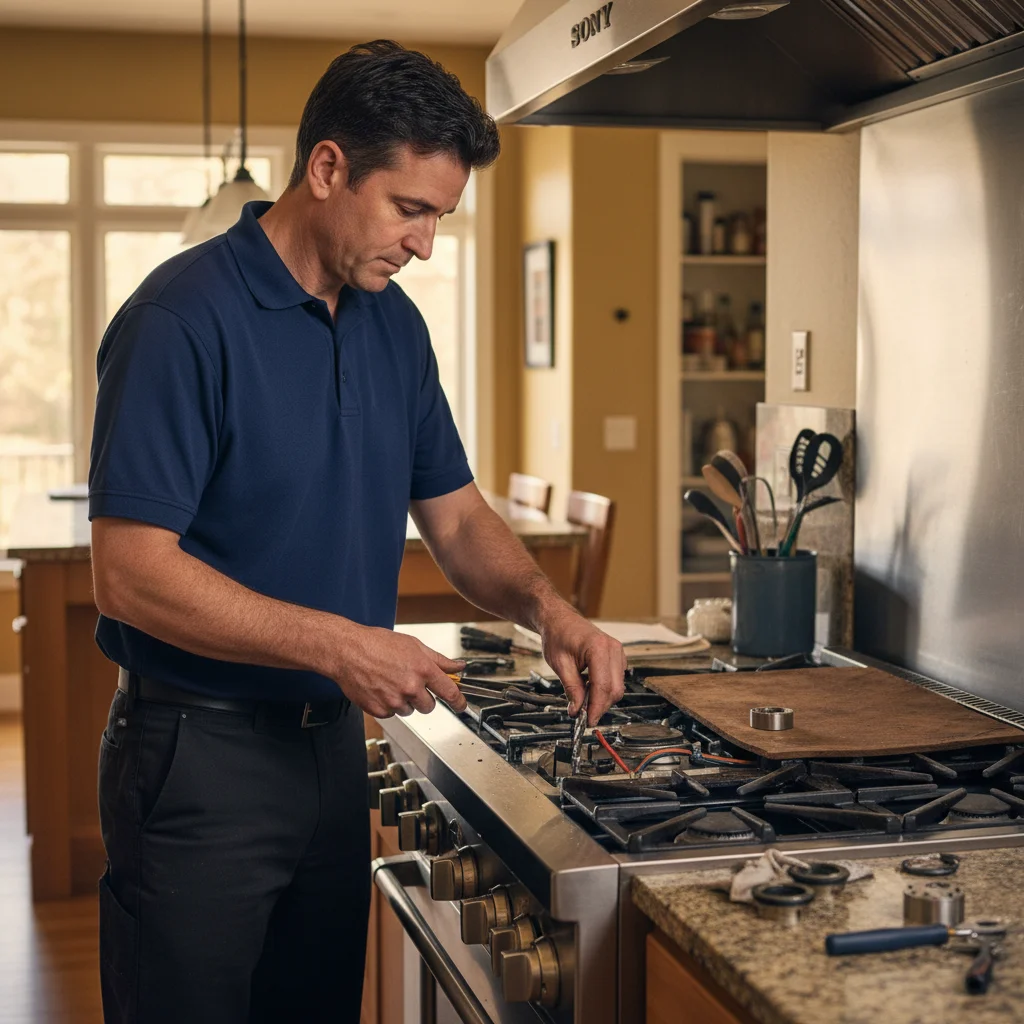
On gas and dual-fuel ranges we measure igniter draw and burner combustion, correcting for Denver’s ~15% thinner air; on electric cavities we test the bake and broil elements directly.
Verify sensing, sealing, and control
We check the temperature probe against a reference, inspect the door gasket and hinges that dry out fast here, and look the control board over for heat damage before quoting. You get a firm price up front, with the $89 service call credited toward the repair.
Coverage and brands
We cover all of Englewood — the ranch neighborhoods south of Hampden, the blocks around Belleview and Broadway, the Old Englewood shopping corridor, and the remodeled pockets up toward the light-rail station. We service freestanding gas and electric ranges, slide-ins, built-in wall ovens, double-oven towers, and dual-fuel pro ranges from the major and premium brands found in these kitchens. Common fixes include igniters, bake and broil elements, gas valves and orifices retuned for altitude, oven sensors, convection motors, door gaskets, and control boards — fitted with OEM-grade or manufacturer-compatible parts.
Get it fixed
Repairs run daily 8:00 AM to 6:00 PM, and the phone is answered 24/7 — useful when an oven quits the night before a holiday meal. Mention a range burner or a second oven acting up when you book and we will cover it in one trip. Call (720) 770-4189 or book online today. We will find the true fault, quote it honestly, and credit your $89 service call toward the repair.