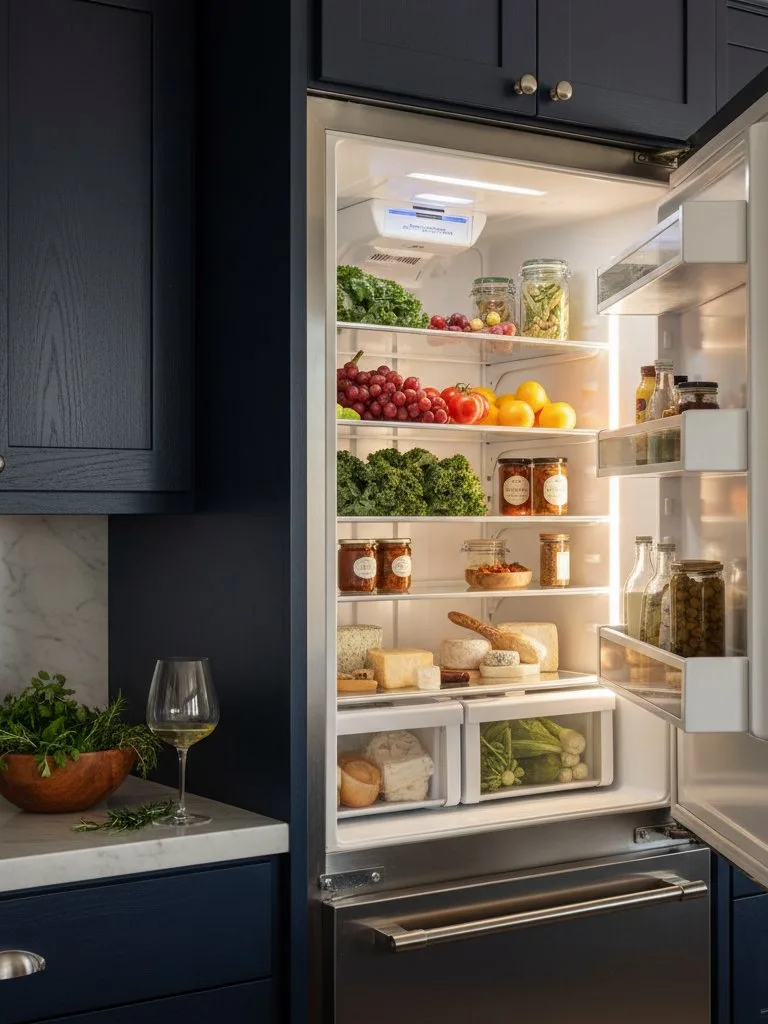
A freezer rarely warns you. There is no alarm, no code on the door — just a slow creep, over a few unwatched days, from a hard zero up into the soft teens. In an Englewood kitchen that drift hides in either of two setups: a freestanding upright in an untouched ranch, or a built-in column sealed into the cabinetry of a gut remodel. Our job is to catch the slide early, trace it to the real cause, and quote one honest number up front.
Quick orientation
Roll down a single block south of Hampden and the houses tell the story. Three original 1950s brick ranches with their first galley kitchens, then a fourth taken to the studs and rebuilt around an integrated Sub-Zero freezer column. The lot lines match; what’s freezing the food could not be more different. The same split runs along the Old Englewood corridor on South Broadway, where buyers keep the solid post-war bones and drop in premium kitchens — steady freezer demand alongside the range work we do here. Whichever you own, the first move is identical: figure out what actually failed, without disturbing a kitchen someone spent real money building.
Most common faults
A freezer complaint is usually one short sentence — “it’s not cold,” “it won’t make ice,” “there’s a wall of frost.” The work is connecting that to the cause underneath, because each symptom has several roots, each with a different fix and price:
- Slowly losing cold. Rarely a dead compressor — far more often a stalled evaporator fan, a dust-packed condenser boxed into tight cabinetry by a retrofit, a tired start relay, or a sealed system low on charge.
- Frost creeping across the back wall. A failed defrost heater, a faulty defrost thermostat, or a worn door gasket can all build the same ice. Dry Colorado air is hard on gaskets, so a cracked seal is a frequent culprit.
- An ice maker turning out slushy, cloudy cubes. Often a hard-water scale problem upstream of the freezer, not a broken mold.
- Running nonstop without pulling fully cold. Usually restricted airflow, a frosted evaporator, or a condenser that can’t shed heat in a cramped enclosure.
We never quote off the symptom alone; we test until the cause is confirmed.
Parts and longevity
Getting the right part in on the first trip matters more here than most places, because pulling a built-in twice means navigating the same retrofitted cabinetry all over again. We fit OEM-grade and manufacturer-compatible parts from verified suppliers, matched to your exact model and serial — compressors, fan motors, defrost heaters and sensors, control boards, gaskets, and ice-maker valves and molds — never a generic stand-in on the parts that decide whether a repair lasts.
The altitude and water angle
Most online freezer advice is written for sea level, which is where it goes wrong here. Englewood sits at Denver’s mile-plus elevation, where the air is roughly 15 percent thinner than at the coast. Refrigeration depends on moving air to shed heat, so a condenser rejects less of it here — and a built-in already squeezed into a tight ranch retrofit feels that penalty hardest. A charge a touch low tips over sooner than it would near an ocean, so we read condenser, compressor, and charge with thin air factored in.
Two more local factors shape every call. The very dry climate and strong UV crack door gaskets faster than a humid region would, so we test the seal on every visit, not just the defrost circuit. And the hard local water, around 150 to 250 ppm, leaves scale in fill valves, lines, and ice molds until cubes go cloudy. A sea-level playbook misses all of it.
How to book
If your freezer is creeping warm, don’t wait for the contents to thaw. Call (720) 770-4189 any time — the phone is answered 24/7 — or book online. Repairs run daily from 8:00 AM to 6:00 PM, we’ve served the Denver metro since 2012, and the on-site diagnostic is $89, credited toward the repair once you approve it. Same-day and next-day appointments are available throughout Englewood and the south metro.