A wine cooler in a RiNo loft fails quietly, and that quiet is what costs you. The light glows, the fan turns, the display reads a number — but the cabinet that held 55 degrees since the building opened now sits at 62, and the bottles inside are slowly cooking. Wait a week and the unit doesn’t get louder; the wine just keeps warming. So the repair begins the moment the set point stops holding: get a technician to the cooler, find what actually changed, and stop the climb before a stocked rack pays for the delay.
What you’re noticing
Across the district’s condos and lofts, the same short list of complaints comes up again and again:
- The cabinet won’t hold its set point, or one chamber of a dual-zone runs warm while the other stays exactly where it belongs.
- A new hum, rattle, or vibration buzzing through custom millwork in an otherwise silent open-plan kitchen.
- Frost on the back wall, condensation sweating across the glass door, or water pooling at the base.
- A thermoelectric under-counter drawer that powers up but never pulls down to temperature.
- Lights and display work, yet the cooling stage never engages — or the unit short-cycles without ever reaching the number you set.
What it usually points to
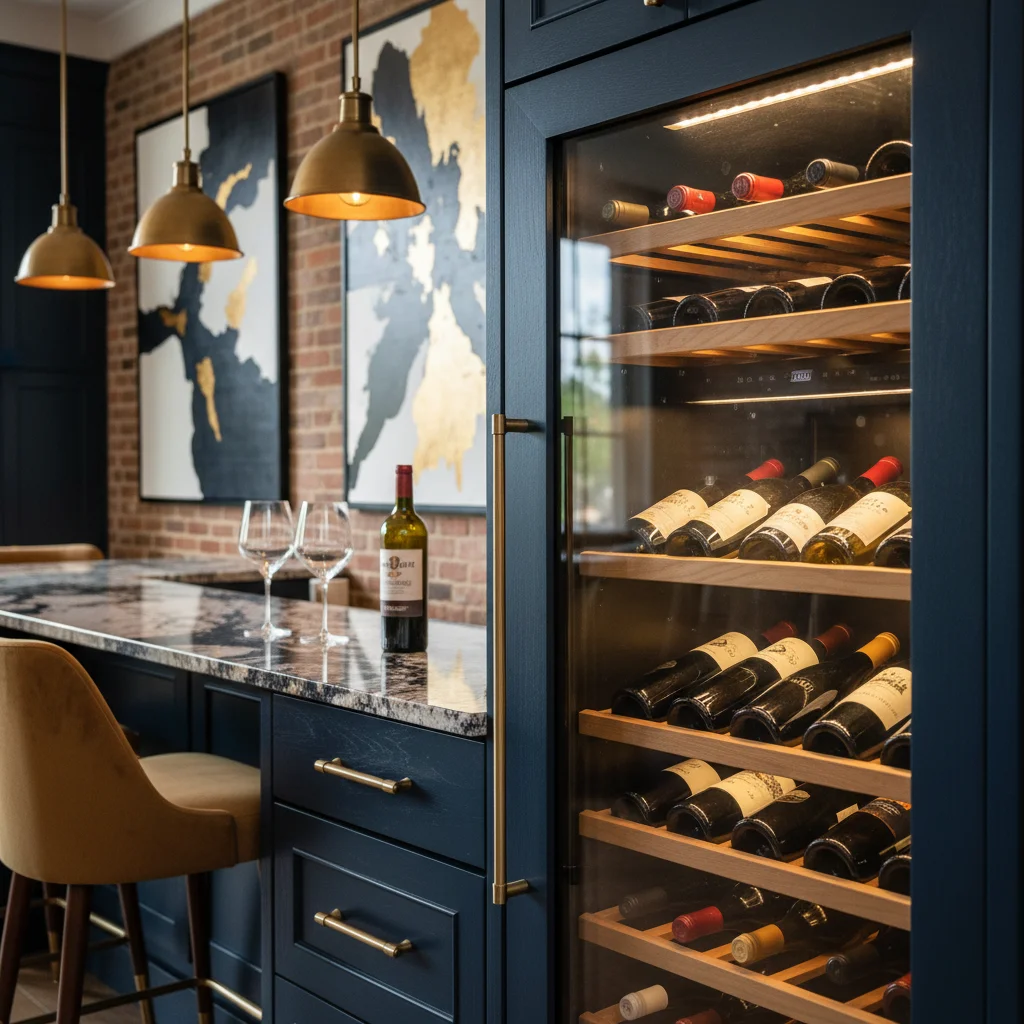
RiNo is young by Denver standards. Where Park Hill is a century of brick bungalows, the River North Art District is a former warehouse and rail stretch along the South Platte that filled, over fifteen years, with glassy condo towers on Blake and Wewatta and signature live/work lofts carved out of old loading bays. The wine units here are almost never freestanding boxes against a wall. They’re integrated columns flush with the cabinet panels, beverage drawers slid under a concrete-topped island, or slim coolers wedged into a footprint laid out before anyone measured the condenser’s breathing room. So a “warm cooler” splits into two questions: what failed inside the machine, and what is the install doing to it. A panel-ready column choking on its own trapped heat is a pattern we see far more in a tight RiNo loft than in a sprawling suburban kitchen.
How we work the diagnosis
Reading the unit, then the install
- Confirm the real cabinet temperature against the set point, separating a genuine cooling failure from a sensor that’s simply lying.
- Check the install — grille clearance, airflow around a flush-paneled cabinet, and the ventilation a compact loft kitchen actually allows.
- Test the sealed system and compressor under load, watching how the unit rejects heat at 5,280 feet rather than at some sea-level assumption.
- On dual-zone units, diagnose each chamber on its own, since dampers, thermistors, and evaporator fans fail one side at a time.
- Inspect the door gasket for the dry-climate shrinkage and UV hardening that let warm air leak in.
The Denver forces underneath it
At 5,280 feet the air is roughly 15% thinner, so every condenser sheds less heat than its maker planned for. In a column boxed into millwork or a slim cooler pressed into a rail-side loft galley — exactly how RiNo tends to build — that margin is often the gap between steady cellar temperature and a slow drift out of range. The dry climate cracks gaskets early, the usual story behind frost and a sweating glass door, and hard local water near 150–250 ppm scales any line feeding a humidified wine cabinet. We read all three — thin air, dry air, hard water — into the diagnosis from the start.
The $89 diagnostic covers that full inspection and credits straight toward the repair the moment you approve the work — quoted up front, never padded later.
Coverage & brands
We fit OEM-grade and manufacturer-compatible parts matched to your model and serial — compressors, condenser and evaporator fan motors, thermistors, dampers, control boards, and door gaskets — across built-in wine columns, dual-zone coolers, and under-counter beverage drawers. The cooler rarely fails alone, so while we’re in the kitchen we also handle the integrated refrigerator columns, ice makers fighting RiNo’s hard water, and altitude-affected ranges and cooktops that round out these premium suites.
Get it fixed
Repairs run daily from 8:00 AM to 6:00 PM, and the phone is answered 24/7, so same-day or next-day slots are usually open. Call (720) 770-4189 or book online anytime. The $89 diagnostic brings a technician to your RiNo loft or condo, pinpoints the true cause, and credits straight toward the repair the moment you approve it.