Oven Repair in RiNo, Denver

RiNo runs younger than almost any pocket of Denver, and the ovens reflect it — flush wall units and integrated ranges set into brand-new condo and loft kitchens. We diagnose why yours stopped, factor in the mile-high air and Front Range water, and price the work before anything is dismantled.

Oven Repair in RiNo, Denver

Quick Answers

Where in RiNo do you repair ovens, and what types?
Denver Sub-Zero Repair covers the entire River North Art District as an independent service — the recent condo builds off Brighton Boulevard and the live/work lofts threaded between the galleries and breweries near Larimer and Walnut. We handle single and double wall ovens, panel-ready oven columns, and the bake cavities inside dual-fuel and gas ranges. Reach us at (720) 770-4189, answered 24/7.
Why is my new RiNo condo oven not holding temperature?
A newer oven rarely fails from age — it usually drifts because something is out of calibration or fighting Denver's environment. At 5,280 feet the thinner air lets a gas cavity burn rich, and a temperature probe that reads even ten degrees off will swing a roast from raw to scorched. In a tight RiNo install the heat also has fewer places to escape, which stresses the sensor and board. We measure all three on-site.
What does oven repair cost in RiNo?
Diagnosis is a flat $89 on-site, and that amount comes off the repair once you approve it. Because a RiNo oven problem can be anything from a single bake igniter to a control board buried behind an integrated panel, we give the exact repair price only after a technician sees the unit. No blind phone quotes.

Most appliance-repair advice assumes an old oven wearing out. RiNo flips that. The River North Art District is one of the newest residential pockets in Denver — condo buildings still smelling of fresh drywall, warehouse shells reborn as live/work lofts — so the ovens here tend to be late-model wall units and panel-ready columns, often only a few years old. When a nearly new oven misbehaves, the cause is almost never simple wear. It is calibration, an environmental mismatch, or a single early-failure part hiding behind a flawless integrated facade.

The repair, explained

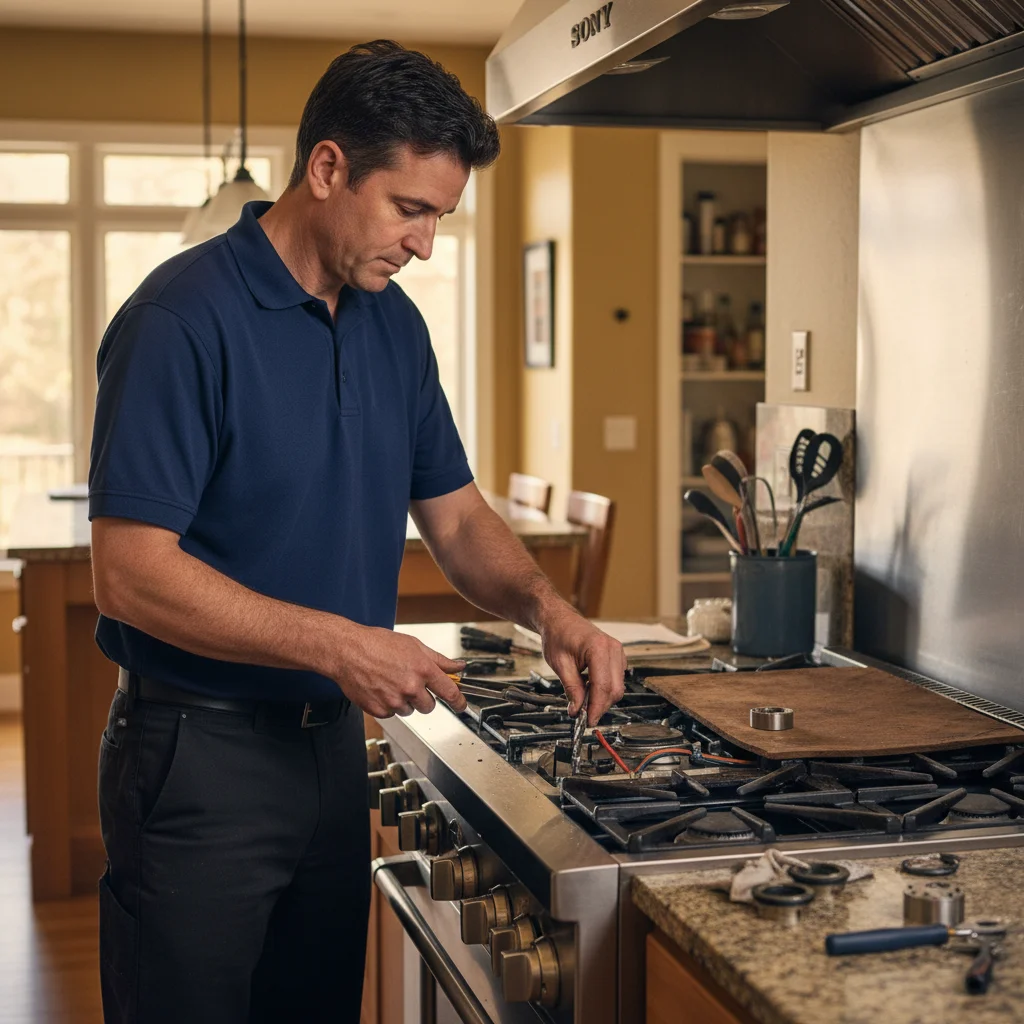
An oven repair in RiNo starts with a different assumption than a repair on a twenty-year-old range. We are usually not looking for a worn-out machine; we are looking for the one thing throwing off an otherwise healthy unit. The work is methodical: reproduce the fault, pull any stored codes off the digital control, and test heat delivery, temperature sensing, and the door seal against Denver’s specific conditions. Only then do we name a cause and a price. Because so many RiNo ovens are flush-mounted into custom surrounds, guessing wrong is expensive — it means a second trip into a finished kitchen.

Symptoms and likely causes

These are the complaints we hear most from RiNo condos and lofts:

  • A roast that browns unevenly — usually a temperature probe reading off, a tired convection fan, or rich combustion on a gas cavity.
  • Long, sluggish preheats — a weakening bake igniter that fires late, or an element that no longer pulls full current.
  • A faint gas smell at light-up — delayed ignition dumping a little raw gas before the burner catches; worth a same-day look.
  • An oven that overshoots its setpoint — often a dry-climate-stiffened door gasket bleeding heat, so the thermostat keeps overcorrecting.
  • An error code on the touch panel — stored faults on integrated boards are early warnings, not noise to scroll past.

Why a specialist matters here

A general handyman swaps the obvious part and leaves, missing the Denver factors that actually drive these faults. At 5,280 feet the air carries roughly 15% less oxygen, so a gas oven set up at sea level runs rich — lazy flames and wandering heat that imitate a broken sensor. The very dry climate ages door gaskets faster than the manufacturer planned, so a young oven can already leak heat. And the 150–250 ppm water scales the steam features built into upscale RiNo models. We weigh all three before condemning a component.

What a visit looks like

  1. On-site confirmation — the technician reproduces your symptom and reads stored codes rather than working from your description alone.
  2. Heat and combustion — igniter draw and burner combustion get measured on gas units with the altitude correction applied; elements get tested directly on electric cavities.
  3. Sensing and seal — the probe is checked against a reference and the gasket inspected, since a leak fakes a calibration fault.
  4. A clear price — you get a firm, up-front number, and the $89 service call is credited toward the repair if you proceed.

We plan cabinet access at booking, including freight elevators and loading windows in the newer buildings, and protect finishes before pulling the unit.

Pricing

The on-site diagnostic is a flat $89, applied to the repair once you approve it. The exact repair figure comes only after inspection — a RiNo oven fault might be one igniter or a full integrated control board, and we will not quote that sight unseen. We fit OEM-grade, manufacturer-compatible parts matched to your model and serial.

Quick answers before you call

Repairs run daily 8:00 AM to 6:00 PM, and the phone is answered 24/7 — useful when the oven quits the night before a dinner in the art district. We cover the whole district, from Brighton Boulevard to the lofts near 38th & Blake, and will look at a scaled dishwasher or panel-ready fridge in the same trip if you mention it. Call (720) 770-4189 or book online today, and we will find the real fault and credit your $89 service call toward the fix.

Frequently Asked Questions

Is a panel-ready oven column harder to service than a standard wall oven?

Not harder, just more deliberate. RiNo developers love the seamless look — a column where the oven, warming drawer, and cabinet fronts all match the millwork — so the unit is anchored into a finished surround rather than a simple cutout. Pulling it forward means clearing trim cleanly. We confirm the install type when you book and pad the surrounding cabinetry and floor before we start.

My loft kitchen is open to the living space. Will the repair be disruptive?

We keep it contained. Many RiNo live/work units put the oven on an open-plan run with no door to close off, so we work with drop cloths and a tidy footprint, test on-site, and stage parts so we are not spreading tools across your living area. Most diagnoses wrap up in a single visit.

How soon can someone get to my RiNo place?

We routinely book same-day or next-day across north-central Denver, and RiNo is fast to reach off Brighton and the 38th & Blake corridor. If you ever catch a gas odor with the oven off, switch it off at the unit, open a window, and call (720) 770-4189 — the line is staffed around the clock and we will prioritize you.

Does Denver's hard water reach the oven, or just the cooktop?

Both, on the higher-end models common in RiNo. Steam, proof, and self-steam ovens hold a small water reservoir, and Denver's 150–250 ppm supply leaves scale inside it and at the steam outlets; on a range, the same water crusts burner caps and igniter tips. We clear or replace the scaled component rather than masking the symptom.

Do you deal with building access — concierge, freight elevator, loading dock?

Yes, that is normal for RiNo's newer towers and converted-warehouse buildings. Give us the building name, garage or dock instructions, and concierge contact when you schedule, and we will arrange arrival so moving tools and parts up to your floor never stalls the repair.

Are you connected to Sub-Zero or my oven brand?

No. We are a fully independent repair company and are not affiliated with, endorsed by, or sponsored by Sub-Zero Group, Inc. or any appliance manufacturer. We focus on built-in and high-end appliances across the Denver metro, where we have worked since 2012.

Your Sub-Zero Deserves Better

Denver's experienced independent repair specialists are standing by. Same-day appointments available throughout the metro area.