What we actually do on a RiNo repair
You text your neighbor across the hall, scroll a forum, and finally pick up the phone because the panel-ready Sub-Zero built into your new RiNo condo is reading three degrees warm and the integrated ice maker has gone quiet. That is the moment this page is for. On a RiNo call, we do one thing well: we figure out the genuine cause of the failure on-site, reach it without scarring a builder-finished kitchen, and hand you a clear price before a single panel comes off. The $89 diagnostic service call covers that inspection, and it is credited toward the repair if you decide to move ahead.
We are an independent appliance repair service — not a manufacturer and not a warranty contractor — and we have worked Denver metro kitchens since 2012. RiNo is, by Denver standards, brand-new territory, and that newness shapes everything about how we work here. Most of the appliances are young. Most of them are integrated and panel-ready. And almost all of them live in open-plan spaces that were designed around a sightline, not around condenser airflow. Knowing that going in is half the job.
The River North Art District, and why its kitchens are different
RiNo did not grow up like the rest of Denver. Where Wash Park and Congress Park are a century of brick bungalows, the River North Art District is a former industrial and warehouse stretch along the South Platte and the rail lines that, over the last fifteen years, turned into one of the city’s densest pockets of new construction. Murals wrap the old loading docks, breweries and galleries fill the ground floors, and above and around them sits a wave of recent housing: glassy mid-rise condo and apartment towers along Blake, Walnut, and Wewatta, and the district’s signature live/work lofts — converted warehouse bays and purpose-built units where the kitchen, the studio, and the living space share one open volume.
That housing stock is the single thing that makes appliance repair in RiNo unique, so it’s worth being specific about what it means for the appliances:
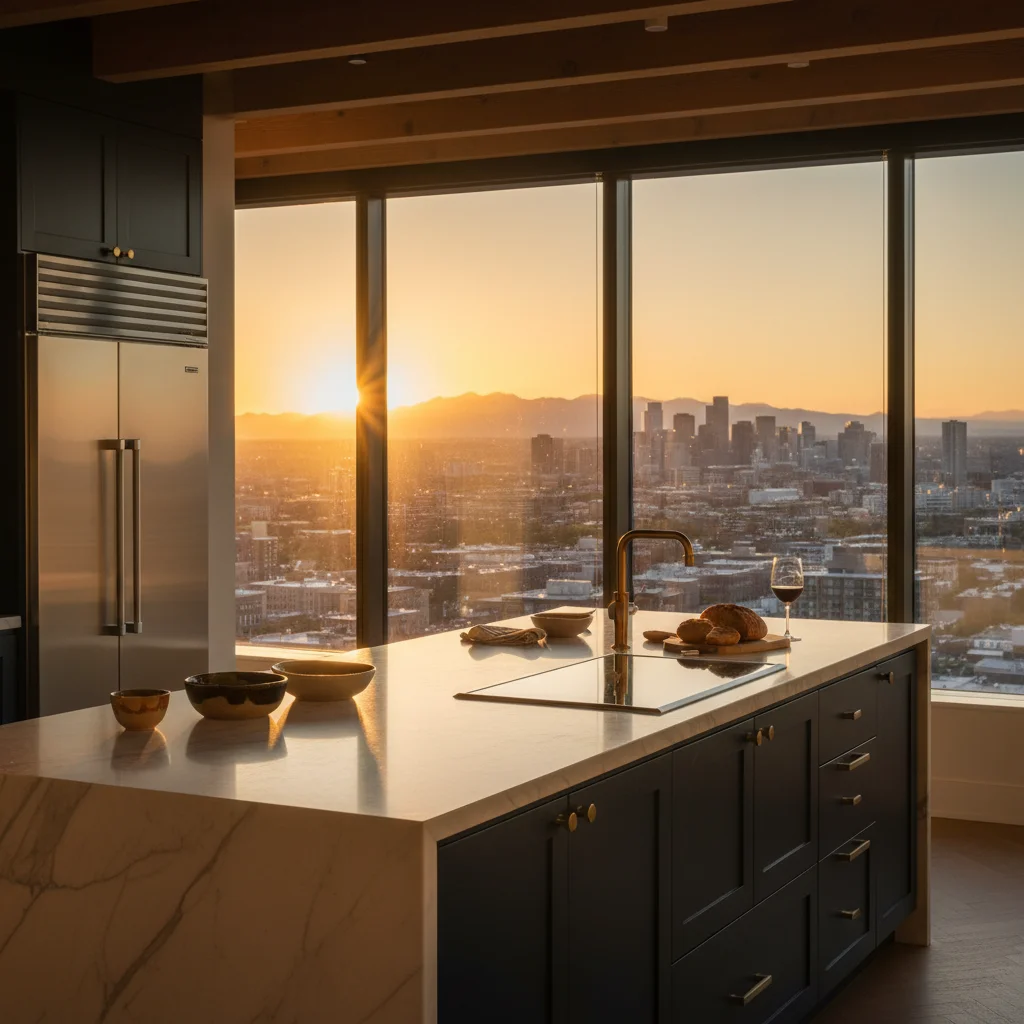
- The kitchens are new, but not simple. A RiNo condo finished in the last decade almost always came with a high-end integrated package — a panel-ready Sub-Zero column or built-in refrigerator wearing the same cabinet front as everything around it, an integrated dishwasher, often a Wolf or comparable range or cooktop, and sometimes a built-in wine column. The appliances disappear into the millwork on purpose. That looks spectacular and it makes service access deliberately hidden.
- Open-plan means tight mechanicals. Loft and condo kitchens are designed as a clean line along one wall or a single island. To keep the look uncluttered, the built-in fridge frequently sits flush in a run of cabinetry with minimal clearance above and behind it — exactly the spots a condenser needs to breathe. A young appliance choking on its own trapped heat is a pattern we see far more in RiNo than in a sprawling suburban kitchen.
- Live/work conversions hide their plumbing. In a warehouse-to-loft conversion, water lines, refrigerant routing, and dishwasher drains were threaded through concrete floors, exposed-duct ceilings, and shared building chases. When a leak or a drain fault shows up, where it appears is not always where it started — and that changes how we trace it.
- Buildings come with access rules. Controlled lobbies, freight elevators, reserved loading windows, and garage check-ins are normal in RiNo’s newer towers. We plan around them so a visit doesn’t stall in the lobby.
None of this is a problem. It’s just the reality of servicing premium appliances in a young, vertical, design-forward neighborhood — and it’s the reality a national service manual written for a two-car-garage kitchen quietly ignores.
Problems we get called for in RiNo
Across the district’s condos and lofts, a recognizable set of complaints comes up again and again. Here’s what we most often find behind each one:
- A panel-ready Sub-Zero that runs a few degrees warm. The classic RiNo call. Usually a condenser blanketed in dust, a failing condenser or evaporator fan, a tired start relay, or — less often — a slow sealed-system refrigerant fault. In a column boxed tight into an open-plan cabinet run, airflow is compromised before anything mechanical even fails.
- The compressor never cycles off and the cabinet face feels warm to the touch. Frequently a dust-choked condenser, a weakening fan, or a door gasket that no longer seals — and Denver’s dry air cracks gaskets early.
- Frost sheeting up the back of the freezer. Typically a defrost heater, a failed defrost sensor, or a control board mistiming the defrost cycle so the ice never clears.
- The integrated ice maker slows, jams, or turns out cloudy, undersized cubes. Almost always scale from Denver’s hard water building up in the fill valve, the line, and the mold.
- A Wolf or built-in range burning lazy, yellow-tipped, or uneven flames. Often a combustion-and-altitude issue rather than a broken burner — orifice and air-mix settings tuned at sea level run rich at 5,280 feet.
- An oven that overshoots or drifts off its setpoint. Usually the bake element, a wandering temperature sensor, or a control board that needs recalibration.
- An integrated dishwasher leaving film or refusing to drain. Scale on the heating element and spray arms, a failed drain pump, or a clogged sump — hard water is usually the root.
- Water showing up where it shouldn’t — under the unit, at a cabinet base, or, in a loft conversion, on a level below. A blocked defrost drain, a cracked drain pan, or a scaled, weeping water line is the usual suspect.
- A built-in wine column that can’t hold its setpoint — a weak compressor or thermoelectric module, a fan fault, or a gasket gone brittle in the dry climate.
- A control panel flashing a fault code you’ve never seen before.
If your symptom isn’t on this list, it still belongs on the phone. These are the patterns, not the limits, of what we fix.
Services we offer in the district
Within RiNo, we regularly handle:
- Panel-ready and integrated refrigerator repair — Sub-Zero columns, built-ins, and under-counter drawers behind custom cabinet fronts.
- Freezer and ice maker service, including the scale-and-water issues that dominate here.
- Range, cooktop, and rangetop repair — gas and dual-fuel, with attention to altitude-affected combustion.
- Wall oven and built-in oven repair — temperature drift, igniter faults, and control-board failures.
- Integrated dishwasher repair, where hard-water scale and drain blockages lead the list.
- Wine and beverage column service for the units these kitchens were built around.
Inspection first, then an honest price
We are deliberately slow to declare a diagnosis, because in a panel-ready RiNo install the cost of guessing wrong is a second trip back through a finished kitchen and a controlled-access building. Here is how a visit actually runs:
- You tell us the brand, the symptom, and the building. When you call or book, let us know whether it’s the Sub-Zero, the range, the dishwasher, or something else, what it’s doing, and which building or block you’re in. That lets us bring the right common parts and plan elevator and entry logistics.
- The technician inspects on-site and reads the system. They confirm the symptom, pull any stored fault codes, and work methodically through whatever the appliance calls for — the sealed refrigeration loop, the gas combustion path, the water path, or the control logic. On a column that’s warming, that means checking the condenser’s condition and airflow, testing both fans and the start components, and verifying the refrigerant charge behaves correctly at this elevation before anyone jumps to a sealed-system conclusion.
- We trace the fault to its cause, not just its symptom. A condenser fan is a quick swap, but if it failed because a dust-packed condenser ran it hot in a tight cabinet — a pattern altitude makes worse — the new fan is just the next part to die. We follow the chain backward so the repair holds.
- You get a plain-English diagnosis and an up-front price. Before any work begins, you know what failed and what it costs. The $89 diagnostic covers the inspection and is credited toward the repair if you proceed.
- We complete the repair and tell you what to watch. Using OEM-grade, model-matched parts, we finish the job and explain plainly what was replaced and why.
The whole point of the sequence is that nothing happens behind your back. You approve the cause and the cost before the work, and the price you’re quoted is the price you pay.
Denver context: why a young appliance acts old at 5,280 feet
It’s tempting to assume a five-year-old appliance in a five-year-old building shouldn’t be giving trouble. But RiNo sits at the same mile-high elevation as the rest of Denver, and elevation doesn’t care how new the kitchen is. A few concrete forces are at work:
- Thinner air means weaker heat rejection. At roughly 15% lower air density, a Sub-Zero’s condenser and cooling fans move less mass per turn, so the system sheds heat less efficiently than the same unit would near the coast. A panel-ready column wedged into a tight, low-clearance cabinet run — the standard RiNo install — feels that deficit sooner. Refrigerant charge and compressor heat rejection are both sensitive to thin air, so we read the system the way it behaves in Denver, not the way a sea-level manual assumes.
- Gas combustion shifts. Thinner air carries less oxygen per cubic foot, so the fuel-to-air mixture changes. Orifice sizing and burner tuning that were correct at sea level can run rich at altitude, producing lazy, yellow-tipped, or sooty flames and harder ignition on ranges, cooktops, and ovens. A burner that looks “broken” is often a combustion-and-altitude problem we can correct.
- Hard water is relentless. Denver’s supply commonly runs 150 to 250 ppm, and that mineral load is brutal on ice makers, dishwasher internals, and the thin water lines feeding a built-in fridge. It’s the leading reason ice output drops, cubes come out cloudy and small, and dishwashers start leaving film. A repair that ignores the water chemistry just resets the clock to the next failure.
- The dry climate and strong UV age seals early. Denver’s low humidity and intense Colorado sun harden and crack door gaskets faster than the warranty math assumes — and RiNo’s big-window, sun-flooded units don’t help. A gasket that no longer seals lets warm air leak in, the compressor runs longer, and the whole system works harder, so we check seals on every refrigeration diagnosis here.
A technician who understands those four forces fixes the cause. One who doesn’t fixes the symptom, and you’ll be making the same call next summer.
Related repairs and the brands we service
Sub-Zero is the name we see most in RiNo kitchens, but a new condo or loft package usually pairs it with several others, and the faults tend to travel together. We service the full premium suite:
- Refrigeration — Sub-Zero built-ins, columns, and under-counter drawers, plus other premium and integrated refrigerators and freezer columns.
- Cooking — Wolf gas and dual-fuel ranges, rangetops, wall ovens, and cooktops, along with comparable professional ranges from other high-end makers, with attention to altitude-affected combustion.
- Integrated dishwashers — panel-ready units where hard-water scale and drainage dominate the fault list.
- Wine and beverage columns — compressor, thermoelectric, fan, and seal faults on built-in and standalone units.
We fit OEM-grade and manufacturer-compatible parts from verified suppliers, matched to your exact model and serial number. A premium appliance is engineered as a system — a sealed refrigeration loop, a precise control board, and airflow and water paths that all depend on one another — so for the components that decide long-term reliability we use the part the system was designed around instead of a generic stand-in. If you have a mixed suite — a Sub-Zero column, a Wolf range, an integrated dishwasher, and a wine column from a third brand — that’s normal in RiNo, and it’s exactly the kind of kitchen we’re set up to handle in one visit.
Book a RiNo repair
We’ve kept booking simple and built it around how this neighborhood actually lives:
- Call (720) 770-4189. The phone is answered 24/7, so you can reach a real person the moment something quits — late night, early morning, or over a weekend.
- Or book online any time that’s convenient.
- Repairs are performed daily, 8:00 AM to 6:00 PM. When we schedule, we’ll confirm a window and check access details — a panel-ready install behind finished millwork, a tight open-plan cabinet run, a freight-elevator window, or concierge and garage entry in a newer tower.
- The $89 diagnostic service call covers a full on-site inspection and is applied toward your repair, so the diagnosis is never wasted money.
We’ve served the Denver metro as an independent specialist since 2012, and RiNo — with its new condos, its converted live/work lofts, and its panel-ready Sub-Zero kitchens dropped into a fast-growing art district — is exactly the kind of work we’re built for.
Ready to get a panel-ready Sub-Zero, a built-in range, or any integrated appliance back in service? Call (720) 770-4189 or book online today — same-day and next-day appointments are available across RiNo and north-central Denver, and the $89 service call goes straight toward your repair.