Quick orientation
You are mid-recipe in your Wynkoop-block loft, the back burner won’t hold a low flame, and the oven you started half an hour ago still reads stone cold. The fix starts with naming the precise fault, not guessing at parts. A burner stuck on high, an oven that bakes to one side, a broiler that won’t catch, an induction ring that quits at level six, each one points to a different component with its own price tag. We confirm the real cause on site, then hand you a single clear number before the work begins. The $89 service call pays for that inspection and comes off the repair once you approve it.
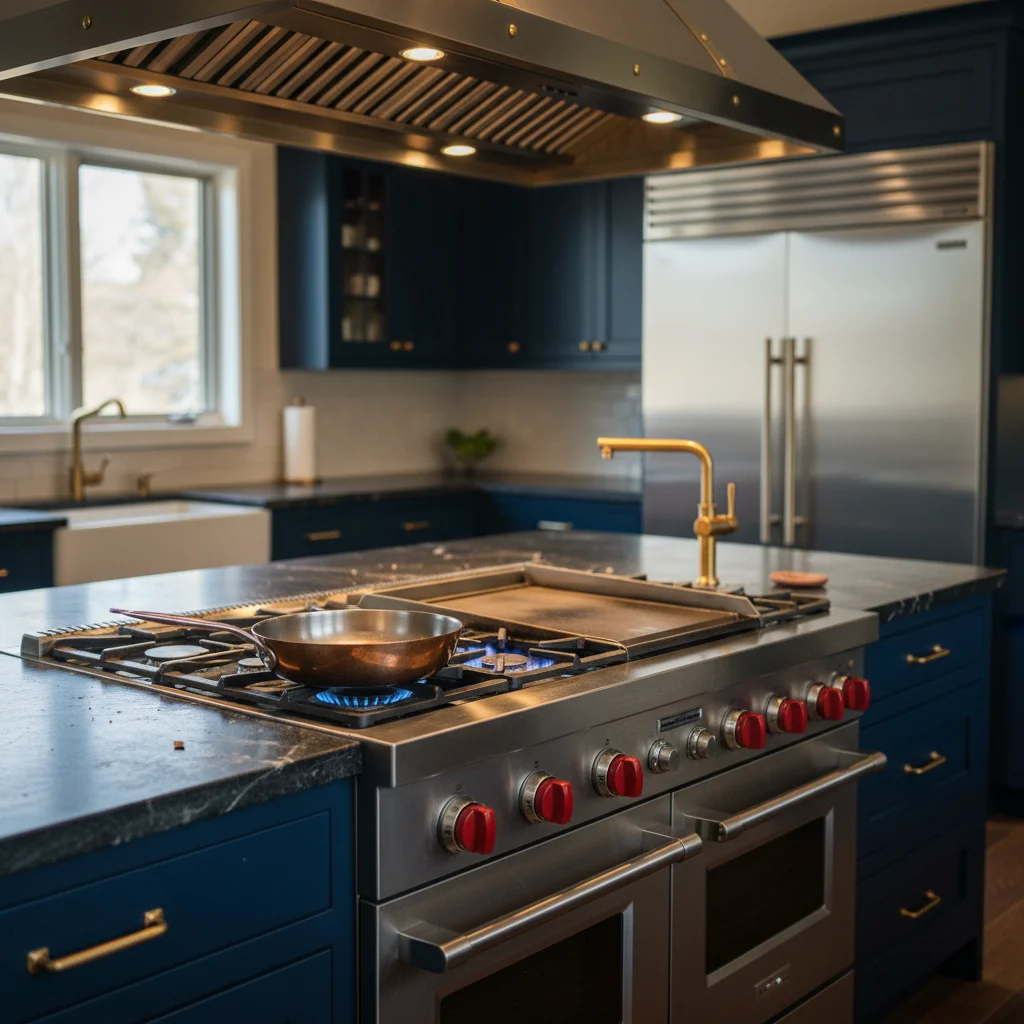
LoDo is not suburban tract kitchens. These are turn-of-the-century warehouse conversions a few blocks off Union Station, where soaring brick, exposed timber, and ductwork meet a kitchen that was designed to be looked at. The range almost always sits flush in a compact run alongside integrated and undercounter refrigeration, so the whole bank reads as one continuous wall of cabinetry. Beautiful, and unforgiving the moment a burner drifts.
Most common faults
A flush-set range is really two appliances under one frame, a cooktop above and oven cavities below, and either half can slip out of spec while the other looks perfect. Boxed into tight loft millwork with little ventilation, the heat that wears these units has nowhere to escape, which slowly bakes the electronics. Here is what we trace most in LoDo:
- Sealed gas burners that spark but won’t light, clogged ports, worn electrodes, or a valve that won’t sit at a steady simmer.
- Ignition and spark faults, a dead spark module or a harness shaken loose when a heavy range was muscled back into its alcove.
- Oven heating problems, fatigued bake igniters, drifting temperature sensors, and burned-out bake, broil, or convection elements.
- Induction and electric failures, dead coils, worn infinite switches, corroded terminal blocks, or a power module that lost its interface.
- Control electronics, the boards and relays that time the oven and stop a surface igniter clicking on its own.
Parts and longevity
When a part is genuinely done, we fit OEM-grade and manufacturer-compatible components matched to your exact model and serial, built to the original spec rather than a generic stand-in. That matters in a LoDo kitchen where the range is keyed to integrated refrigeration as a designed set, and a mismatched igniter or off-spec sensor just sends you back to square one. We also look at how the unit breathes inside its run, because a cooktop that overheats its own controls in a sealed cabinet will burn through replacement boards no matter how good the part is.
The altitude and water angle
Three local forces shape every LoDo diagnosis. The thin mile-high air leaves a sea-level burner running rich and a marginal igniter short of its firing margin, which is often a tuning fix and not a replacement. The very dry, high-UV climate hardens oven door gaskets early, so heat leaks and the oven cycles harder to hold temperature. And on any water-fed range, Denver’s 150 to 250 ppm hard water scales the injector valves and supply lines. We read all three before reaching for a part.
How to book
Call (720) 770-4189 at any hour, the phone is answered 24/7, or book online. On-site repairs run daily 8:00 AM to 6:00 PM, the diagnostic is a flat $89 applied toward the repair, and you always have an up-front price before we start. Independent and serving the Denver metro since 2012.