A repair built around how LoDo kitchens are actually put together
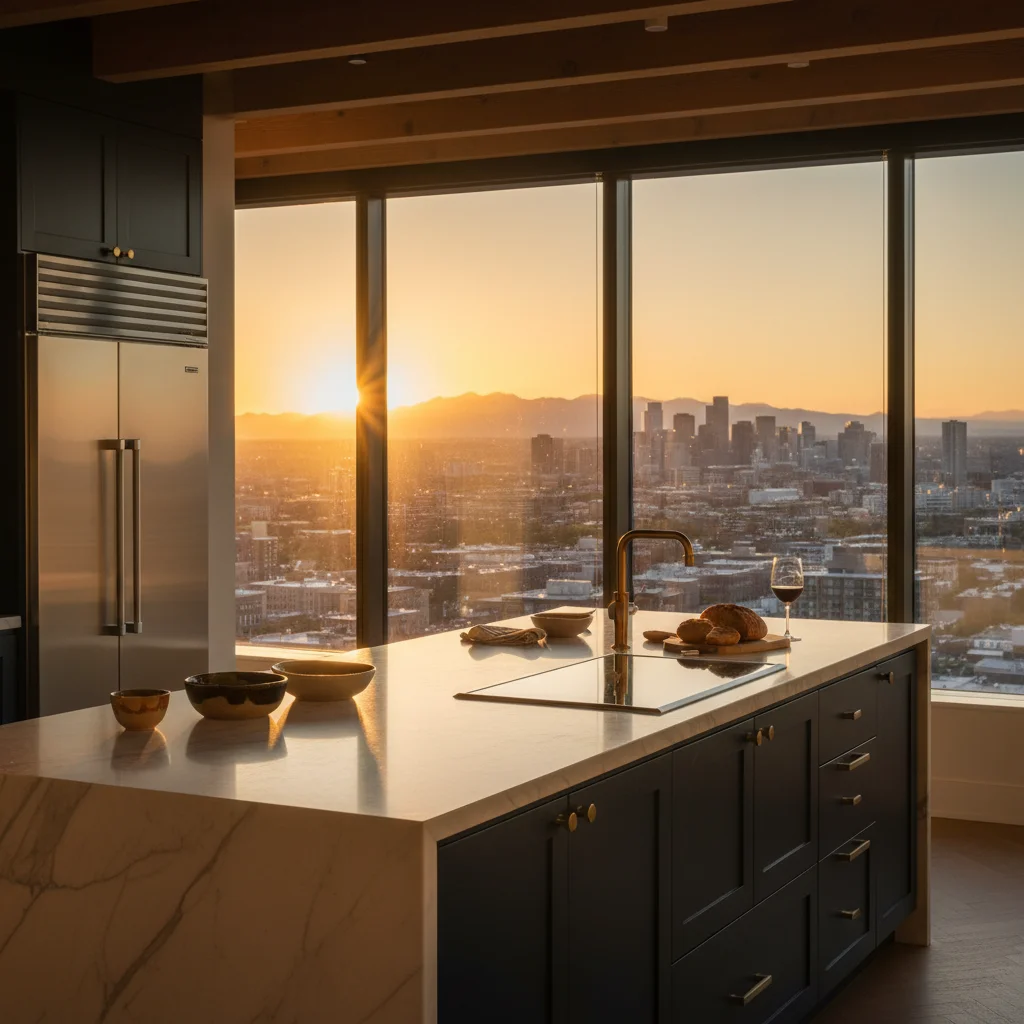
Walk into a LoDo loft and the kitchen tells you the same story almost every time: a hundred-year-old warehouse shell — exposed brick, timber columns, ductwork left honest overhead — wrapped around a kitchen that someone designed down to the millimeter. The refrigeration is rarely a freestanding box you can roll out and walk around. It is an integrated Sub-Zero column made to vanish into custom panels, a pair of undercounter refrigerator drawers slid beneath a stone island, or a panel-ready unit pressed flush against a structural brick wall that was never going anywhere. That is what makes a repair here different from a standard appliance call: the failure is only half the problem. Reaching it without scuffing reclaimed wood, marking a polished-concrete floor, or disturbing the install is the other half.
So the work starts with diagnosis, not disassembly. A warming integrated fridge in a Wynkoop loft could be a tripped fan, a condenser choked with dust pulled in from a busy downtown, a frosted-over evaporator, or a sealed-system fault — four separate repairs at four separate price points. We identify which one it actually is before quoting anything. The $89 diagnostic service call covers that inspection, and it is applied toward the repair if you decide to go ahead.
A quick read on the neighborhood and its appliances
Lower Downtown is Denver’s oldest surviving commercial district — the brick-and-timber warehouses that once stored flour, dry goods, and rail freight, now some of the most sought-after addresses in the city. The blocks around Union Station, Wynkoop, Wazee, Market, and Blake hold a dense mix of loft conversions, newer infill towers, and ground-floor restaurants, all close enough together that delivery trucks, foot traffic, and HVAC churn fill the air with fine grit.
For appliance repair, the building stock shapes the job more than people expect:
- Authentic warehouse conversions built integrated kitchens into spaces with thick masonry walls and limited mechanical chases. Refrigeration often ventilates through a narrow toe-kick grille or a top grille tucked under a soffit, and those airways clog faster downtown than they would in a quiet suburb.
- Open-plan loft layouts put the kitchen on display in the main living space, so a built-in column or a run of undercounter drawers is meant to read as cabinetry, not appliance. Damage during a careless service call is impossible to hide.
- Newer LoDo high-rises near the station favor panel-ready and column refrigeration too, but with their own quirks — shared mechanical walls, freight-elevator-only deliveries, and tight galley footprints where a built-in cannot be pulled more than a few inches forward.
The common thread is access. In most LoDo kitchens, the appliance was installed before the surrounding finishes were locked in, which means servicing it later takes a plan, not a crowbar.
What usually goes wrong — and what’s really behind it
Premium refrigeration and cooking equipment tends to fail in patterns. The symptom you notice is rarely the root cause, and chasing the symptom is how people end up paying for the wrong part. Here is what we see most often in LoDo lofts and what it typically points to.
Refrigeration that drifts warm or runs constantly
An integrated Sub-Zero that is creeping above temperature, short-cycling, or never quite shutting off usually traces back to one of a handful of culprits:
- A condenser packed with dust and downtown grit, choking heat rejection — extremely common given how much airborne debris circulates around LoDo’s streets and rooftop equipment.
- A failing evaporator or condenser fan, so cold air stops moving even though the compressor is running.
- A frosted or iced evaporator from a tired defrost heater, thermistor, or control board.
- A sealed-system or refrigerant issue, which is where Denver’s altitude quietly raises the stakes (more on that below).
Ice makers and water systems that quit
LoDo runs on Denver municipal water, which lands in the moderately hard range — roughly 150–250 ppm. That mineral content steadily builds scale inside ice-maker fill valves, water lines, dispensers, and the small passages of built-in ice systems. Slow ice, hollow or cloudy cubes, a unit that stops making ice entirely, or a slow leak at a fitting are frequently scale and water-supply problems rather than a dead ice maker.
Ranges, ovens, and cooktops that heat unevenly
High-end gas ranges and cooktops are tuned for combustion, and combustion behaves differently at altitude. Burners that run lazy or yellow-tipped, ovens that bake unevenly, or igniters that struggle are worth a proper look — sometimes it is a worn igniter or a failed control, and sometimes it is a unit that was never adjusted for thin Denver air.
Why a specialist matters at 5,280 feet
This is where the geography stops being trivia and starts mattering to your repair. Denver sits a mile up, and the air here holds roughly fifteen percent less oxygen than air at sea level. That single fact ripples through nearly every premium appliance in a LoDo kitchen.
- Sealed refrigeration systems reject heat into thinner air, so a compressor and condenser have to work harder to dump the same amount of heat. A refrigerant charge or sealed-system repair that was correct at sea level can run hot or inefficient here. The right diagnosis accounts for the altitude the appliance actually lives at — not a factory spec written for somewhere lower.
- Gas combustion changes with elevation. Burners, orifices, and air-fuel mixtures on ranges, ovens, and cooktops are sensitive to thin air, which is why a unit that performed perfectly in a coastal showroom can run rich or uneven once it is installed downtown.
- Hard-water scale quietly attacks ice makers, dishwashers, and every water line in between, so what looks like a failed component is often mineral buildup that a generic swap will not fix.
- Denver’s very dry climate ages door gaskets and seals faster than humid regions, and a refrigerator fighting a hardening gasket can read as a cooling problem when it is really a sealing one.
A technician who treats a LoDo Sub-Zero like any other fridge can miss all of this. We diagnose for the building, the water, and the altitude it actually operates in — which is the whole point of calling a specialist instead of a generalist.
What a visit to your loft looks like
We try to make the appointment predictable from the first phone call. Here is the usual rhythm:
- Booking. Call (720) 770-4189 — answered 24/7 — or book online. Tell us the brand, the model if you can find it, and what the appliance is doing. LoDo-specific details help: which building, whether there is a loading dock or freight elevator, and how lobby or fob access works.
- Arrival and protection. The technician arrives in the scheduled window and sets up to protect the kitchen first — floor coverings on concrete or hardwood, padding against exposed brick and custom panels — before anything is moved.
- Diagnosis. We inspect the appliance on site, confirm the real fault rather than the obvious symptom, and factor in the things that matter at altitude and on Denver water. This is what the $89 service call covers.
- Up-front pricing. You get a clear, itemized repair price before any work starts. If you approve it, the $89 is credited toward the total. If you would rather not proceed, there is no pressure and nothing hidden.
- The repair. With your go-ahead, we complete the work using OEM-grade, manufacturer-compatible parts matched to your model and serial, then test the appliance through a full cycle to confirm it is genuinely fixed.
Repairs are performed daily, 8:00 AM to 6:00 PM, and the phone is staffed around the clock so you can reach a person whenever something goes wrong — including the night before a dinner party when the wine column drifts warm.
Straightforward pricing, every time
Pricing in this trade should not be a guessing game. Ours is simple:
- The diagnostic service call is $89, and it is applied toward the repair if you proceed.
- The exact repair price is quoted only after an on-site inspection, because an integrated install and a freestanding unit are not remotely the same job, and only a real look tells us which parts and how much labor.
- No invented phone estimates, no surprise line items. You approve the full price before work begins.
Parts are OEM-grade or manufacturer-compatible, sourced from verified suppliers and matched to your specific appliance — important for premium refrigeration, where a generic substitute on a sealed system or control board is a false economy.
Questions LoDo loft owners ask us
Will you need to pull my integrated fridge completely out of the cabinetry? Often no. Plenty of repairs are reachable through the front grille, the toe-kick, or a service panel without fully extracting the unit. When a column does need to come forward, we do it slowly and with protection in place — your custom panels and the brick around them stay untouched.
My undercounter drawers are built into a stone island. Can they still be serviced? Yes. Undercounter refrigerator and freezer drawers are extremely common in LoDo open kitchens, and most service points are accessible from the front. We confirm the install before we book so there are no surprises on the day.
The kitchen is open to my whole living space — will this be messy? We plan for that. Because LoDo loft kitchens are usually on full display, containment is part of the job, not an afterthought: covered floors, protected surfaces, and a clean workspace from start to finish.
Do you only fix Sub-Zero? No. Sub-Zero and built-in refrigeration are our focus, but we also service premium ranges, cooktops, ovens, and other high-end kitchen appliances found in these lofts.
Ready when your kitchen isn’t
If a Sub-Zero is drifting warm, an ice maker has gone quiet, or a range is running uneven in your LoDo loft, get an honest diagnosis from a specialist who understands these buildings, Denver’s water, and the altitude your appliances actually run at. Call (720) 770-4189 — answered 24/7 — or book online, and we will usually have you on the schedule same day or next. The $89 service call gets a technician to your door and applies straight to the repair if you move forward.