Littleton stretches between two worlds, and its kitchens tell you which one you are standing in. Down by the old streetcar core around Main Street and the Littleton Museum, the homes are historic — narrow rooms reworked over the years to hold a modern slide-in range or a wall oven dropped into reframed cabinetry. Climb west toward Ken Caryl and the hogback, and the picture flips: roomy foothills builds with big kitchens designed around pro-style dual-fuel ranges, double wall ovens, and the built-in refrigeration and wine storage that come with that scale. When the oven at the heart of either kitchen stops heating right, the fix starts the same way — find the actual cause, then say the price out loud before any work begins.
Quick orientation
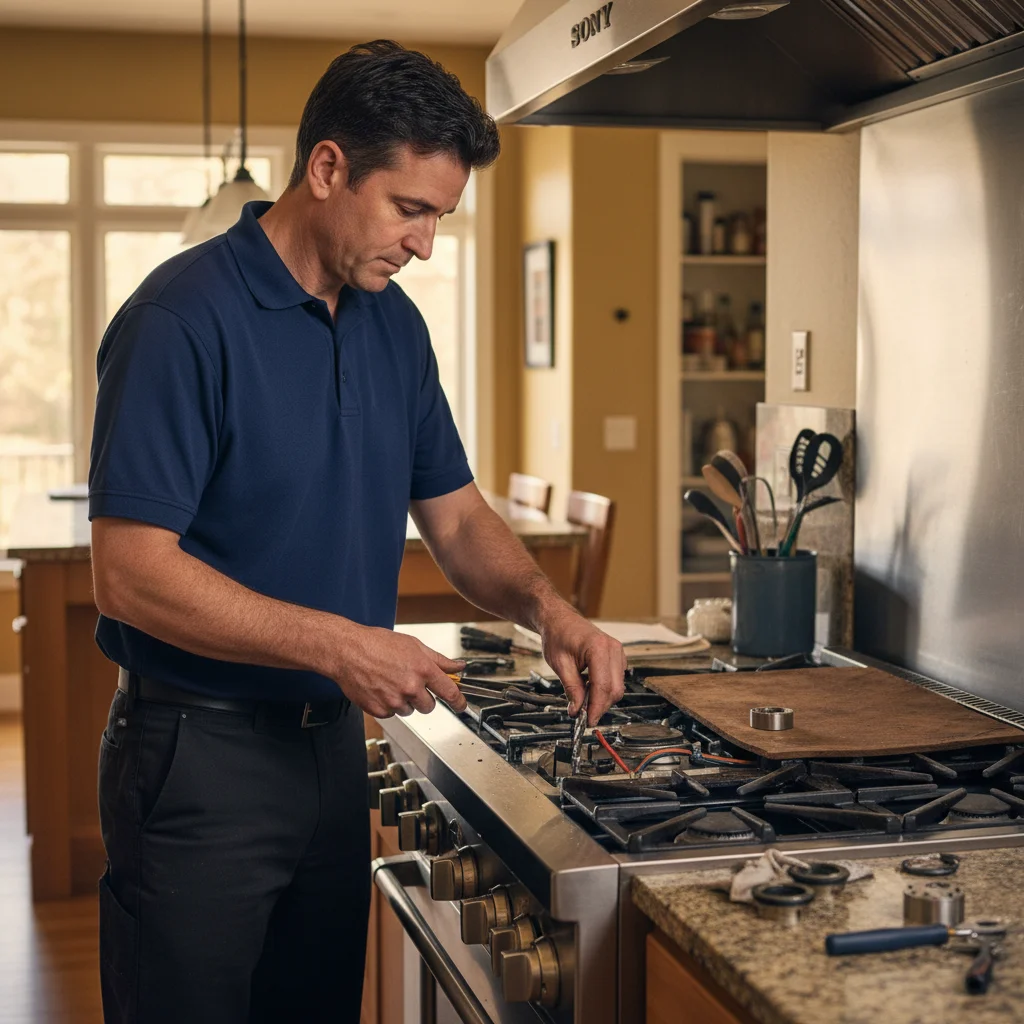
When you call about an oven that will not light, bakes lopsided, or runs hot in Littleton, we do not open with a guess at a part. We reproduce your symptom, pull any stored fault codes, and trace the heat source, the sensing, and the seal as one system. Only then do we name the cause in plain language and quote it. A tight Main Street retrofit and an open foothills kitchen get the same disciplined order: diagnose, confirm, price, fix.
Most common faults
The symptom usually narrows the diagnosis to a short list:
- Delayed ignition or a whiff of gas on light. A tired bake igniter glows too weakly to open the valve on time, letting gas pool before it catches.
- One side of the pan scorched, the other pale. Lopsided baking points to a drifting temperature sensor, a failing convection motor, or combustion thrown off by altitude.
- A cavity that sails past its setpoint. A gasket cracked by the dry climate bleeds heat, so the thermostat keeps chasing and the oven overshoots.
- Self-clean that quits or locks shut. The latch, thermal fuse, or door switch is the usual culprit, not the whole oven.
- A stored fault code you have learned to ignore. On modern boards these are early warnings worth reading, not background noise.
A range that will not heat at all is the urgent one; a slow drift still earns a look before it ruins another holiday dinner.
Parts and longevity
What decides whether a repair lasts is the part that goes back in. We fit OEM-grade and manufacturer-compatible components matched to your model and serial — igniters, elements, gas valves, sensors, convection motors, and control boards — not a generic stand-in that fails again in a season. That matters on Littleton’s foothills ranges, where a model-specific board or sealed-burner assembly is easy to mismatch, and on Main Street ovens reseated into tight millwork, where a second visit means pulling the unit out of the cabinetry all over again.
The altitude and water angle
Two local realities shape how Littleton ovens behave:
- Altitude. At about 5,280 feet the air holds roughly 15% less oxygen, so a sealed burner or range oven set with a sea-level orifice burns rich — lazy, yellow-tipped flames and uneven heat that mimic a broken part but are really a combustion correction. On electric and dual-fuel units, the cavity leans harder on its sensor and fan to compensate.
- Dry, hard conditions. The very dry, high-UV climate stiffens and cracks door gaskets early, forcing the oven to overheat to hold temperature. And the hard water — commonly 150 to 250 ppm — scales the steam reservoirs and proof features on newer ovens and the burner caps on the cooktop side.
We have weighed all three since 2012, across the historic core and the newer subdivisions alike.
How to book
Repairs run daily, 8:00 AM to 6:00 PM, and the phone is answered 24/7 — handy when the oven dies the night before you are hosting. Call (720) 770-4189 or book online, and a technician will reach your Littleton door, Main Street bungalow or foothills custom build, to find the real fault and quote it honestly. The $89 service call covers the full diagnosis and credits toward the repair. Mention a cooktop burner or second oven acting up when you book, and we will handle it in one trip.