A dishwasher rarely quits all at once. In Littleton it tends to drift — a drain that empties a little slower each week, a bottom rack that comes out damp, a faint seep nobody catches until a kick-plate swells. We start every call the same way: trace the actual fault, weigh the local water and altitude, and hand you a firm price before anything comes apart. That diagnostic is $89, and it credits straight toward the repair.
Quick orientation
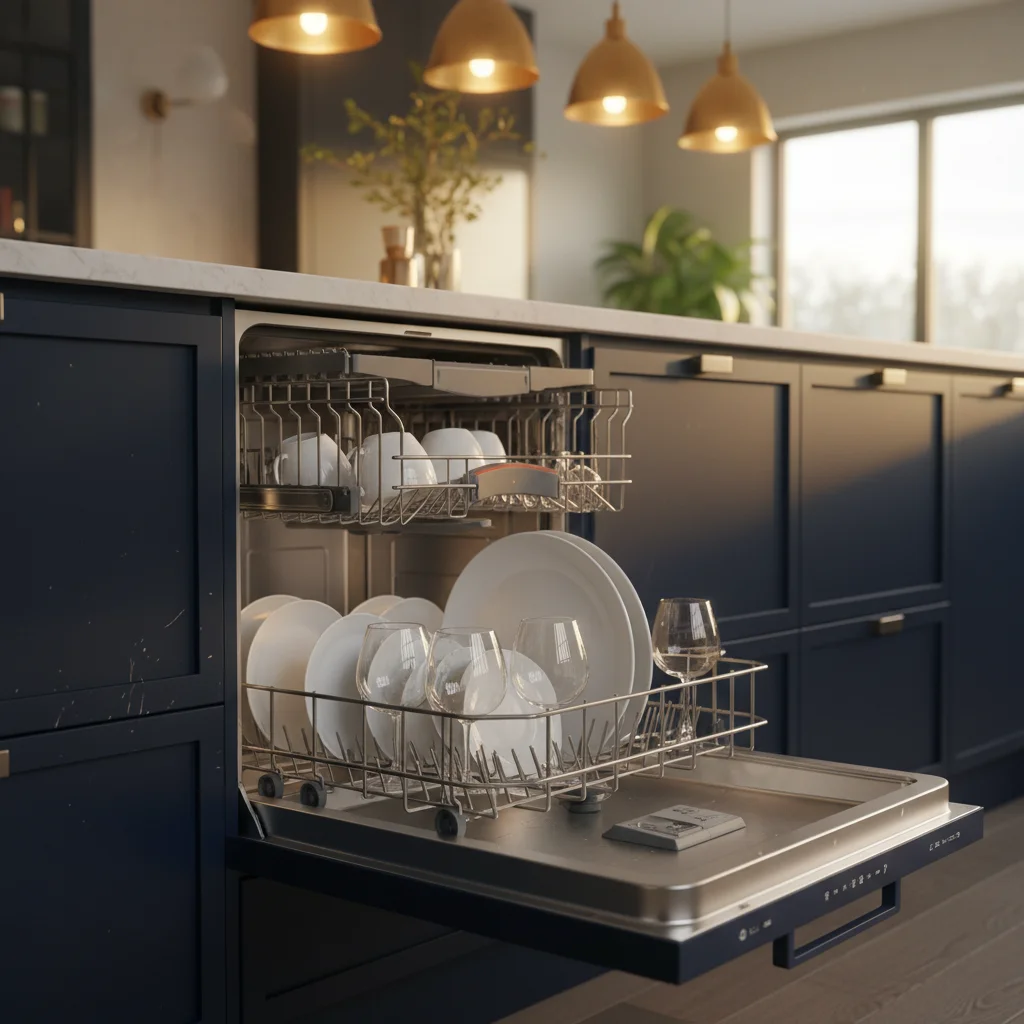
Littleton gives us two very different kitchens, and the dishwasher inside each tells us where we are. Down in the historic core near Main Street and the Littleton Museum, the unit is often a standard built-in squeezed into a remodeled galley that was never laid out for it. Out toward the foothills — Ken Caryl, Roxborough, the builds rising along the hogback — the larger kitchens favor integrated, panel-ready machines framed flush into custom cabinetry, frequently sharing the room with a built-in refrigerator and a wine column. We confirm how yours is mounted before we condemn a single part.
Most common faults
The symptom is seldom the fault itself, but it usually points us in the right direction:
- Standing gray water in the tub after the cycle ends — often a check valve scaled shut, not a dead pump
- Cloudy, gritty, or still-wet dishes that masquerade as a broken heat-dry element
- A unit that won’t start or stalls mid-cycle — door latch, control board, or a thermal fault
- A slow seep onto the floor from a hardened gasket or a weeping pump seal
- Grinding or a burnt smell on the drain stroke, usually a failing pump or trapped debris
- A fill that never completes, mimicking a dead inlet valve when a scaled supply line is starving it
In an older Main Street kitchen especially, a mineral-furred supply line behind remodeled cabinetry can imitate an electrical fault while needing a completely different fix.
Parts and longevity
When a component genuinely needs replacing, we fit OEM-grade and manufacturer-compatible parts from verified suppliers, matched to your exact model and serial — drain pumps, control boards, door latches, gaskets, heating elements, inlet valves, and spray arms. But replacement is the last step, not the first. A scaled element or check valve gets a far longer second life from a proper descale than from a new part installed on the same hard water, so we clean the water path and retest before we quote a swap. The goal is a repair that holds, not one that scales over again by next season.
The altitude and water angle
Three Denver realities sit behind most Littleton dishwasher calls, and we factor all three into every diagnosis:
- Hard water, roughly 150–250 ppm, which scales the spray arms, check valve, heating element, and supply line — the single biggest driver of slow drains, filmy glassware, and weak drying out here.
- Air about 15% thinner at 5,280 feet, which weakens the heat-dry stage, so a unit that dried fine at sea level can leave racks damp in a foothills kitchen.
- A bone-dry, high-UV climate that hardens gasket rubber years early, turning a good door seal into a bottom-edge leak before its time.
We’ve built these factors into how we read a Littleton dishwasher since 2012, across both the historic streets and the newer subdivisions.
How to book
Don’t let a slow drain or a quiet leak soak a Littleton floor or the finished basement below. Call (720) 770-4189 — answered 24/7 — or book online anytime. Repairs run daily, 8:00 AM to 6:00 PM, with most Littleton visits landing same-day or next-day. The $89 diagnostic gets a technician to your door, whether it’s a Main Street bungalow or a foothills custom build, pins down the real cause, and goes straight toward the repair once you give the go-ahead.