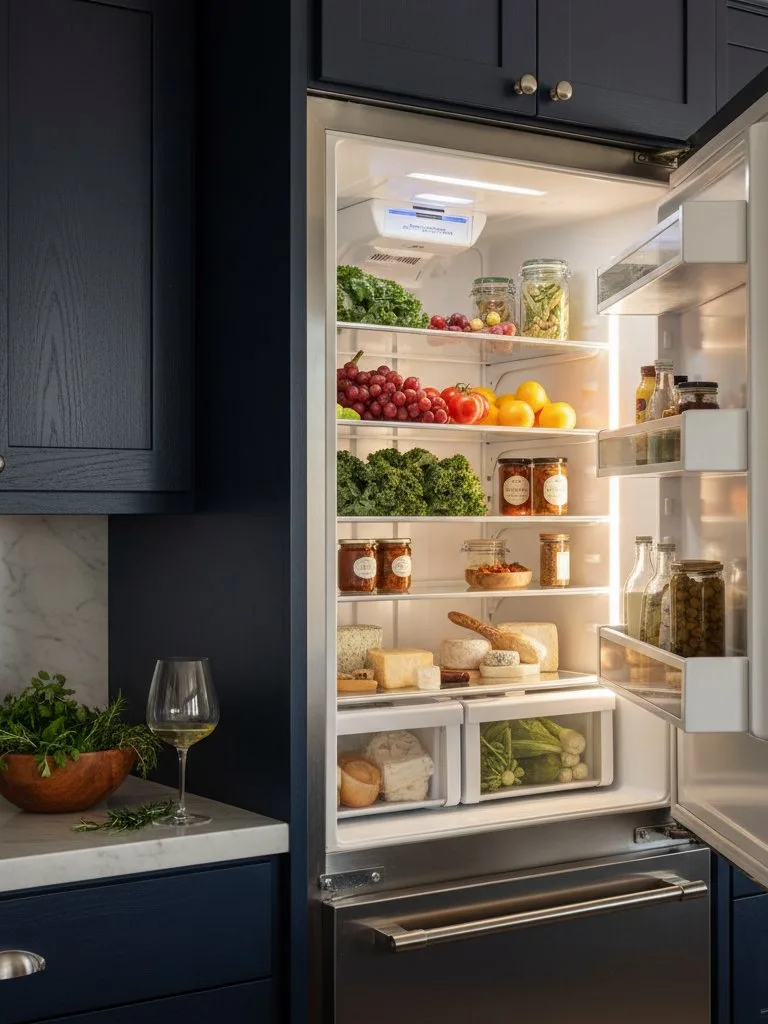
A freezer gives almost no warning before it costs you. No alarm, no code on the door — just a slow slide, over a quiet day or two, from a hard zero toward something soft. By the time the ice cream caves or the cubes have fused into a cloudy slab, the compartment has stopped freezing and started merely chilling. In a Littleton kitchen, where that unit is often a built-in column in a cabinet run or a drawer stack set into an island, the drift hides until the contents give it away. Catching it early is the difference between a part swap and a freezer full of spoiled food.
What you are noticing
Littleton spans two housing worlds, and both put serious freezing in the kitchen. Behind a Main Street facade you’ll find a rebuilt kitchen wrapped around a modern Sub-Zero column squeezed into a footprint a 1920s house never planned for. Push west toward Ken Caryl, Roxborough, and the ground rising under the hogback, and a newer build arrives with a panel-ready freezer, a drawer stack, and freezing wired into a wine room off the island. The early signs are the same across both: a soft pint, hollow ice, frost up the back wall, or a unit that hums without ever pulling the temperature back down.
What it usually means
A freezer that runs but climbs off zero is rarely a mystery once you read it against the system. The short list of real causes:
- A frosted evaporator behind a dead defrost heater or drifting sensor
- A stalled evaporator fan starving the compartment of airflow
- A condenser choked with dust inside a sealed cabinet recess
- A sealed system running slightly low on refrigerant charge
- A hardened door gasket leaking warm room air past the seal
Our approach
Denver factors built into the diagnosis
Two local realities ride along with every Littleton freezer. At 5,280 feet — higher toward the foothills — the air is roughly 15% thinner, so a condenser sheds less heat and a sealed system already low on charge tips over earlier than at the coast. A built-in boxed into millwork feels that hardest. And Denver’s hard water, commonly 150 to 250 ppm, scales up ice-maker fill valves and lines until cubes turn slow and cloudy, while the dry, UV-heavy climate stiffens door gaskets years ahead of a humid region.
How we inspect it and price it
- Confirm the real symptom. We log actual compartment temperature and cycling instead of trusting the door display.
- Read the sealed system at altitude. Condenser, compressor, and charge get checked with thin air in mind, since “normal” shifts here.
- Test the defrost circuit. Heater, sensor, and control board all get checked when frost is the complaint.
- Check airflow and the gasket. A tired fan or hardened seal can mimic a sealed-system fault.
- Trace the water path. On ice-making units we follow the fill valve and lines for scale before quoting.
The diagnostic is $89, credited toward the repair once you approve it. A firm price comes only after the inspection — one clear number, nothing added later.
Coverage and brands
We service the full spectrum of Littleton freezing: integrated columns, under-counter drawer stacks, paired top sections, and the freezing inside wine and beverage rooms — the built-in equipment that fills both historic remodels and foothills custom kitchens. When a part needs replacing, we fit OEM-grade or manufacturer-compatible components from verified suppliers, matched to your exact model and serial. Getting the right part in on the first trip matters double here, since a return means navigating the same tight cabinetry or flush panels all over again.
A freezer rarely fails next to a working everything-else. While on site we can also look at the refrigerator, the wine cooler anchoring these rooms, and the dishwasher fighting the same hard water.
Get it fixed
Don’t wait for a drifting freezer to give out — a built-in holds a lot of food, and a stocked wine room holds far more in value. Call (720) 770-4189 any time; the phone is answered 24/7. You can also book online. Repairs run daily from 8:00 AM to 6:00 PM, the diagnostic is $89, and that amount is credited toward the repair once you approve it. Serving the southwest metro since 2012, Littleton is exactly the work we’re built for.