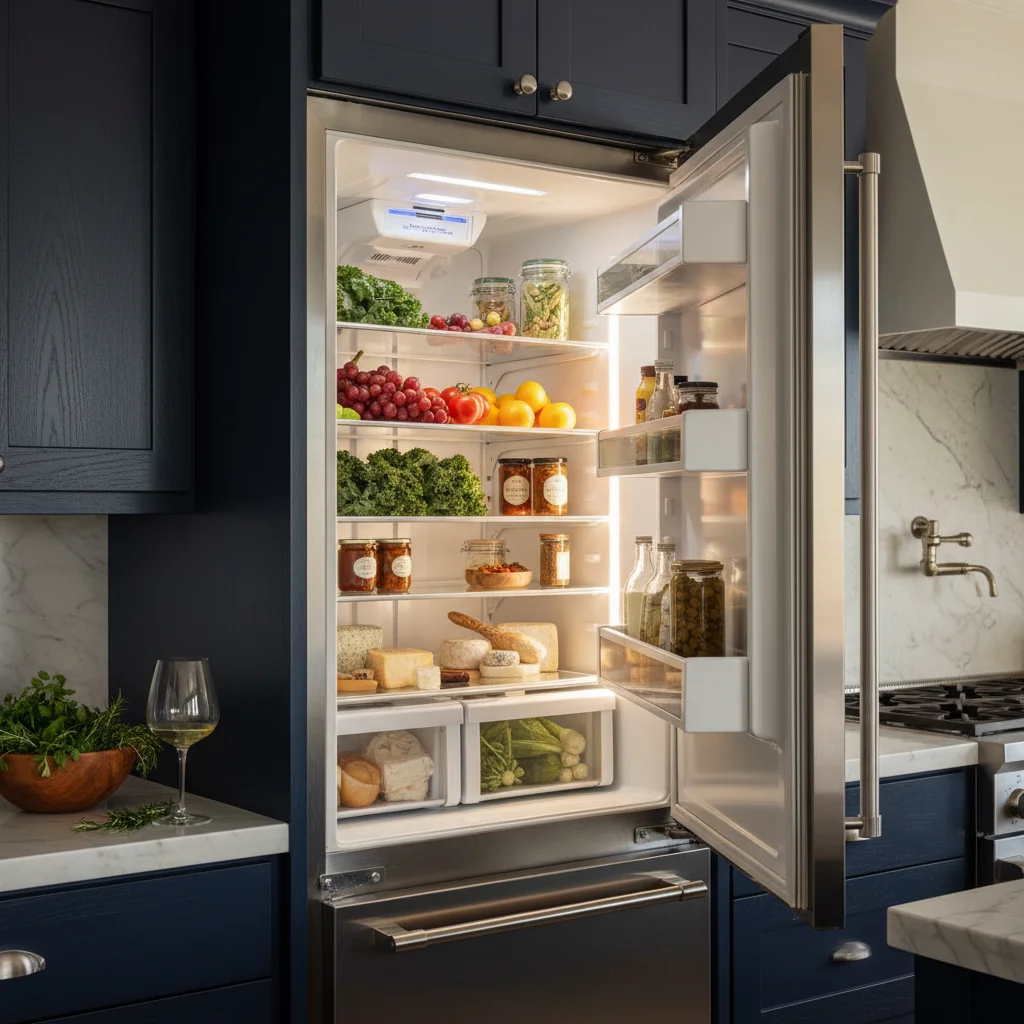
When a built-in column starts losing the room
Most refrigerator calls out here begin the same way: a Highlands Ranch homeowner notices the milk warming on the fresh-food side while the freezer still feels fine. In a flush-set built-in — the kind these master-planned kitchens were designed around — that split almost always traces to airflow or the sealed system, not to a door left ajar. The evaporator fan stalls, the condenser coil packs with dust, a start relay weakens, or a small refrigerant leak quietly drops the charge. We figure out which one before anything gets pulled from the millwork.
The mile-high reason it shows up here first
Highlands Ranch sits on the rolling ground south of C-470, up near 5,900 feet, and that elevation is the quiet villain behind a lot of these failures.
- Thin air, less heat rejection. Air this high is roughly 15% less dense, so a condenser dumps heat more slowly. A tall column boxed into deep cabinetry has almost no margin to begin with, so it crosses the line into “running warm” sooner than the same unit would in a flatland kitchen.
- Hard water, scaled lines. At 150 to 250 ppm, local water leaves mineral crust in ice-maker fill tubes, inlet valves, and dispenser lines across these neighborhoods.
- Dry, sun-baked air. Denver’s low humidity and strong UV stiffen door gaskets faster than owners expect, so a seal cracks early and the compressor fights to hold temperature.
That combination is exactly why we read clearances and the refrigeration circuit as one system instead of reaching for a gauge set first.
How the diagnosis actually runs
- We log real fresh-food and freezer temperatures and look at how the unit sits in the cabinet — top vent and toe-kick exhaust get checked before anything else.
- We pull any stored fault codes, then trace the condenser, evaporator, compressor, fans, and defrost parts together as a single path.
- We test the suspect electrical parts while the fridge is running, so the part we replace is the one that genuinely failed — not a guess.
- We explain the cause in plain language and hand you one firm price. The repair number is set only after this inspection, never blind, never padded later.
Parts and faults we handle on these units
Condenser and evaporator fan motors, clogged or failing condenser coils, compressors and start relays, defrost heaters, sensors, and control boards, blocked defrost drains, brittle door gaskets, mineral-choked inlet valves and water lines, and scaled-up ice makers. Whether it is a freestanding side-by-side, a panel-ready integrated box, a set of refrigeration drawers, or a six-foot column, the diagnostic approach is the same.
Booking a same-day Highlands Ranch visit
A fridge that is barely slipping is the cheap fix; the one ignored for a week rarely is. Call (720) 770-4189 — answered 24/7, with repairs run daily 8 AM to 6 PM — or book online, and a technician will be at your Highlands Ranch door to find the real cause and quote it up front, with the $89 service call credited toward the work.