Highlands Ranch grew as one of the largest master-planned communities in the metro, and that planning shows up most clearly in the kitchens: big two-story homes drawn around a full built-in cooking suite, with the oven engineered into the room rather than parked against a wall. That is the difference this page is about. A stacked wall-oven tower or the cavity inside a professional range is not the freestanding unit a big-box tech swaps in an afternoon — it carries more heat, more sensing, more control logic, and far more cabinetry between a technician and the part that failed.
What this repair involves
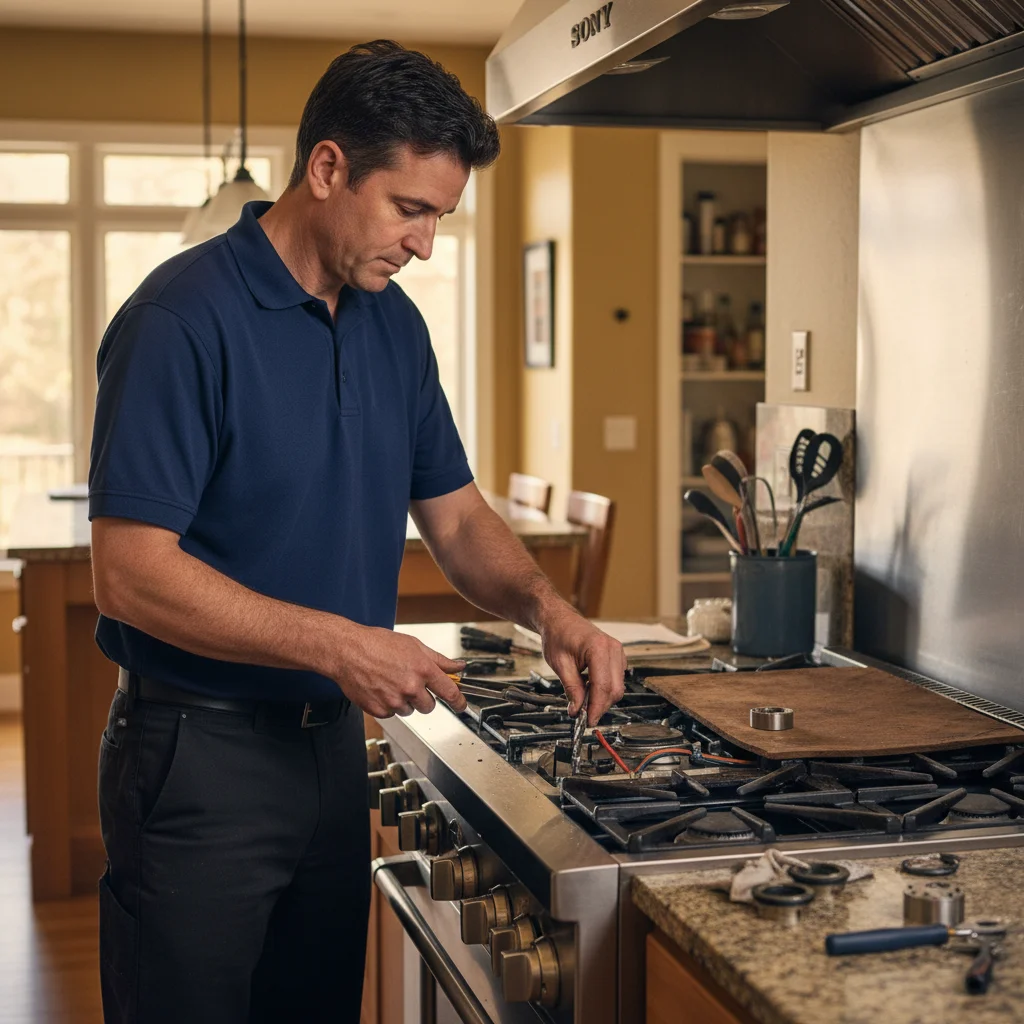
A double wall oven flush-set into Highlands Ranch millwork behaves nothing like a slide-in range. You are usually looking at two cavities stacked in a tower, or the oven inside a high-BTU gas range anchoring an island kitchen. One control board has to choreograph the bake element, the broiler, the convection fan, and the temperature probe at the same time, so a break anywhere along that chain surfaces as a baking problem.
Faults we trace most often
In these south-metro kitchens, the recurring culprits are:
- Slow ignition or a faint whiff of gas on light. A weak bake igniter glows too dimly to open the valve in time, letting gas linger before it catches.
- One edge of the sheet pan scorched, the other pale. Lopsided baking usually means a drifting temperature sensor, a tired convection motor, or combustion knocked off by the altitude.
- A cavity that blows past its setpoint. A gasket hardened by the dry climate bleeds heat until the thermostat keeps chasing and the oven runs hot.
- Self-clean that aborts or locks shut. The latch, thermal fuse, or door switch is almost always the cause — not the entire oven.
- A stored fault code you have learned to ignore. On a dual-cavity board, those are early warnings worth reading.
Inspection and honest pricing
The diagnostic service call is $89. It buys a full on-site inspection, and it comes straight off the total the moment you approve the repair. We set the repair price only after a technician has actually seen the oven, because Highlands Ranch kitchens hold too wide a range of equipment for an honest phone estimate. A visit runs in this order:
- Reproduce and read. We recreate your symptom and pull any stored fault codes before assuming anything.
- Work the heat source. On gas and dual-fuel ovens we measure igniter draw and check combustion with the altitude correction in mind; on electric cavities we test the bake and broil elements directly.
- Verify sensing and control. We compare the probe against a reference and inspect the board for heat damage.
- Quote before opening up. You get a firm number first, with the $89 credited toward the work. The price you approve is the price you pay.
Why elevation and water change the job
Two local realities a sea-level checklist skips matter here. The air above 5,900 feet holds roughly 15% less oxygen, so a sealed burner or a range oven set with a sea-level orifice burns rich — lazy, yellow-tipped flames and patchy heat that mimic a broken part. On dual-fuel units the electric cavity then leans harder on its sensor and fan to compensate. Layer on Colorado’s very dry air and strong UV, which stiffen door gaskets years early, plus the hard 150–250 ppm water that scales the steam systems on many higher-end ovens, and you get heat behavior no generic playbook predicts.
Related repairs nearby
Built-in ovens rarely fail alone in these suites. While we are out, we also handle pro-range cooktops, warming drawers, column refrigeration, and panel-front dishwashers — just mention the second appliance when you schedule and we will cover it in one trip.
Book your repair
Repairs run daily, 8:00 AM to 6:00 PM, and the phone is answered 24/7 — handy when the oven quits the night before you are hosting. Call (720) 770-4189 or book online today. A technician will reach your Highlands Ranch door, find the real fault, quote it honestly, and credit your $89 service call toward the fix.