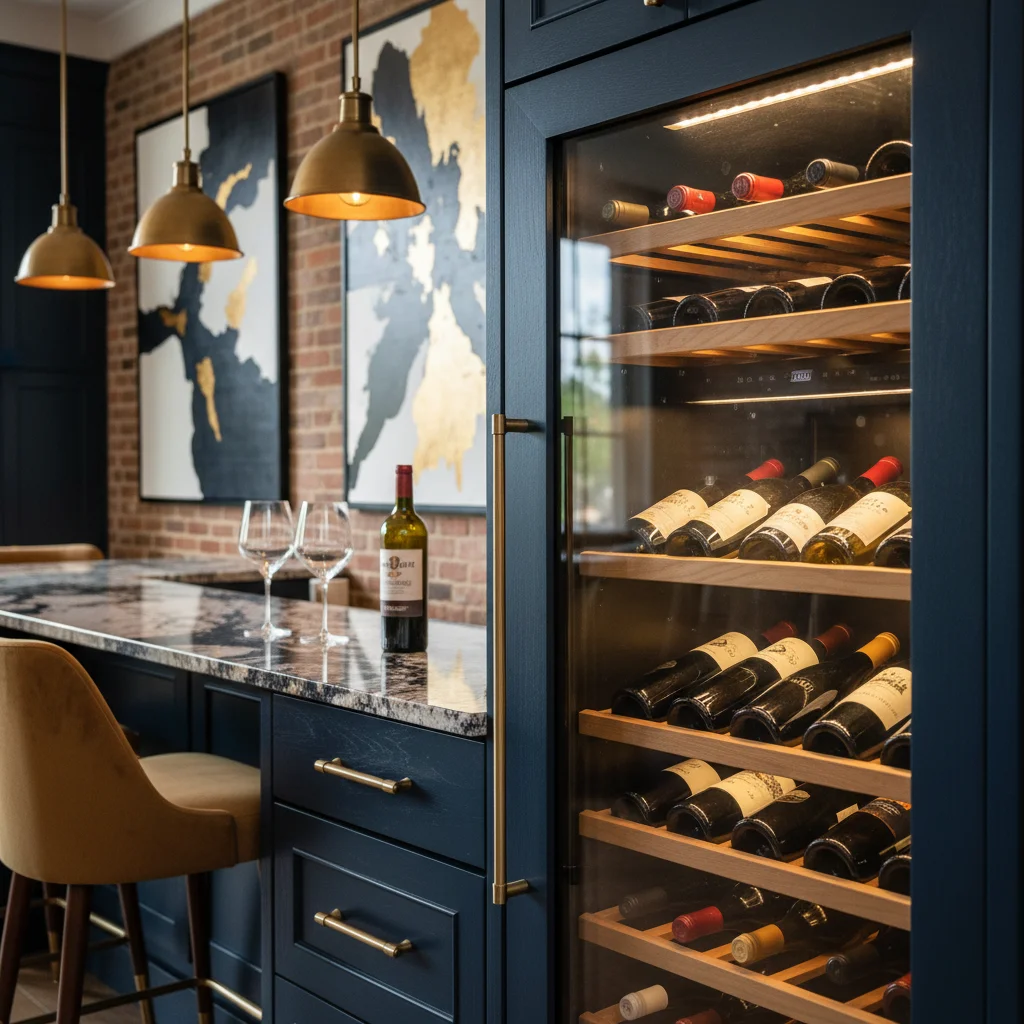
A wine column that has quietly held 55 degrees for years, then reads 61 on a Tuesday, is easy to put off — the light still glows, the fan still hums, nothing is leaking. But in a Centennial collection that slow climb is the whole problem, because the first unmistakable sign of trouble is often a lifted cork or a flat, oxidized pour. Every week you wait, the rack keeps baking a degree at a time. Get a technician to the unit, pin down what actually changed, and the fix is usually a single part — not a ruined cellar.
What you are seeing
Centennial’s older subdivisions off Arapahoe and Dry Creek, and the larger homes feeding the Cherry Creek schools, tend to share one trait: tall two-story kitchens laid out around full built-in suites. The wine unit is rarely a freestanding box here — it’s a panel-ready column framed into millwork or a bank of under-counter drawers. The complaints we hear most:
- The cabinet won’t hold its set point, or one zone of a dual-zone runs warm while the other stays put.
- A new hum, buzz, or vibration telegraphing through custom cabinetry in an otherwise quiet kitchen.
- Frost on the back wall, condensation sweating across the glass door, or water collecting at the base.
- Lights and display look normal, but cooling never kicks in, or the unit short-cycles without pulling down.
What it usually means
A warm column in one of these kitchens is really two questions: what failed inside the unit, and what is the cabinetry around it doing to it. A cooler boxed flush into deep millwork chokes its own condenser airflow, so we rule the exhaust path in or out before touching the sealed system. A buzzing column is often a failing fan motor or a worn compressor mount. Frost and sweat usually trace to a gasket gone brittle. A unit that runs but never cools points at a control board, a relay, or a genuine refrigerant fault — and those can look identical from the outside, which is exactly why guessing wastes your money.
Our approach
Diagnose to one part
The $89 diagnostic gets a technician to your door. We measure actual cabinet temperature, check how the unit sits in its opening, pull any stored fault codes, and test the condenser, evaporator, fans, and compressor as one circuit. You get the cause in plain language and one firm price before a panel ever moves.
Read the Denver conditions
At 5,280 feet the air is roughly 15% thinner, so every condenser sheds noticeably less heat than its maker assumed at sea level. Wedge that condenser into tall Centennial cabinetry and the margin between steady cellar temperature and a slow drift gets razor-thin. The dry, high-UV climate hardens door gaskets early — the usual story behind frost and a sweating door. And on units with humidity control, hard local water near 150–250 ppm scales the humidifier lines until flow chokes. We read all three into the diagnosis.
Fix it to last
What decides how long a repair holds is the part that goes back in. We match OEM-grade or manufacturer-compatible components to your model and serial — compressors, fan motors, thermistors, dampers, control boards, and gaskets — so a flush-set column doesn’t earn you a second service call.
Coverage & brands
We cover every Centennial neighborhood, from the Tech Center edge to Smoky Hill, and we open built-in wine columns, dual-zone coolers, under-counter drawers, and integrated cellar units across the major built-in and luxury brands. Panel-ready installations are routine for us, and we protect the surrounding cabinetry and stone on every visit.
Get it fixed
The longer a wine cooler runs warm, the more the rack pays for it. Call (720) 770-4189 — answered 24/7, repairs run daily 8 AM to 6 PM — or book online anytime. The $89 diagnostic brings a technician to your Centennial door, pinpoints the real cause, and credits toward the repair the moment you approve it.