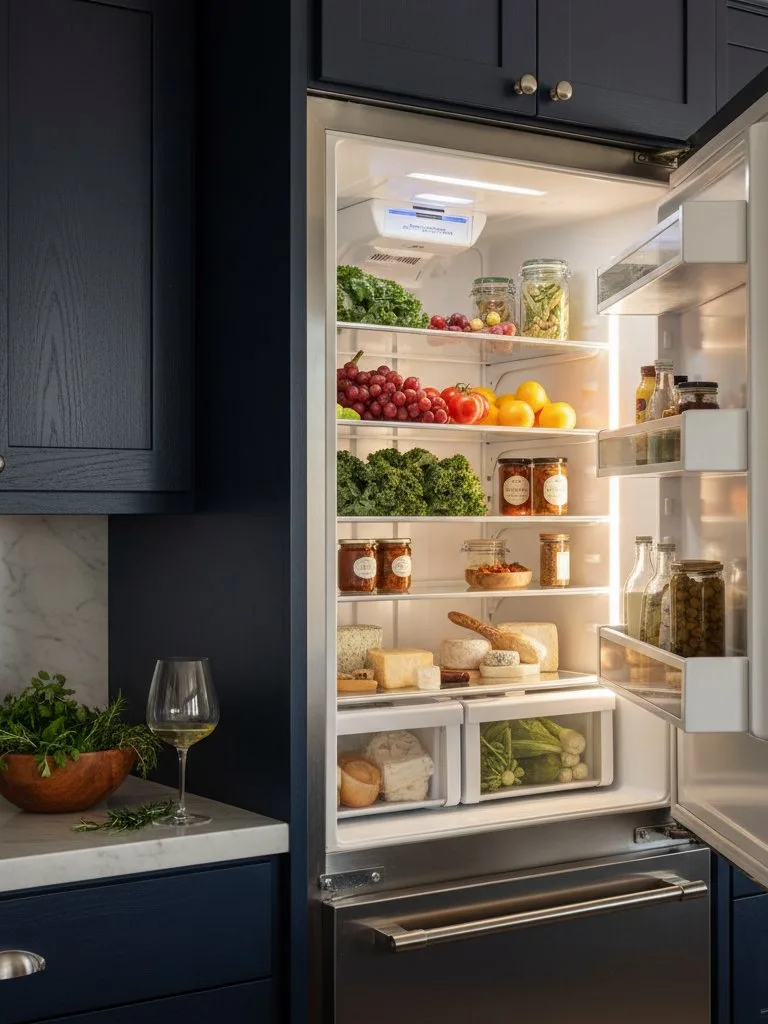
When a builder framed out a two-story in Walnut Hills, Piney Creek, or one of the Cherry Creek school subdivisions, the kitchen was almost never planned around a freestanding freezer. It was planned around a suite — a freezer column flush with the cabinets, a refrigerator beside it, and often a drawer set tucked into the island. That design choice is exactly why a warming freezer in Centennial is rarely a simple swap. We come out, read the sealed system and defrost circuit against this region’s altitude and water, and put one honest price in front of you before a single panel comes off.
What goes wrong on a built-in freezer here
The integrated units that fill these kitchens have tight refrigerant loops and condensers buried in millwork, so the failures cluster differently than they would on a garage upright. The short list we chase:
- Defrost failure. A dead heater, a drifting sensor, or a confused control board lets frost sheet across the evaporator until airflow chokes and the box warms.
- A stalled evaporator fan. Cold is being made but never moved, so the compartment climbs while the coil itself stays iced.
- A smothered condenser. Cabinet dust packs the coil, heat stops leaving, and the compressor labors and overheats.
- A charge running low. Even a slight refrigerant shortfall keeps the unit from reaching zero, and at altitude that shortfall bites harder.
- A gasket past its prime. A hardened door seal pulls in warm room air and quietly feeds the frost cycle all over again.
The inspection and what you pay
We do not guess prices over the phone, because two columns from the same brand can need wildly different work. Here is the sequence:
- You tell us the basics — brand, symptom, and which part of Centennial you are in, so we arrive with the right access plan for a panel-ready install.
- We test cold and airflow together — charge, compressor, both fans, and the full defrost circuit, read against a mile-high baseline rather than a sea-level chart.
- We trace frost, water, and seals — the defrost heater and sensor, the gasket, and on any ice maker the whole path from fill valve to mold.
- We hand you one number before work starts. The $89 diagnostic is credited toward that total the instant you approve it.
Why Centennial’s altitude and water change the diagnosis
At better than 5,280 feet, the air over Centennial is about 15% thinner than at sea level, so a freezer’s condenser rejects measurably less heat. A built-in already boxed inside cabinetry feels that penalty most, and a sealed system carrying a marginal charge tips over here long before it would near the coast. We factor that thin air into every reading, which is the difference between a real fix and a quick part swap that fails again by next season.
The water adds its own layer. South-metro supply runs hard, around 150 to 250 ppm, and that mineral load scales the fill valve, line, and mold on any ice-making freezer until cubes slow and cloud over. Pair that with the dry climate stiffening door gaskets early, and you have two Front Range factors that a sea-level technician would never think to check.
Related repairs we handle nearby
A freezer rarely fails in isolation in these full-suite kitchens. We also service the matching refrigerator column, the dishwasher fighting the same hard water, and the built-in range or wall oven whose gas orifices were sized for thinner air. If more than one unit is acting up, mention it when you book and we will look at the whole suite in one visit.
Get your freezer fixed
If a stocked built-in is drifting warm, do not wait for it to thaw. Call (720) 770-4189 any time — the phone is answered 24/7 — or book online. Repairs run daily from 8:00 AM to 6:00 PM, the on-site diagnostic is $89, and it comes straight off your repair once you approve the work.