Why a built-in fridge quits in these kitchens
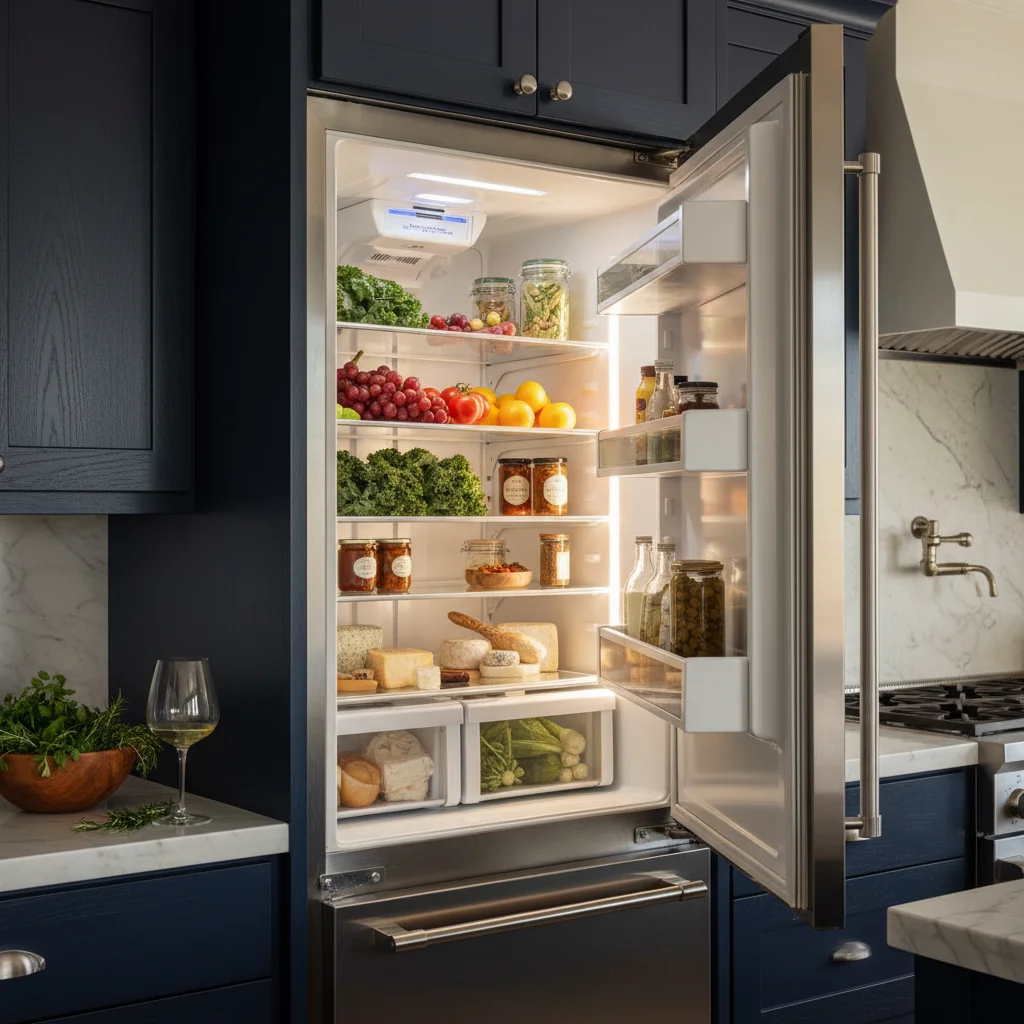
Centennial’s housing stock leans toward roomy two-story homes, and the kitchens that anchor them were laid out around tall built-in refrigeration — six-foot columns, integrated drawers, and panel-ready units set flush into deep cabinetry. That design looks seamless and it cools beautifully, right up until the day it doesn’t. When a fridge in one of these kitchens starts drifting, the usual culprits are predictable: a condenser smothered in dust, an evaporator or condenser fan that has stalled, a worn start relay, a defrost cycle the control board has lost track of, or a slow leak in the sealed system. Because the unit is boxed into millwork, a restricted exhaust path is almost always the first thing we rule in or out.
The symptom usually tells us where to look:
- The fresh-food compartment warms while the freezer still reads cold
- The compressor runs nonstop yet the cabinet feels warm to the touch
- Frost sheets across the back wall of the freezer
- Ice arrives cloudy, undersized, or barely at all
- Water pools under a drawer unit or beneath the crisper
- A door no longer seats tight, or the gasket feels stiff and cracked
Denver factors that push these units over the edge
Centennial shares the metro’s mile-high elevation, and that thin air is the quiet reason a borderline fridge finally fails. At 5,280 feet the air is roughly 15% less dense, so a condenser sheds heat noticeably slower than the same unit would at sea level. Tuck that condenser behind a column wedged into tall cabinetry, and the heat it can’t reject builds inside the cabinet — which is exactly why we read airflow and the refrigeration circuit together instead of jumping to refrigerant.
Two more local conditions shape the work here. The water runs hard, commonly 150 to 250 ppm, and that scale chokes ice makers, dispenser lines, and inlet valves across these subdivisions. And Centennial’s dry, high-UV climate hardens rubber faster than most owners expect, so a door gasket that should last years can crack early and leave the compressor fighting to hold temperature.
How we run the diagnosis
The diagnostic service call is $89, credited toward the repair when you approve it. Here’s the order we work in:
- We measure actual fresh-food and freezer temperatures and inspect how the unit sits in its cabinet — clearances and the exhaust path read first.
- We pull any stored fault codes and trace the condenser, evaporator, compressor, fans, and defrost components as a single system.
- We test electrical parts while the unit is running, so the component we replace is the one that genuinely failed.
- We explain the cause in plain language and hand you one firm price before a single part comes off.
Components we service
A column drifting warm points us at the condenser, the fans, the start relay, or the sealed system. Frost on the freezer wall usually traces to a defrost heater, a sensor, or a board mistiming the cycle. Cloudy ice and a weeping line are almost always scale at the inlet valve. A door that won’t seal is a gasket gone brittle. We service all of it — compressors, evaporator and condenser fan motors, defrost heaters and thermostats, control and inverter boards, water inlet valves, ice makers and dispensers, and door gaskets — on built-in columns, integrated panel-ready units, refrigeration drawers, and freestanding side-by-sides alike.
Same-day scheduling in Centennial
When a refrigerator slips, the early fix is the cheap one. Call (720) 770-4189 — answered 24/7, with repairs run daily 8 AM to 6 PM — or book online, and a technician will be at your Centennial door to pin down the real cause and quote it up front.