A built-in oven is the one appliance a Centennial kitchen cannot route around. In the two-story homes that fill the subdivisions near the Denver Tech Center and the Cherry Creek school neighborhoods, the oven is engineered into the room — a stacked tower or the cavity inside a pro range, framed by custom millwork. So when it quits the week of a dinner party, there is no countertop substitute. Worse, the faults that look minor rarely stay minor: a sluggish igniter that fires late today fails outright next month, and a hardened gasket that leaks heat keeps the board straining until it cracks. The smart move is to read the fault while it is still one part.
What you are noticing
Most Centennial oven calls start with a symptom the cook has worked around for a week or two:
- It lights slowly, or there is a whiff of gas on ignition. The bake igniter glows too weakly to open the gas valve on time, so fuel pools before it catches.
- One edge of the sheet pan scorches while the other stays pale. Heat is landing unevenly across the cavity.
- The oven sails past its setpoint and runs hot. It overshoots no matter what you dial in.
- Self-clean stalls or the door locks shut and stays shut. The cycle starts but never releases.
- A fault code keeps flashing and you have learned to dismiss it. On a dual-cavity board, that code is an early warning.
What it usually means
These symptoms trace back to a short list of culprits, and Centennial’s location shapes which one is likely. The thin air at this elevation carries roughly 15% less oxygen, so a sealed burner or a range oven set with a sea-level orifice burns rich — lazy flames and patchy heat that imitate a broken part. On dual-fuel units the electric cavity then drives its sensor and convection fan harder to keep pace. Add Colorado’s very dry air and strong UV, which stiffen gaskets early, and an oven flush-paneled into a tight cabinet that traps its own vented heat, and you get behavior no sea-level checklist predicts. So slow ignition points at the igniter; uneven baking at the sensor, fan, or combustion tune; overshoot at the gasket or thermostat; a stuck cycle at the latch, thermal fuse, or door switch.
How we work the problem
Reproduce and read first
We recreate your symptom and pull any stored fault codes before touching a part, so we diagnose the failure you actually have.
Test the heat source
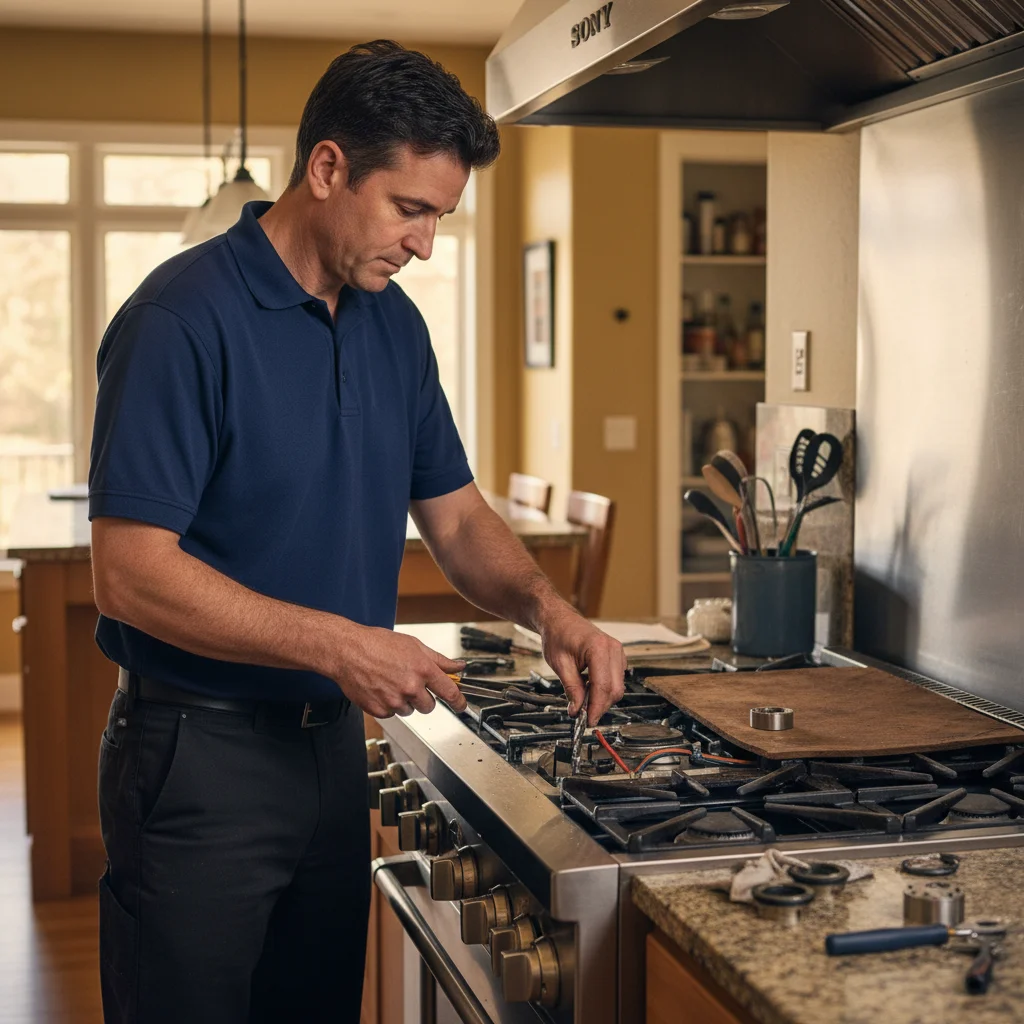
On gas and dual-fuel ovens we measure igniter draw and check burner combustion with the altitude correction in mind. On electric cavities we test the bake and broil elements directly.
Verify sensing, control, and seal
We compare the temperature probe against a reference, inspect the board for heat damage, and check the hinges, self-clean latch, and worn gasket — since a heat leak mimics a calibration fault.
Quote before anything comes apart
You get a firm price up front. The $89 service call covers the full on-site inspection and comes off the total the moment you approve the repair. We never price a Centennial oven blind over the phone, because these kitchens hold too wide a spread of equipment for an honest guess.
Coverage and equipment
We cover all of Centennial — the Tech Center-adjacent subdivisions, the Cherry Creek school neighborhoods, and the communities further out like Piney Creek, Foxridge, Willow Creek, and Smoky Hill — and we work on built-in wall ovens, stacked double-oven towers, warming drawers, and gas and dual-fuel pro ranges. Parts are OEM-grade and manufacturer-compatible from verified suppliers, matched to your exact model and serial so a flush-set oven does not come back out twice.
Get it heating right again
Mention a second oven, a warming drawer, or a misbehaving range burner when you book, and we handle it in one trip. Repairs run daily, 8:00 AM to 6:00 PM, and the phone is answered 24/7 — useful when the oven dies the night before you host. Call (720) 770-4189 or book online today. A technician will reach your Centennial door, find the real fault, quote it honestly, and credit your $89 service call toward the fix.