
A repair team that respects how Bonnie Brae kitchens were built
There is a particular feeling to Bonnie Brae that you notice the moment you turn off the grid of surrounding Denver and onto its curving, almost park-like streets. The lanes bend instead of running straight, the lots are generous, and the brick bungalows sit back behind mature trees that the rest of the city would envy. At the heart of it all is Bonnie Brae Ice Cream, the little corner institution that gives the neighborhood its name in most people’s heads — the kind of place where the line spills onto the sidewalk on a warm evening and everyone seems to know the order in front of them.
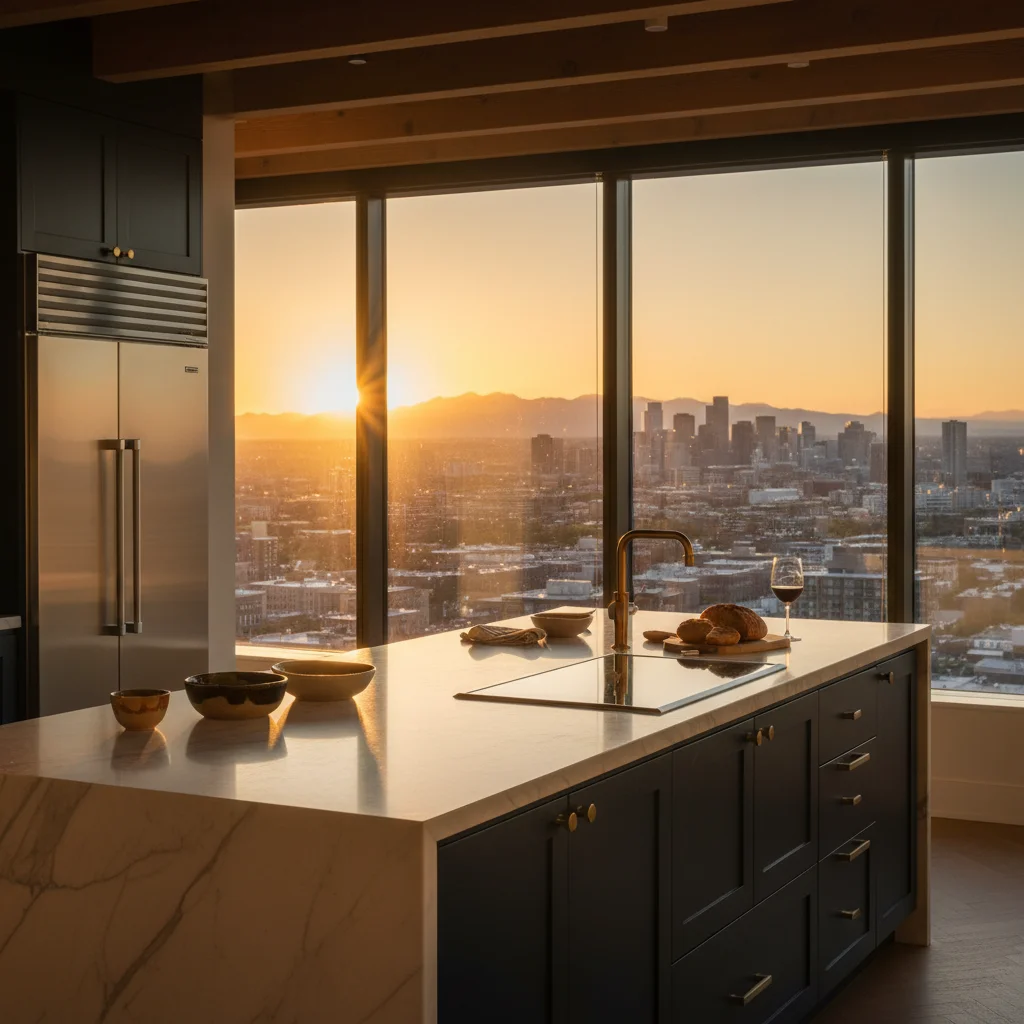
That mix of charm and care extends straight into the kitchens. Bonnie Brae is a neighborhood of careful remodels. Many of the original 1920s and 1930s bungalows have been opened up, expanded, or rebuilt from the studs, and when that happened the owners almost always chose premium, integrated appliances to suit the result: a built-in Sub-Zero column tucked flush with custom cabinetry, a professional gas range as the centerpiece, a panel-ready dishwasher you can barely find unless you know where the handle is. These are not appliances you yank away from the wall for a quick part swap. They are designed into the room.
So before anyone talks about parts or price, the real job is to understand what actually failed and how to reach it without disturbing the careful kitchen built around it. That is the whole approach: diagnose the true cause, not the first symptom that catches the eye, then give you an honest, up-front number before any work begins. The $89 diagnostic service call covers that inspection and is applied toward the repair if you decide to go ahead.
Quick orientation: the neighborhood and its kitchens
Bonnie Brae is a compact, well-defined pocket of south-central Denver. It curls around the small commercial node near University Boulevard and Ohio Avenue — the block with the ice cream shop and a handful of neighborhood storefronts — and spreads outward along streets that famously curve rather than follow the usual rectangular plat. To the west it runs toward Washington Park; to the south and east it blends into Cory-Merrill, Belcaro, and the University corridor. It is small enough to feel like a single place and old enough to have real architectural character.
For appliance repair, the housing stock tells the story:
- Restored and expanded bungalows. The original Tudor-influenced and brick bungalows are the backbone of the neighborhood. When these were remodeled, premium refrigeration and ranges were often dropped into cabinet runs that had to be designed around them — which means tight, deliberate installs rather than the wide-open clearances a freestanding unit assumes.
- Pop-top and scrape-and-rebuild homes. A number of lots have been added onto or rebuilt entirely, and these newer kitchens were frequently planned from the start around a full premium suite: a built-in column fridge, a pro-style gas range, an integrated dishwasher panel, and sometimes a wine or beverage column in the island.
- Panel-ready, integrated everything. The aesthetic here leans toward appliances that disappear. Custom panels matched to the cabinetry hide refrigerators and dishwashers, which is beautiful to live with and demands a careful hand to service.
- Generous but considered kitchens. Unlike the cramped galleys of denser Denver neighborhoods, Bonnie Brae kitchens often have room — but they were styled with intent, so a scuffed panel or a marked floor is exactly the kind of thing a remodel was meant to avoid.
We service all of it. The common thread across Bonnie Brae is premium appliances built into kitchens people clearly cared about — and that rewards a specialist over a general handyman.
Most common faults we diagnose in Bonnie Brae
Across the neighborhood’s remodeled bungalows and rebuilt homes, a familiar set of failures comes up again and again. Here is what we most often find:
- A built-in refrigerator that drifts warm. Frequently a dust-clogged condenser, a failed evaporator or condenser fan, a worn start relay, or — less often — a sealed-system refrigerant fault. In a flush, integrated Bonnie Brae install, the condenser can choke on dust because airflow around the cabinet is already snug.
- Ice on the back wall of the freezer. Usually a defrost heater, a defrost sensor, or a control board mistiming the defrost cycle.
- A compressor that runs and runs without cycling off. Often a dirty condenser, a tired fan, or a door gasket that has stopped sealing — something Denver’s dry air tends to speed along.
- Ice makers that slow, jam, or turn out cloudy, undersized cubes. Extremely common here, and almost always scale from the hard local water.
- A gas range or cooktop with lazy, yellow-tipped, or uneven flames. This is often a combustion-and-altitude matter rather than a broken burner — more on that below.
- An oven that will not hold its set temperature. Igniter, temperature sensor, or control-board faults are the usual culprits.
- Water pooling under a fridge or dishwasher. Commonly a blocked defrost drain, a cracked drain pan, or a scaled-up water line.
- Control panels throwing error codes. Typically a sensor fault or a board that needs reprogramming or replacement.
Services we offer in the neighborhood
Within Bonnie Brae, we regularly handle:
- Built-in and integrated refrigerator repair — columns, under-counter drawers, and panel-ready units matched to your cabinetry.
- Freezer and ice maker repair, including the scale-and-water problems that dominate here.
- Range, cooktop, and rangetop repair — gas and dual-fuel, with attention to altitude-affected combustion.
- Wall oven and built-in oven repair — temperature, igniter, and control faults.
- Dishwasher repair, where hard-water scale and drain issues lead the list.
- Wine and beverage column service for the islands and butler’s pantries that included them.
Parts and making the repair last
A premium appliance is engineered as one interdependent system — a sealed refrigeration loop, a precise control board, and a network of airflow and water paths that all rely on each other. Drop in a generic part and you can find yourself chasing the same fault again a year later. That is why we fit OEM-grade and manufacturer-compatible parts from verified suppliers, matched to your specific model and serial number.
It matters more than usual in Bonnie Brae, because so many of these units live behind custom panels and inside cabinet runs that were measured to the millimeter. Coming back for a second visit means unfitting the same integrated panel and disturbing the same carefully styled kitchen all over again. Getting the right part in the first time is not just about reliability here — it is about not opening up that beautiful remodel twice. We would rather take the time to source the correct component than rush a substitute that drags us back.
When the technician finishes, you get a plain explanation of what failed, what was replaced, and why — not a vague line on an invoice. If a part has to be ordered for an older or less common model, we tell you that on the first visit and set a clear expectation for the return, instead of leaving you to wonder.
The altitude and hard-water angle
Bonnie Brae sits at Denver’s mile-high elevation, and that is not a slogan — it genuinely changes how appliances behave. At 5,280 feet the air is roughly 15% thinner than at sea level, and a few real consequences follow:
- Refrigeration sheds heat differently. Condensers and cooling fans push less-dense air, so a built-in fridge that is even mildly dusty or short on clearance — exactly the situation in a flush Bonnie Brae install — runs into trouble here sooner than the same unit would near the coast. Both refrigerant charge and compressor heat rejection are sensitive to that thinner air.
- Gas combustion shifts. Less oxygen per cubic foot changes how a gas range, cooktop, or oven burns. Orifice sizing and the air-to-fuel mixture that were dialed in at sea level can throw lazy, yellow-tipped, or sooty flames at altitude. A burner that seems “broken” is sometimes a combustion-and-altitude problem we can actually correct.
Then there is the water. Denver’s supply tends to run hard — commonly around 150 to 250 ppm — and that mineral content is rough on ice makers, dishwasher internals, and the slim water lines feeding built-in refrigerators. It is one of the leading reasons ice production tails off, or cubes come out cloudy and small, in Bonnie Brae kitchens.
Finally, Denver’s very dry climate and strong UV age door gaskets and seals faster than a humid environment would. A gasket that stiffens and cracks lets warm air seep in, which makes the compressor run longer and the whole system labor. We check seals as part of every refrigeration diagnosis precisely because this climate wears them out early.
Taken together, these are the factors a sea-level repair playbook tends to overlook — and they are built into how we approach every appliance in Bonnie Brae.
How to book a Bonnie Brae repair
Booking is straightforward, and we have set it up around how this neighborhood actually lives:
- Call (720) 770-4189. The phone is answered 24/7, so you can reach a real person whenever the problem surfaces — late at night, first thing in the morning, or over the weekend.
- Or book online anytime that suits you.
- Repairs are performed daily, 8:00 AM to 6:00 PM. We confirm a window and check the access details that matter on Bonnie Brae’s curving streets — driveway parking, a custom-paneled install, or a remodel where we will want to protect specific finishes.
- The $89 diagnostic service call covers a full on-site inspection and is credited toward your repair.
We have served the Denver metro since 2012, and Bonnie Brae — with its remodeled bungalows, integrated kitchens, and premium appliances built to disappear into the cabinetry — is exactly the kind of work we are built for.
Ready to get a built-in fridge, range, or wine column back in service? Call (720) 770-4189 or book online today — same-day and next-day appointments are available across Bonnie Brae and south-central Denver.