Why a wine cooler drifts off temperature
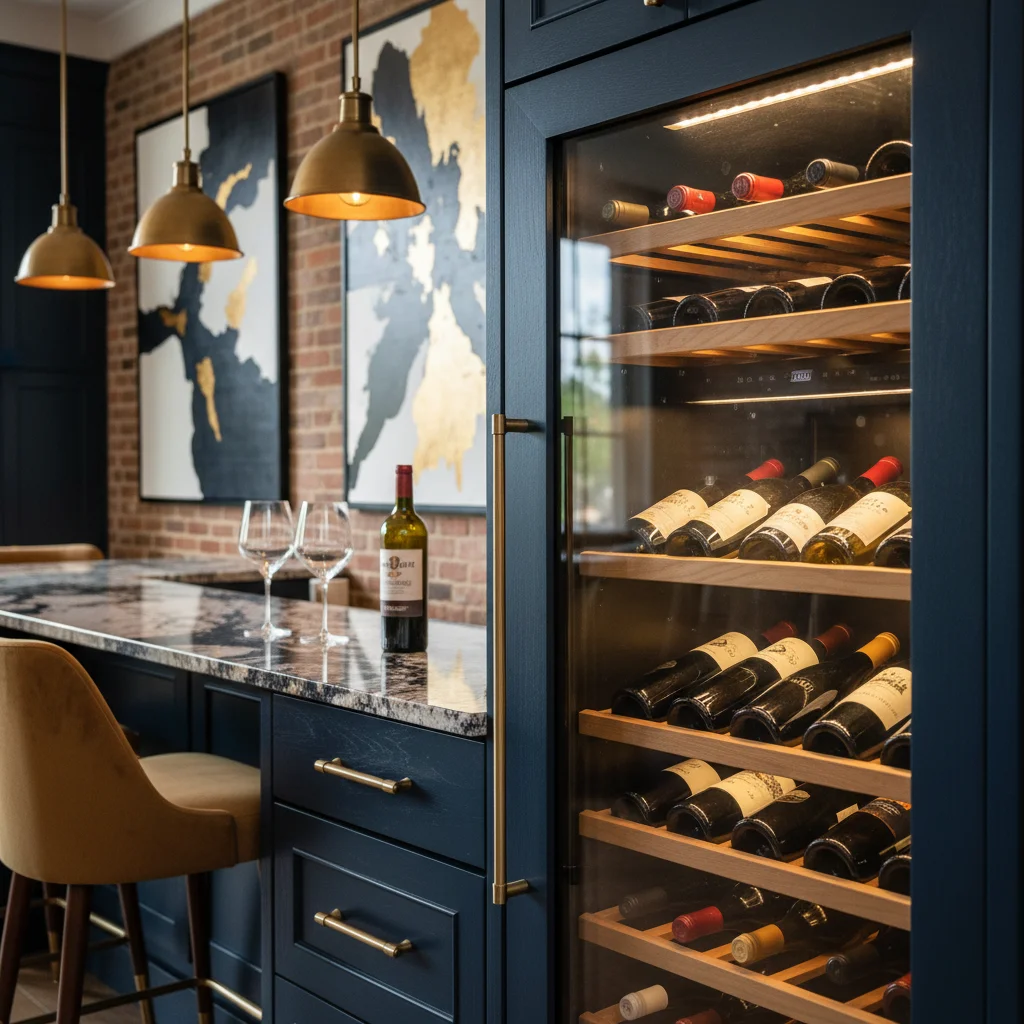
Wine coolers don’t usually die outright. The interior light still glows and the fan still spins, but a cabinet that held 55 degrees for years now reads 63, and the bottles racked inside are quietly cooking. That slow creep is the entire problem, and it traces back to a familiar short list: a condenser choked with kitchen dust, a circulation fan that stalled, a thermistor reading the box wrong, a damper stuck part-open, or a door gasket that no longer seals. On thermoelectric drawers the culprit shifts — a tired Peltier module or a clogged heat sink — but the outcome looks identical from the front.
Arvada widens that picture, because the cooler you own depends on where you live. A century-old remodel near Olde Town often holds a freestanding unit shoved against a wall. A Gold Line townhome squeezes a slim cooler into a galley footprint. And the Candelas builds out west box a panel-ready column flush into cabinetry drawn before anyone measured the condenser’s breathing room. So “warm cooler” is really two questions stacked together: what failed inside, and what is the install doing to it.
The Denver conditions working against it
Before we touch a part, we account for three forces that follow every Arvada call:
- Thin mile-high air. At roughly 5,280 feet the atmosphere is about 15% less dense, so a condenser sheds noticeably less heat than its maker assumed at sea level. In an open kitchen that thin margin disappears unnoticed; in a column sealed into Candelas millwork, it’s often the gap between steady cellar temperature and a slow climb out of range.
- Bone-dry, high-UV climate. The Front Range strips moisture and bakes rubber, so door gaskets harden and shrink early. That’s the usual story behind frost on the back wall and a sweating glass door.
- Hard water at 150 to 250 ppm. Any cooler with a humidity reservoir or a water line collects scale until airflow and moisture control quietly fall apart.
A generalist who skips these tends to swap the obvious part and leave the underlying condition in place. We read all three into the diagnosis from the first minute.
How we pin down the fault
- We confirm the true cabinet temperature against the set point, separating a genuine cooling failure from a sensor that’s simply lying.
- We assess the install — grille clearance and the actual airflow a flush-paneled Candelas cabinet or a tight Olde Town nook allows.
- We load-test the sealed system and compressor, watching how the unit rejects heat at altitude rather than at a sea-level assumption.
- On dual-zone units we diagnose each chamber on its own, since dampers, thermistors, and evaporator fans fail one side at a time.
- We inspect the door gasket for the dry-climate shrinkage that lets warm air leak past the seal.
The $89 diagnostic pays for that whole inspection, and it credits straight toward the repair the instant you approve the work — quoted up front, never padded afterward.
Components we repair and replace
Most wine cooler jobs come down to a handful of parts, matched to your model and serial: compressors and the sealed refrigerant loop, evaporator and condenser fan motors, thermistors and control boards, air dampers on dual-zone cabinets, thermoelectric modules on under-counter drawers, and door gaskets gone stiff in the dry air. We also descale humidity lines and valves fouled by Arvada’s hard water. Because a wine unit usually shares a premium kitchen with the rest of the install, one visit can also cover built-in refrigerator columns, under-counter drawers, and ice makers fighting the same scale. As an independent shop serving the Denver metro since 2012, we’re not affiliated with any manufacturer.
Same-day and next-day scheduling
Repairs run daily from 8:00 AM to 6:00 PM, and the phone is answered 24/7, so same-day or next-day slots are usually open. Call (720) 770-4189 or book online anytime. The $89 diagnostic brings a technician to your door — Olde Town remodel or Candelas built-in — pinpoints the real cause, and credits straight toward the repair the moment you approve it. No guesswork, no surprise line items.