What’s happening here
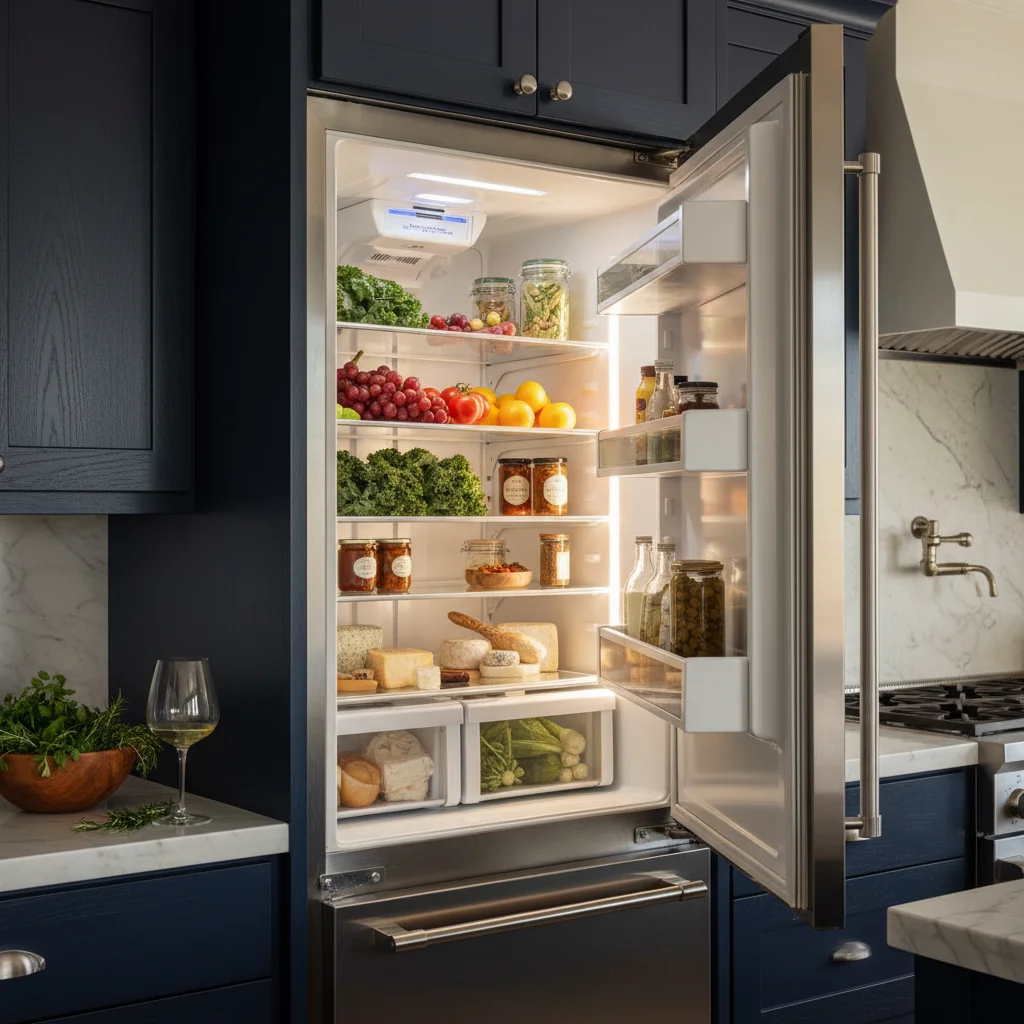
That warm-fridge, cold-freezer split is the scenario we get pulled into most across Arvada, but it’s far from the only one. This is a town that fails its refrigerators in two distinct ways. Around Olde Town and the streets off Ralston Road, the housing skews older, and the fridges are mostly freestanding French-door and side-by-side units — the kind where a tired fan or a stuck defrost cycle is the usual culprit. Out along the Gold Line corridor and in the newer Candelas and Leyden Rock builds, upgraded kitchens increasingly arrived with built-in columns and panel-ready refrigeration boxed into custom cabinetry, which trap heat and behave nothing like a fridge with open air around the coils.
We figure out which world your fridge lives in before we name a part. Call (720) 770-4189 — answered 24/7 — and a technician usually reaches you the same or next day.
Symptoms we trace most often
The complaint usually points us straight at the system to test:
- Fresh-food side warming while the freezer holds (airflow, evaporator fan, or a frozen coil)
- Compressor running nonstop with the cabinet still drifting warm (sealed system or condenser)
- A built-in column in a Candelas kitchen creeping up a few degrees and staying there (trapped heat)
- Water pooling beneath the crisper drawers (clogged defrost drain)
- Ice that’s cloudy, undersized, or has stopped arriving (hard-water scale)
- A door that no longer pulls itself shut or a gasket that sweats (dried-out seal)
How we pin down the cause
We don’t replace parts on a hunch. A typical Arvada visit runs like this:
- Read the real temperatures. We measure both compartments against the set point — a “warm fridge” is often a 4-degree drift, not a failure.
- Pull fault codes where the model stores them, then check the obvious mechanicals: condenser coils, both fans, the defrost heater, and the damper.
- Test the sealed system when the symptoms point there, rather than assuming a leak.
- Inspect the install on built-ins — clearances and airflow around a boxed-in column are part of the diagnosis, not an afterthought.
- Quote the repair up front before a single part comes off, with the $89 diagnostic credited toward it.
Why Arvada’s climate ages a fridge faster
Three local forces quietly push these units past their schedule. At roughly 5,280 feet, the air is about 15% thinner, so condensers and fans shed heat less efficiently — a tightly boxed-in column in Candelas runs warm here sooner than the same model would near sea level, and a marginal refrigerant charge shows up as “just not as cold lately.” The hard water feeding these neighborhoods, commonly 150–250 ppm, lays down scale in ice makers and the slim lines behind built-in dispensers. And the dry, high-UV Front Range air hardens door gaskets early, which forces longer compressor runs and earlier wear. We weigh all three when we diagnose.
Models and parts
We work on freestanding French-door, side-by-side, and top-mount fridges as well as the built-in columns, integrated panel-ready units, and freezer drawers common in Arvada’s remodeled and newer kitchens. Replacement parts are OEM-grade and manufacturer-compatible, pulled to your model and serial. As an independent shop serving the Denver metro since 2012, we are not affiliated with, endorsed by, or sponsored by any manufacturer.
Get a technician out
Repairs run daily, 8:00 AM to 6:00 PM, and the phone is answered 24/7, so you can call the moment the temperature slips. The $89 service call covers a full on-site diagnosis and credits toward the repair. Call (720) 770-4189 or book online, and a technician will be at your Arvada door — Olde Town bungalow or Candelas built-in — to find the real cause and quote it before any work begins.