Oven Repair in Arvada, Denver

Arvada sits a full mile up, where thin air and hard water quietly push an oven off its setpoint long before a part actually breaks. We read the kitchen first — Olde Town bungalow or Candelas built-in — then quote the repair before anything comes apart.

Oven Repair in Arvada, Denver

Quick Answers

Where can I get my oven repaired in Arvada, Denver?
Denver Sub-Zero Repair is an independent shop that covers Arvada end to end — the older streets around Olde Town and Ralston Road, the transit builds along the Gold Line, and the newer Candelas blocks out west. We handle wall ovens, gas and dual-fuel ranges, and stacked oven towers. Call (720) 770-4189, answered 24/7, and most homes get a same-day or next-day visit.
Why does my Arvada oven take so long to preheat?
At Arvada's 5,280-foot elevation the air carries about 15% less oxygen, so a gas oven burns leaner and an aging bake igniter that barely coped at sea level can no longer pull enough heat to open the gas valve quickly. A drifted temperature sensor does the same thing. We measure igniter current draw and sensor resistance on site rather than swap parts on a hunch.
Do you service built-in wall ovens in Candelas and other new Arvada kitchens?
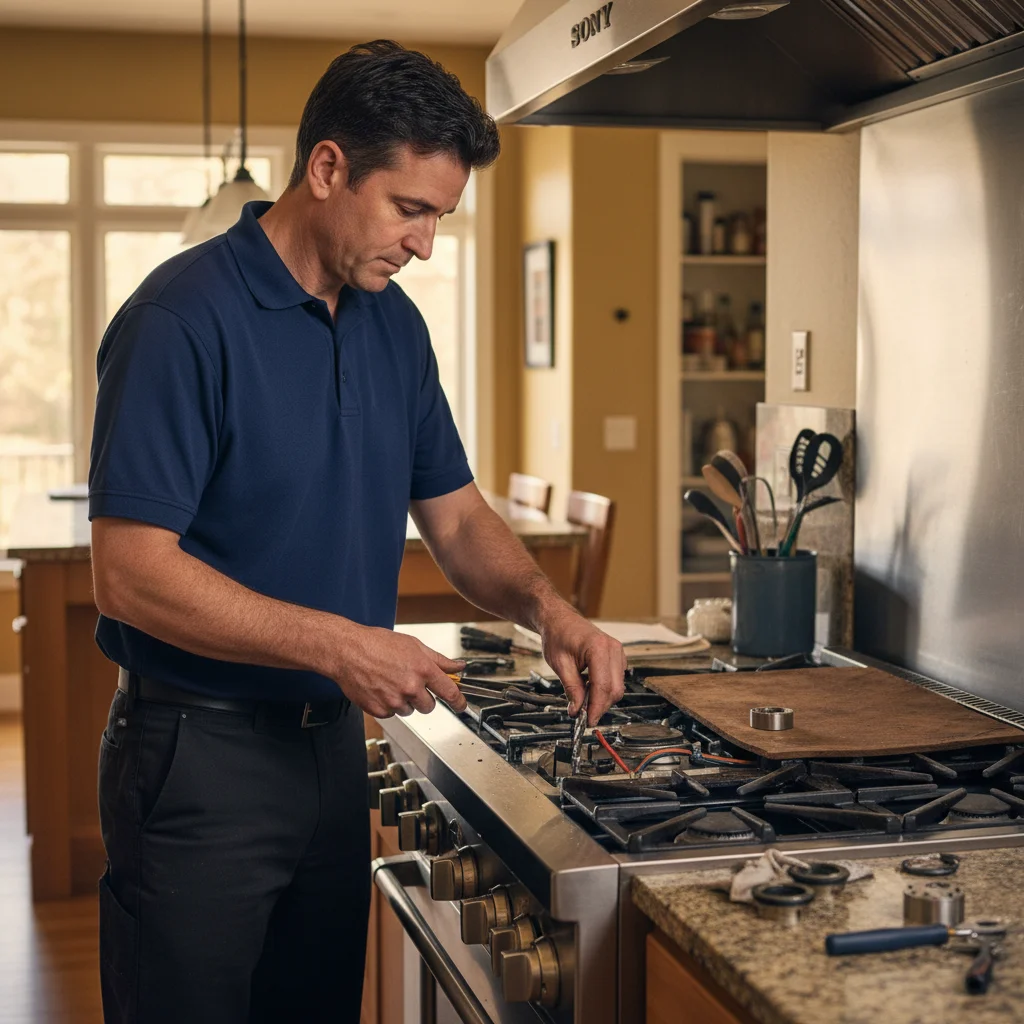
Yes. Candelas and the newer master-planned blocks increasingly set a built-in wall oven flush into custom cabinetry, often inches from panel-ready refrigeration. Those low-airflow installs trap heat and fail differently than a freestanding range. The $89 diagnostic pins down whether it's an igniter, a sensor, a gasket, or the board — and that fee credits toward the repair.

When an oven misbehaves in Arvada, the cause is often the city itself before it’s the appliance. At 5,280 feet the air is roughly 15% thinner, the tap water runs mineral-heavy, and the Front Range climate is bone dry — three forces that nudge a healthy oven off its setpoint and disguise themselves as broken parts. We start there, read the kitchen the oven lives in, and quote the $89 service call toward the repair before a panel ever comes off.

What’s actually going wrong

An oven rarely dies all at once; it drifts. In the brick bungalows reworked around Olde Town and along Ralston Road, the usual culprit is a tired bake igniter that glows but no longer fires hot, or a bake element that’s begun to arc. In the compact, apartment-grade ovens stacked into the transit builds along the Gold Line corridor, we more often find a sensor reading the cavity wrong or a control board throwing a stored code. And in the show-kitchen built-ins out in Candelas, where a wall oven sits flush against panel-ready refrigeration, trapped heat and starved airflow cook the electronics over a few seasons. Same symptom — won’t hold temperature — three very different root causes.

Why Arvada’s conditions come first

Before we condemn a single part, we account for the things every Arvada oven fights:

  • Thin air: a gas orifice jetted for sea level burns rich a mile up, giving lazy yellow flames and heat that pools on one side of the cavity.
  • Hard water: at 150 to 250 ppm, scale builds in the steam reservoirs and injector lines that newer Candelas ovens increasingly rely on.
  • Dry, high-UV climate: door gaskets stiffen and crack early, so a flush-mounted built-in leaks heat and runs the thermostat ragged to keep up.

Miss any of these and you replace a sensor that was never broken. We weigh all three against the symptom first.

How we diagnose it on site

  1. Trigger the fault and watch. We run the oven through the failing cycle — preheat, bake, broil, or self-clean — and watch how it behaves instead of relying on your description alone.
  2. Read the install. In a boxed-in Candelas kitchen we check airflow and clearance, because an oven cooking its own controls mimics a part failure exactly.
  3. Measure, don’t assume. We read igniter current draw, sensor resistance, and element continuity under power, and we pull stored fault codes where the model keeps them.
  4. Check combustion for altitude. On gas and dual-fuel units we judge flame quality and orifice sizing against Arvada’s mile-high air before blaming any component.
  5. Quote one firm price. You hear the real cause in plain language and an up-front number — millwork protected — before any work starts.

Components we service

We diagnose and replace the parts that decide whether a fix actually holds: bake and broil igniters, bake and broil elements, temperature sensors and thermostats, convection motors and fans, door gaskets and hinges, self-clean latches and thermal fuses, gas safety valves, and control boards. On steam-equipped ovens we also descale or rebuild the reservoir and injector path. Parts are OEM-grade and manufacturer-compatible from verified suppliers, matched to your exact model and serial — so a built-in wall oven doesn’t have to come back out of tight cabinetry a second time.

Same-day scheduling

On-site repairs run daily, 8:00 AM to 6:00 PM, and the phone is answered 24/7, so you can call the moment the oven quits. Call (720) 770-4189 or book online. A technician will be at your Arvada door — Olde Town remodel, Gold Line condo, or Candelas built-in — to find the true fault and quote it honestly, with your $89 service call credited toward the repair.

Frequently Asked Questions

How fast can a technician reach my Arvada home?

Arvada threads the northwest metro with quick routes off Wadsworth, Sheridan, and the Gold Line, so it's an easy reach for us. Most calls land same-day or next-day. If you smell gas while the oven is off, shut it down, crack a window, and call (720) 770-4189 before anything else.

My oven near Olde Town browns one side of everything. What causes that?

Lopsided browning usually traces to one of three things: a temperature sensor that has drifted off spec, a convection fan or motor losing speed, or off-tune combustion in a gas cavity. In older Olde Town kitchens we also see scorched wiring on a dated bake element. We map the hot and cold zones with a probe before deciding which one it is.

Does Arvada's altitude really change how an oven holds temperature?

It does, more than most people expect. Thinner mile-high air leans out gas combustion, so a sea-level burner orifice runs rich here — yellow flames, soot, and heat that wanders across the cavity, all of which mimic a broken part. On dual-fuel ranges the electric oven then strains its sensor and fan to compensate. We correct for altitude before condemning a component.

Can hard water hurt an oven if it doesn't use water?

Only the steam features can scale, and a lot of upgraded Candelas ovens now include steam-assist or self-steam cleaning. Arvada's supply runs mineral-heavy, often 150 to 250 ppm, and that deposit clogs the reservoir, the injector, and the thin feed lines over time. A standard bake-only oven won't see it, but we check the water path on any model that has one.

Is the $89 service call really applied to the repair?

Yes. The $89 covers a full on-site diagnosis, and once you approve the work that amount comes straight off the repair total. You get the complete price before anyone picks up a tool, and nothing is added on afterward.

Are you affiliated with Sub-Zero or the oven's manufacturer?

No. Denver Sub-Zero Repair is fully independent and not affiliated with, endorsed by, or sponsored by Sub-Zero Group, Inc. or any manufacturer. We have served the Denver metro since 2012 and fit OEM-grade and manufacturer-compatible parts matched to your exact model and serial.

Can you work on an oven boxed into tight Candelas cabinetry?

Yes. Many Candelas kitchens flush-set the oven into custom millwork beside an integrated fridge, so clearances are tight and heat has nowhere to vent. We protect the surrounding finishes, ease the unit forward only as far as needed, and diagnose the install alongside the appliance so the same trapped-heat fault doesn't return.

Your Sub-Zero Deserves Better

Denver's experienced independent repair specialists are standing by. Same-day appointments available throughout the metro area.