Oven Repair in Cherry Creek, Denver

In Cherry Creek's high-rises and townhomes, the oven usually shares its kitchen with a paneled Sub-Zero and a glassed-in wine room — and it has to perform on entertaining night. We find the real fault fast, factor in Denver's altitude and hard water, and put a number on the repair before any panel comes off.

Oven Repair in Cherry Creek, Denver

Quick Answers

Who repairs built-in ovens and pro ranges in Cherry Creek, Denver?
Denver Sub-Zero Repair is an independent service that covers Cherry Creek, from the high-rise condos along First and Second Avenues to the townhome rows beside the shopping district. We work on built-in wall ovens, stacked oven towers, and dual-fuel and gas pro ranges set into custom millwork. Call (720) 770-4189, answered around the clock, for a same-day or next-day appointment.
What does it cost to fix an oven in Cherry Creek?
An on-site diagnostic is $89, and that amount is credited toward the repair once you approve it. The actual repair could be a single bake igniter or a full dual-cavity control board, so we set the price only after a technician opens the unit and sees the fault. We do not guess at a number over the phone.
Why does my Cherry Creek oven run hot or bake unevenly?
Denver's mile-high air carries about 15% less oxygen, so a burner tuned at sea level burns rich and an electric cavity leans on its sensor and fan to hold temperature. In a flush-paneled high-rise install, a gasket dried out by the climate also leaks heat, pushing the thermostat to overcorrect. We check combustion, the temperature probe, and the door seal before naming a part.

When the oven quits in a Cherry Creek kitchen, it is rarely a standalone appliance — it is one piece of a built-in suite that also holds a paneled Sub-Zero and, more often than not, a glass-fronted wine room. Our job on this repair is narrow and concrete: confirm exactly why the oven stopped heating right, account for what Denver’s elevation and water do to it, and hand you a firm price before we touch a panel.

What we are actually fixing

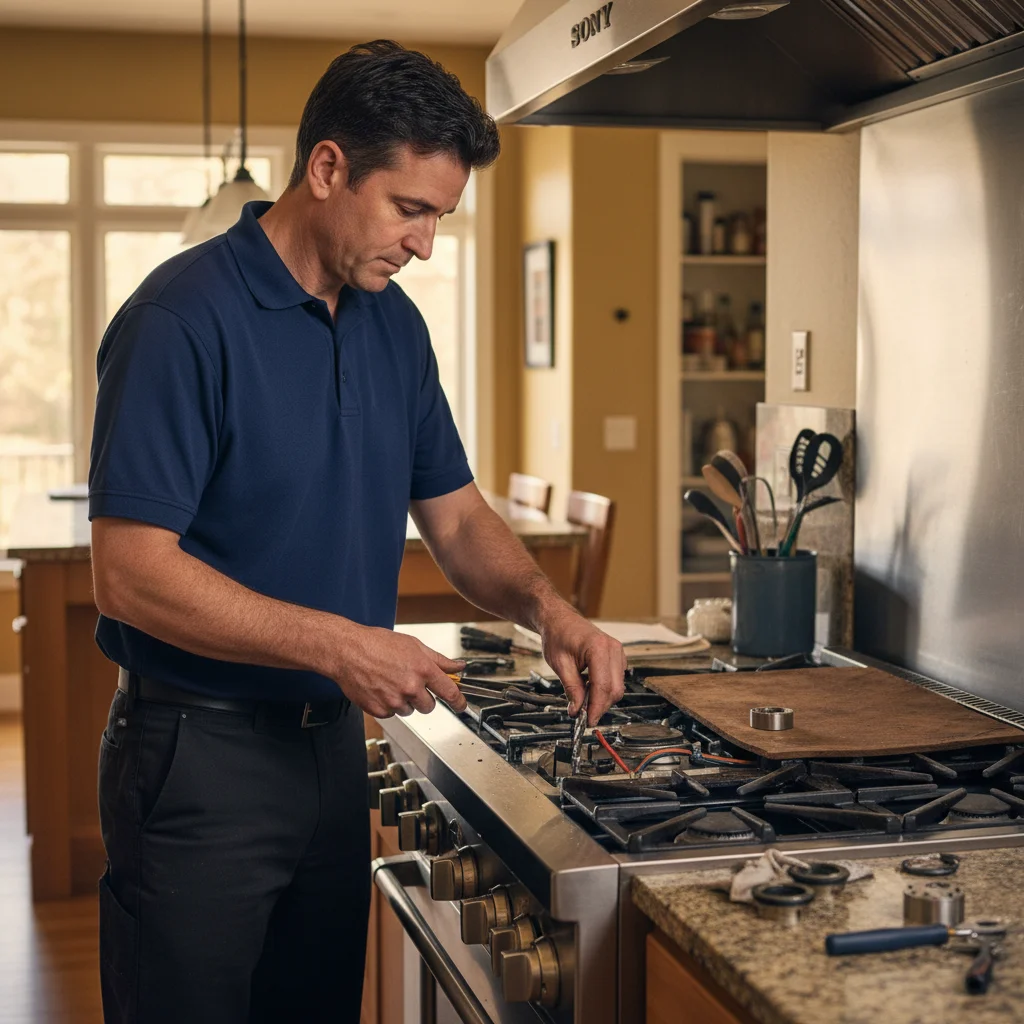
The homes ringing the Cherry Creek shopping district — the high-rise condos along First and Second Avenues, the townhome rows tucked behind them — tend to share a kitchen template. A built-in wall oven, frequently a stacked pair, sits flush in custom cabinetry beside the refrigeration and wine storage. Some kitchens swap that for a high-BTU dual-fuel range. Either way there is more heat, more sensing, and a control board juggling all of it than a basic freestanding unit ever carries. The faults we trace most:

  • A burner that lights late, sometimes with a whiff of gas. A tired bake igniter glows too slowly and lets unburned gas linger before it catches.
  • Convection that browns one half of the pan and leaves the other pale. Usually a drifting temperature sensor, a failing convection motor, or combustion thrown off by altitude.
  • A self-clean cycle that ends in a dead oven. The high-limit cutout or latch fails under the cycle’s heat, especially on a unit boxed into tight cabinetry.
  • Stored fault codes nobody acted on. On a dual-cavity board these are early warnings, not noise to dismiss.

What the inspection looks like, and what it costs

We start by reproducing your symptom and reading any stored codes, then work the heat source — measuring igniter draw and burner combustion on gas and dual-fuel units with the altitude correction in mind, or testing the bake and broil elements directly on an electric cavity. From there we verify the temperature probe against a reference, inspect the board for heat damage, and check the gasket, hinges, and self-clean latch, since a leaking seal can imitate a calibration fault. Only then do we quote. The $89 diagnostic covers all of that and is credited toward the repair the moment you approve it. You see the full price up front, with nothing added afterward.

Why Denver works against these ovens

Three local conditions shape what fails here. First, elevation: at 5,280 feet the air holds about 15% less oxygen, so a sealed burner or range oven set with a sea-level orifice burns rich, throwing lazy yellow flames and patchy heat that look like a broken part but are really a combustion issue we can retune. Second, the dry air and strong UV stiffen door gaskets early — and in a flush-paneled high-rise that vents into a cramped cabinet, that worn seal lets heat escape and the thermostat overshoot. Third, the hard water, roughly 150 to 250 ppm, scales the steam-assist reservoirs built into many of these higher-end ovens. We weigh all three before settling on a cause.

Other appliances we cover nearby

Because Cherry Creek kitchens are built as a set, problems rarely arrive alone:

  • Sub-Zero refrigerator repair — paneled built-ins and column units.
  • Wine cooler and wine-room repair — the temperature-held storage so common in these homes.
  • Pro range and cooktop repair — burners, igniters, and dual-fuel controls.

Flag any of these when you call and we will cover them on the same trip.

Book your Cherry Creek oven repair

Cherry Creek sits central in Denver and is quick for us to reach, so most visits land same-day or next-day. Repairs run daily from 8:00 AM to 6:00 PM, and the phone is answered 24/7 — handy when the oven dies the night before you are hosting in a shopping-district high-rise. Call (720) 770-4189 or book online today. We will find the true fault, quote it honestly, and credit your $89 service call toward the fix.

Frequently Asked Questions

My oven sits in the same cabinetry as a Sub-Zero and a wine room. Is that a problem for you?

Not at all — it is the exact kitchen we see most in Cherry Creek. These rooms are designed as a suite: paneled Sub-Zero refrigeration, a temperature-held wine room, and a built-in oven recessed into matching millwork. We are comfortable working around adjacent panels and trim, and if the wine room or the fridge is also acting up, mention it when you book and we will look at everything in one visit.

Can a high-rise condo install make the oven harder to diagnose?

Sometimes. In a Cherry Creek tower the oven often vents into a tight cabinet run with little clearance, so heat backs up and ages the gasket and board faster than the original spec assumed. We read cavity temperatures with that enclosure in mind rather than condemning the first part that looks suspect, which keeps us from a misdiagnosis on a sealed-in unit.

The oven door has been hard to latch and the self-clean failed. Related?

Often, yes. A self-clean cycle runs the cavity extremely hot, and on a built-in that already vents into tight cabinetry the heat can stress the latch motor, the thermal fuse, and the door hinges at once. We test the latch circuit and the high-limit cutout together rather than swapping a fuse and hoping, since a tripped cutout usually has a cause worth finding.

Does Denver's hard water reach an oven?

It reaches the steam-assist and proofing features many upscale Cherry Creek ovens carry, plus the cooktop side of a pro range. Local tap runs roughly 150 to 250 ppm, so scale builds in steam reservoirs, on burner caps, and at igniter tips. We descale or replace the affected components instead of only changing the part that first catches the eye.

Do you use genuine oven parts?

We install OEM-grade and manufacturer-compatible parts from verified suppliers, matched to your exact model and serial. On the pieces that decide whether a repair lasts — igniters, bake and broil elements, gas safety valves, sensors, and control boards — fitting the correct part is what keeps you from pulling a paneled oven back out of designer cabinetry a second time.

Are you affiliated with Sub-Zero or the oven manufacturer?

No. We are a fully independent repair company, not affiliated with, endorsed by, or sponsored by Sub-Zero Group, Inc. or any manufacturer. We specialize in servicing this class of appliance across the Denver metro, where we have worked since 2012.

Your Sub-Zero Deserves Better

Denver's experienced independent repair specialists are standing by. Same-day appointments available throughout the metro area.