You opened the cabinet for a bottle and the rack felt off — not cellar-cool the way it always was, and the readout that lived at 55 for years now glows 62. Everything looks alive: the light, the fan, the soft hum. But a collection you’ve built quietly is warming a degree at a time behind that glass, and the moment the number stops holding is the moment to act.
What’s happening here
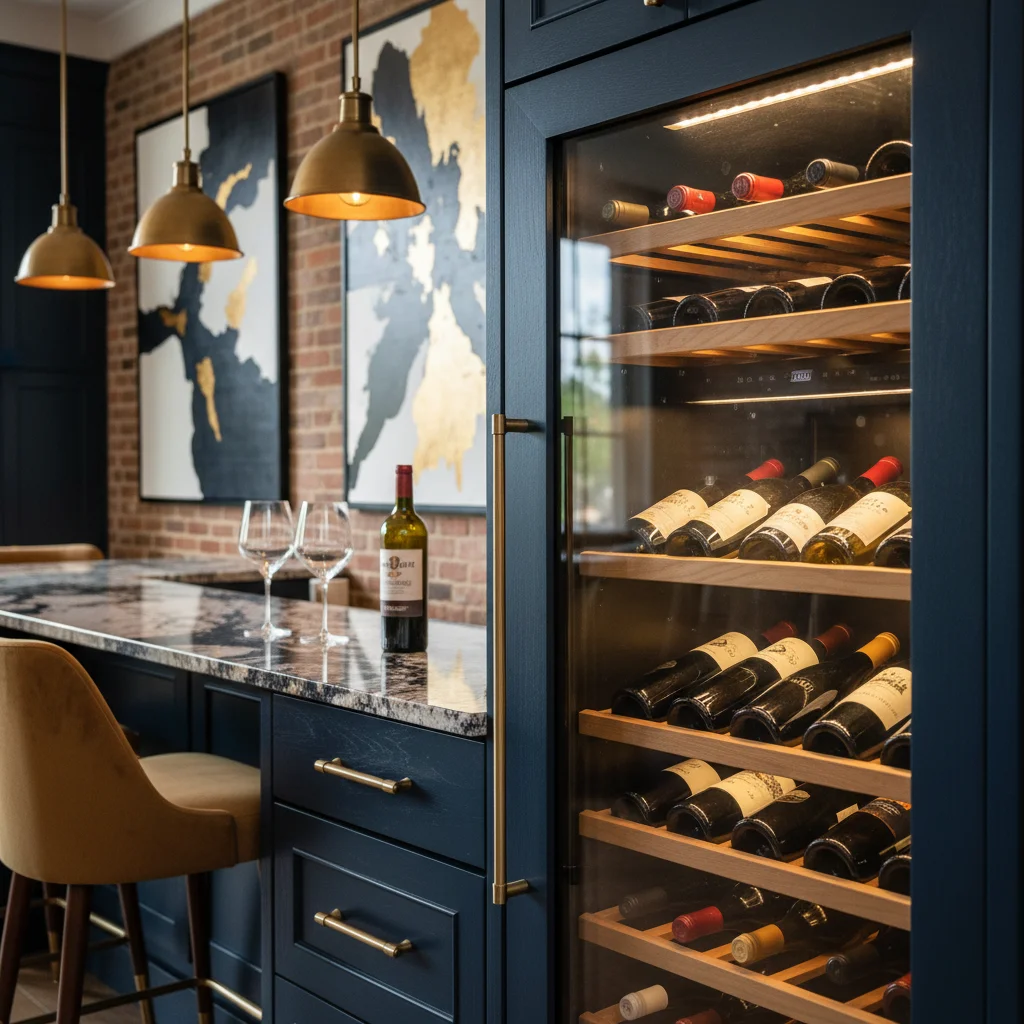
Parker grew up fast along the Douglas County corridor, and it shows in the housing stock. Beyond the older core around Mainstreet and Parker Road, the town fills out with large, recently built homes — Pradera, Stepping Stone, The Pinery, Stroh Ranch — kitchens designed around premium refrigeration from day one: a built-in cooling column, a gas or dual-fuel range under a vent hood, and almost always a wine cabinet worked into the island or butler’s pantry.
That design choice shapes every repair. A standalone cooler against a wall breathes whatever air the room gives it. A column dropped into estate millwork breathes through one hidden grille sized for looks, not ventilation. So a warm cabinet is really two questions: what broke in the machine, and what the cabinetry is doing to its ability to stay cold.
Symptoms we field most
The same handful of complaints comes through from Parker kitchens:
- A cabinet that won’t settle on its set point, or a dual-zone where one chamber drifts while the other stays exact.
- A fresh hum, click, or rattle resonating through custom cabinetry that used to be silent.
- Frost creeping up the back wall, condensation beading on the glass, or a puddle at the base.
- A thermoelectric drawer that powers on, lights up, and never actually pulls down to temperature.
- Display and controls working normally while the cooling stage simply never engages — or short-cycles without reaching target.
Don’t see your exact symptom? It still belongs on a call. This is what we see most across Parker, not the boundary of what we repair.
How the diagnosis runs
- Watch how the temperature actually behaves — steady drift, short-cycling, or cold-then-warm swings — instead of trusting the front display alone.
- Pull the unit clear of its enclosure and inspect that concealed grille, because a built-in choking on its own trapped heat copies a failing sealed system.
- Walk the components one by one: condenser, condenser and evaporator fans, thermistors, damper, control board — and on a dual-zone, each compartment on its own.
- Test the door gasket and seal path early, since a stiffened seal is cheap, common in this dry air, and easy to misread as a refrigerant problem.
- Hand you one clear, up-front price before any panel comes off.
Where Denver’s climate enters the picture
At roughly 5,280 feet the Front Range air carries about 15% less density, so a condenser here rejects less heat than its sea-level engineering assumed. Inside a column sealed into Pradera or Stepping Stone cabinetry, that thin-air margin can be the entire difference between a rock-steady 55 and a slow climb out of range. Parker’s parched, high-UV air hardens gaskets ahead of schedule — the usual story behind frost and a sweating door. And the hard water common across the area, often 150 to 250 ppm, scales any line feeding a humidity-controlled cabinet. All three sit in the diagnosis from the first minute on site.
Brands and nearby equipment
We service built-in and freestanding wine refrigeration of every make — Sub-Zero, Thermador, U-Line, Marvel, Perlick, Liebherr, and the rest — along with the beverage centers and refrigeration columns sharing the same kitchen. As an independent shop, we’re not affiliated with any manufacturer; we simply specialize in their equipment and the way Parker installs stress it.
Schedule a visit
Repairs run daily from 8:00 AM to 6:00 PM, and the phone is answered 24/7, so same-day or next-day slots are usually within reach. Call (720) 770-4189 or book online whenever it suits you. The $89 diagnostic puts a technician at your door — older Mainstreet home or new Pradera estate — finds the true cause, and credits straight to the repair the moment you approve it. Serving the Denver metro since 2012, with honest pricing after a real inspection.