A repair company built for Parker’s newer, bigger kitchens
Drive south out of the metro into Parker and the housing changes character almost immediately. Where the older Denver neighborhoods are mid-century ranches and brick bungalows, Parker is a Douglas County boomtown — and most of it is new. Subdivision after subdivision of larger two-story and ranch-style homes went up here through the late 1990s, the 2000s, and the years since, marching out along Parker Road and Hilltop Road past Stroh Ranch, Stonegate, Canterberry Crossing, and on toward The Pinery and Idyllwilde. These are family homes on generous Douglas County lots, and the builders did not skimp on the kitchen.
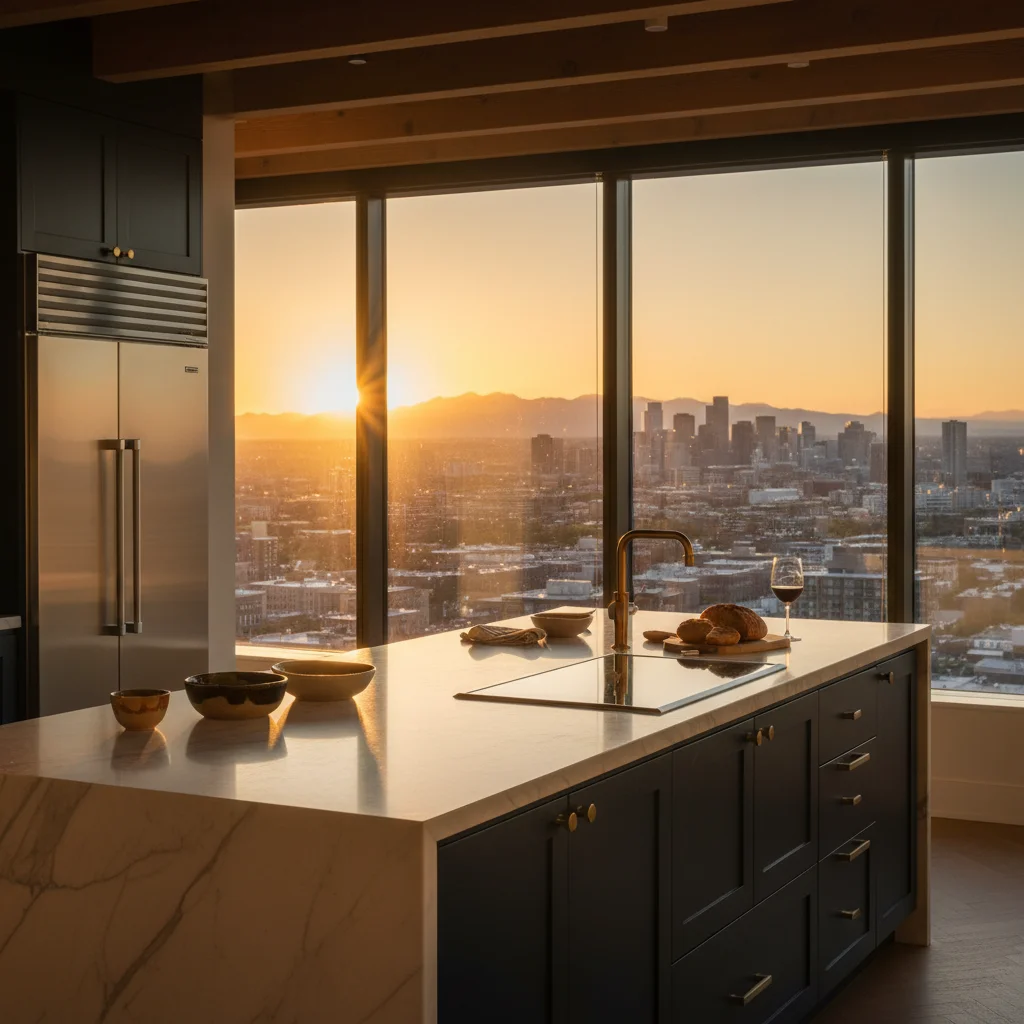
That is the thread that ties almost every service call we run in Parker together. When a home is built large and built recently in this corridor, the kitchen is frequently the showpiece — and the appliances reflect it. A built-in Sub-Zero column flush with the cabinetry. A professional 36- or 48-inch gas range with a row of burners and a griddle. A panel-ready dishwasher you would never pick out of the millwork. An undercounter wine column in the island, or a beverage drawer by the butler’s pantry. Parker did not inherit these appliances through remodels the way an older neighborhood does; in much of the town, the kitchen was planned around a premium suite from the first set of blueprints.
So before anyone talks about a part or a quote, the real task is figuring out what actually failed on a sealed system or a calibrated burner — and that is a specialist’s job, not a generalist’s. A warming Sub-Zero in a Stonegate two-story could be a stalled condenser fan, a dust-choked condenser, a tired start relay, or a slow sealed-system leak: four different repairs at four very different prices. We identify which one it is first, then give you a clear, up-front price before any work begins. The $89 diagnostic service call covers that inspection and is credited toward the repair if you proceed.
Why premium appliances fail the way they do out here
A new home with a high-end kitchen is not immune to trouble — it just fails on a different timeline and for different reasons than the freestanding box a big-box service tech expects. Across Parker’s housing stock, a few patterns repeat:
- Built-ins that ran hot from day one. A built-in refrigerator lives in a sealed cabinet cavity and depends entirely on the airflow path the builder left it. If a Parker install boxed the condenser in a little tight, or the grille sits where it collects dust, the system rejects heat poorly and ages faster than the warranty math assumes — and at Parker’s elevation that margin is even thinner.
- Pro ranges that were never tuned for altitude. Many of these professional gas ranges were shipped and set for a national average, not for 5,800-plus feet. A burner that lights fine but burns lazy, yellow-tipped, or sooty is often an air-fuel-and-orifice problem, not a failed igniter.
- Hard-water scale on everything that touches water. Ice makers, dishwashers, and the thin water lines feeding built-in fridges all collect mineral deposits. Newer construction is no exception — the water chemistry is regional, and a brand-new Idyllwilde kitchen scales up the same as an older one.
- Gaskets and seals worn early by dry air. Colorado’s low humidity and strong UV harden and crack door gaskets faster than a humid climate would. A seal that whistles or sweats lets warm air in, the compressor runs longer, and the whole system works harder.
The common throughline across Parker is new, expensive, precisely engineered equipment in a house that was designed to hold it — which sounds easy and is not. These appliances punish guesswork. Swap the wrong part on a sealed refrigeration loop and you can turn a one-visit fix into a recurring headache.
Denver factors first: thinner air, hard water, dry climate
A lot of repair advice online is written for sea-level kitchens, and it quietly steers technicians wrong here. Parker actually sits above Denver’s famous mile-high line — much of the town is up around 5,800 to 6,200 feet — so if anything the altitude effects are sharper than in the city below. Three local realities shape nearly every diagnosis we make in this corridor.
Thinner air, weaker heat rejection. The atmosphere here is roughly 15% less dense than at the coast, and refrigeration lives or dies on moving air to shed heat. Condensers and cooling fans push thinner air, so a built-in fridge that is even slightly dusty or slightly boxed in struggles to reject heat sooner than the same unit would near an ocean. Refrigerant charge and compressor heat rejection are both sensitive to that thin atmosphere — which is exactly why a service manual written for sea-level Texas can lead a tech astray on a Parker call.
Combustion shifts on gas appliances. Less dense air means less oxygen per cubic foot, and that changes how a professional gas range, cooktop, or oven burns. Orifice sizing and the air-to-fuel mixture that were dialed in at a lower elevation can run rich at Parker’s altitude, producing the lazy, yellow, or sooty flames homeowners notice. When a pro range suddenly burns unevenly, the cause is frequently combustion-and-altitude rather than a broken burner — and it is correctable.
Hard water and very dry air. Denver-area water tends to run hard, commonly in the 150 to 250 ppm range, and that mineral load is rough on ice makers, dishwasher internals, and the slim water lines feeding built-in refrigerators. It is the leading reason ice output drops or cubes come out cloudy and undersized. On top of that, Colorado’s very dry climate and intense high-altitude UV crack door gaskets and seals faster than a humid region would. We check gaskets on every refrigeration call because this climate wears them out early.
These four forces — thin air, altered combustion, hard water, and dry UV-heavy air — are the things a national playbook tends to miss, and they are built into how we approach every appliance in Parker.
How we diagnose a repair, step by step
A sound diagnosis is methodical. Guesswork on a sealed system or a calibrated gas burner is how a one-visit fix becomes a recurring problem, so we work in a deliberate order:
- Confirm the model and serial. Every diagnosis starts by identifying your exact unit. The right parts, the right specs, and the right service procedure all flow from this — and on integrated built-ins the model number is rarely sitting in plain sight.
- Separate the symptom from the failure. “It is warm” is a symptom; a stalled condenser fan, a clogged condenser, a tired start relay, or a sealed-system leak are causes. Each points to a different repair, so we name the cause before we touch a part.
- Read the install. In Parker’s newer kitchens the unit is usually flush with custom or semi-custom millwork. Where the condenser sits and how the cabinet is boxed in shapes the whole job, so we map the access and plan to protect the surrounding cabinetry and flooring before anything moves.
- Test airflow, temperatures, and the sealed circuit. We check actual temperatures, fan operation, defrost behavior, and — where the symptoms point that way — the sealed refrigeration loop, reading the numbers the way they behave at this elevation rather than at sea level.
- Check the supply side. Water lines, gas pressure, and electrical feeds get a look, because the real problem is sometimes upstream of the appliance: a scaled water line can mimic a broken ice maker, and a gas-pressure issue can read like a bad burner.
- Explain the fault and quote it up front. Once we know the real cause, you get a plain-language explanation and a clear price before any work begins — no surprises tacked on at the end.
Components and appliances we service in Parker
Across Parker’s newer subdivisions and its larger custom homes, here is what we regularly handle and the parts that most often need attention:
- Built-in and integrated refrigerators — columns, French-door built-ins, under-counter drawers, and panel-ready units flush with the cabinetry.
- Freezers and ice makers — fill valves, water lines, molds, defrost systems, and the scale-driven failures the hard local water causes.
- Professional gas and dual-fuel ranges — burners, igniters, orifices, and the altitude-affected combustion that makes flames burn lazy or yellow.
- Wall ovens and built-in ovens — bake and broil elements, igniters, temperature sensors, and control boards that drift off their set point.
- Cooktops and rangetops — gas, induction, and dual-fuel, including ignition and surface-element faults.
- Dishwashers — drain pumps, sumps, spray arms, and the scale buildup hard water leaves on heating elements and jets.
- Wine and beverage columns — thermoelectric modules, compressors, fans, and gaskets gone brittle in the dry air.
Common faults that bring us out to Parker include a built-in fridge that slowly warms, frost piling up on the freezer’s back wall, a compressor that never cycles off, ice makers that jam or shrink their cubes, gas burners with weak yellow flames, an oven that overshoots its set temperature, water pooling under the unit, and control panels throwing error codes. If your symptom is not on this list, it still belongs on the phone with us — these are the patterns, not the boundaries.
Parts, and making the repair last
A premium appliance is engineered as a single system — a sealed refrigeration loop, a precise control board, and a set of airflow and water paths that all depend on one another. Drop in a generic part and you can be chasing the same fault again within a year. That is why we use OEM-grade and manufacturer-compatible parts from verified suppliers, matched to your specific model and serial number.
It matters even more in Parker, where pulling a built-in for a second visit means navigating the same custom millwork and the same tight cabinet cavity all over again. Getting the correct part in on the first trip is not only about reliability — in a showpiece kitchen it is about not disturbing the install twice. We would rather take the time to source the right component than rush a substitute that brings us back. When the technician finishes, you get a straight account of what failed, what was replaced, and why. If a part has to be ordered for a less common model, we tell you on the first visit and set a clear expectation for the return.
Same-day scheduling in Parker
Booking is straightforward, and we have set it up around how this corridor actually lives:
- Call (720) 770-4189. The phone is answered 24/7, so you reach a real person whenever a problem surfaces — late at night, early morning, or over a weekend.
- Or book online any time that suits you.
- Repairs are performed daily, 8:00 AM to 6:00 PM. We confirm a window and check any access details — a built-in flush with custom cabinetry, a gate code for a community like Stonegate or The Pinery, or a long driveway on a rural-feel Pinery or Tallman Gulch lot.
- The $89 diagnostic service call covers a full on-site inspection and is applied toward your repair.
We have served the Denver metro since 2012, and Parker — with its growing run of larger newer homes built around premium refrigeration and professional gas ranges — is exactly the kind of work we are built for. When the centerpiece appliance in a Parker kitchen quits, you do not need a generalist guessing at a built-in.
Ready to get a built-in fridge, pro range, or cooktop back in service? Call (720) 770-4189 or book online today — same-day and next-day appointments are available throughout Parker and the wider Douglas County corridor, and the $89 service call goes straight toward your repair.