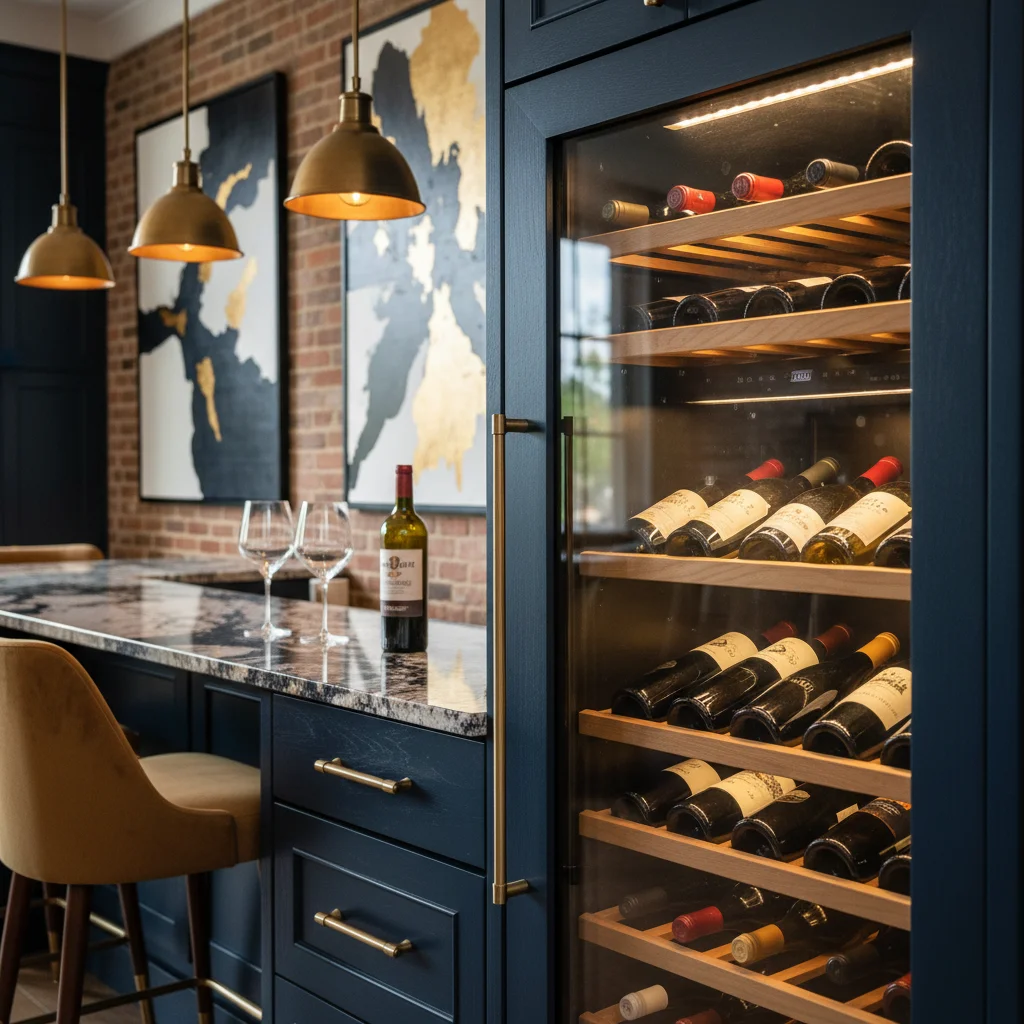
You walked through the kitchen on your way past Park Meadows traffic, glanced at the wine column by the bar, and the display now reads 58 where it always sat at 54. No alarm, no puddle, no rattle — just four degrees of slow drift that have been warming the rack for who knows how long. In a Lone Tree home built around its kitchen, that quiet creep is the whole problem, and it’s exactly where we start.
Overview
Lone Tree anchors the south metro between Park Meadows and the Bluffs, and its housing skews upscale — custom and semi-custom homes across Heritage Hills, the Bluffs, and the newer RidgeGate blocks, with a concentrated pocket of full built-in Sub-Zero and Wolf kitchens. Wine storage in these homes is almost never a freestanding box you can wheel out on a Saturday. It’s a column framed into millwork, a bank of under-counter drawers, or a wet-bar cabinet wired into the floor plan. So a “warm cooler” here is two questions stacked together: what failed inside the unit, and what the cabinetry around it is doing to make things worse. We separate them on purpose.
Common problems
Across Lone Tree’s neighborhoods, the same handful of faults keeps turning up:
- The cabinet slides off its set point, or a dual-zone runs warm on one side while the other holds firm.
- A fresh hum, buzz, or vibration carrying through custom millwork in an otherwise silent room.
- Frost spreading across the back wall, condensation beading on the glass door, or water collecting at the base.
- A unit whose lights and display look perfectly normal while the cooling stage never kicks in.
- Short-cycling — the compressor snapping on and off without ever pulling the cabinet down to temperature.
Each symptom maps to a specific part: a thermistor, a fan motor, a damper, a gasket, a control board, or the sealed system itself.
Our diagnostic process
We follow the symptom to its source rather than throwing parts at it. A typical visit runs in order:
- Confirm the unit type — compressor column versus thermoelectric drawer — since the two fail nothing alike.
- Read the real interior temperatures against the controls, and check the cabinet’s airflow before touching the sealed system.
- Open the cabinet faces or draw the unit forward far enough to work, protecting your floors and millwork.
- Pin the fault to one part, then hand you a plain explanation and a firm price before any repair begins.
Denver-specific factors
Three forces shape almost every cooler we open in Lone Tree. At 5,280 feet the air is about 15% thinner, so every condenser sheds less heat than its maker planned for — and boxing it into bar or island millwork, the way Lone Tree tends to build, tightens that margin further. The very dry climate hardens door gaskets early, which is the usual story behind frost and a sweating glass door, and strong UV through south-facing windows speeds it along. Hard local water near 150–250 ppm then scales any humidifier line or valve until flow chokes. We read all three straight into the diagnosis.
Brands and related units
We see a lot of Sub-Zero and Wolf in these kitchens, plus Liebherr, Thermador, U-Line, and Marvel coolers. We fit OEM-grade and manufacturer-compatible parts from verified suppliers, matched to your model and serial. If the same kitchen has a built-in refrigerator or freezer acting up, we can look at those on the same visit.
Booking
Repairs run daily from 8:00 AM to 6:00 PM, and the phone is answered 24/7, so same-day or next-day slots are usually open. The $89 diagnostic brings a technician to your Lone Tree door, pins down the real cause, and credits toward the repair the moment you approve it. Call (720) 770-4189 or book online anytime, and we’ll get your wine cooler holding a steady temperature again.