The price of leaving it a week
A pro range almost never fails politely. A back burner starts sparking on its own at 2 a.m., or the oven reads 350 but bakes like 320, and because the rest of the cooktop still lights, the problem gets pushed to “next weekend.” That delay is where the bill grows. A spark module that won’t stop firing slowly cooks its own harness; a weak bake igniter forces the oven to cycle longer and longer, fatiguing the valve behind it. The cheap fault, ignored, takes a pricier part down with it.
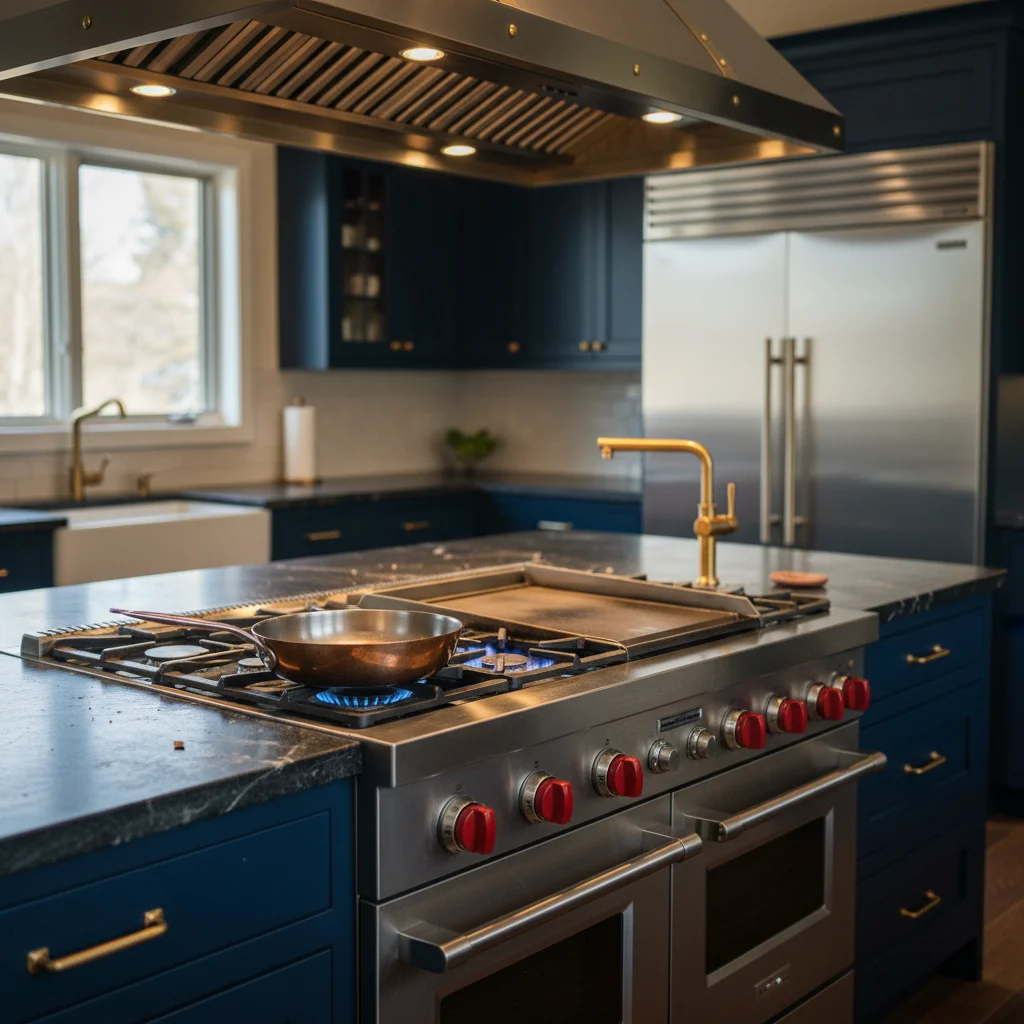
In a Lone Tree kitchen that math stings more than most. Near Park Meadows and the Bluffs, the range isn’t a standalone box you swap on a whim — it’s a 48-inch Wolf or dual-fuel unit set flush into custom cabinetry, gas-fed and wired into a full built-in suite. The fix is simple if you move early: call the day something feels off, and we’ll pin the real fault before it spreads. The phone at (720) 770-4189 is answered 24/7, and the $89 service call is credited toward the repair.
What you are seeing
Ranges announce trouble in distinct ways, and the symptom usually names the part:
- A burner that jumps from off to a hard boil with no usable simmer.
- An oven that preheats forever, then bakes lopsided or undercooks.
- A broiler that won’t catch, or a surface igniter that keeps clicking after lighting.
- An induction zone that drops out mid-sear or throws an error.
What it usually means
Each of those points somewhere specific. No simmer is a worn valve, a clogged port, or an air shutter left rich. A cool, slow oven is a tired bake igniter, a drifted sensor, or a board misreading the cavity. A clicking-after-light cooktop is often a cracked electrode insulator or a spark module that won’t reset.
Two local forces shape these faults in Lone Tree. At the 5,280-foot elevation common to the south metro, air is roughly 15% thinner, so a factory-tuned burner runs rich — a lazy yellow flame that soots heavy cookware — and a marginal igniter loses its firing margin. Meanwhile the dry, high-UV climate hardens oven door gaskets early, so heat leaks and the oven works harder to hold its set point.
Our approach
Read the install first
These ranges sit deep in islands and long custom runs near RidgeGate and Heritage Hills. We start by watching the fault happen, then check how the unit breathes — a boxed-in install can overheat its own controls and mimic a board failure.
Test, don’t guess
On the cooktop we check the spark module, electrodes, valves, and flame quality, watching for that altitude-rich burn before condemning anything. In the oven we measure bake igniter draw, sensor resistance, and the elements under power, reading stored fault codes where the model keeps them.
One firm price
Then you get the cause in plain language and a single quote — surrounding stone and cabinetry protected — before work begins.
Coverage & brands
We service sealed and open gas burners, spark and ignition systems, oven heating (igniters, sensors, bake/broil/convection elements), induction coils and electric switches, and the control boards that time it all — across pro and dual-fuel ranges throughout Lone Tree. Parts are OEM-grade or manufacturer-compatible, matched to your model and serial. We’re independent, not affiliated with any manufacturer, and have worked the Denver metro since 2012.
Get it fixed
Many of these homes pair the range with the rest of a built-in suite, so we can look at a second appliance acting up on the same visit. Call (720) 770-4189 any hour — answered 24/7 — or book online. Repairs run daily 8:00 AM to 6:00 PM, the $89 diagnostic applies to the repair, and you always have an up-front price before we begin.