What this repair really involves
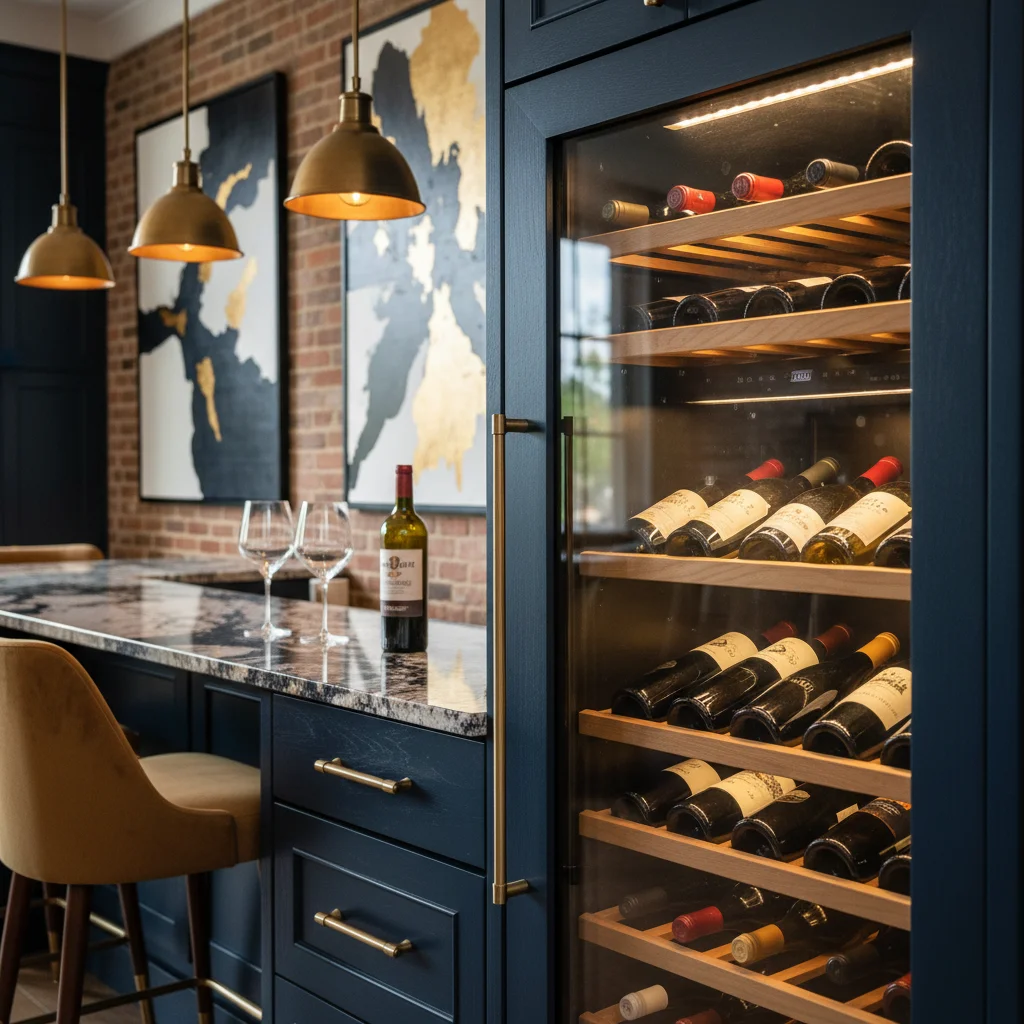
Fixing a wine cooler is closer to tuning a small climate than swapping a part. The cabinet has to hold a tight cellar band — often within a couple of degrees of 55 — and a Lakewood collection feels a four-degree slip long before anyone notices. Across this suburb the units themselves vary wildly: a mid-century ranch near West Colfax might still run a freestanding box, while a gutted-and-rebuilt Green Mountain kitchen hides a panel-ready column in the island and a Belmar loft lines its bar with under-counter drawers. Compressor-driven cabinets and thermoelectric drawers fail along different routes entirely, so the first job on any visit is naming the machine in front of us before touching it.
Symptoms and what they usually mean
Around Lakewood the same complaints keep recurring, and each one points somewhere specific:
- Temperature won’t hold — the cabinet drifts warm, or one side of a dual-zone climbs while the other stays put. Suspect a thermistor, damper, evaporator fan, or the heat-rejection side.
- New noise — a hum, buzz, or rattle carrying through quiet custom cabinetry on a still evening, often a fan bearing or a loose mount.
- Moisture — frost on the back wall, a sweating glass door, or water pooling at the base, frequently a gasket that has dried and shrunk.
- Runs but never cools — lights and display fine, cooling stage never engaging, common on thermoelectric drawers wedged into tight cabinetry.
- Short-cycling — the compressor clicking on and off without pulling the cabinet down.
Why a specialist makes the difference here
A “warm cooler” in Lakewood is really two questions stacked together: what failed inside, and what the tight retrofit is doing to make it worse. When a 1960s ranch off Union gets opened up, the wine unit goes in flush, with a single narrow grille handling all its airflow — nothing like the breathing room its maker assumed. Add Denver’s altitude and the gap widens. At 5,280 feet the air is roughly 15% thinner, so every condenser sheds less heat than its sea-level design counted on; boxed into Belmar island cabinetry with an inch of clearance, that thin-air penalty is often the whole reason a cellar setting won’t hold. We read the install and the sealed system together, not one on sight.
What a visit looks like
- We confirm the true cabinet temperature against the set point, separating a real cooling failure from a misreading sensor.
- We study how the cooler was built into the room — grille clearance and the airflow a flush Green Mountain panel actually allows.
- We load-test the compressor and sealed system against altitude reality, not a sea-level chart.
- On dual-zone units we check each chamber’s thermistor, damper, and fan on its own.
- We inspect the gasket for dry-climate shrinkage and any water line for hard-water scale.
Pricing you see first
The $89 diagnostic covers that full inspection and credits straight toward the repair the moment you approve it — quoted up front, never padded later. We fit OEM-grade and manufacturer-compatible parts from verified suppliers, matched to your model and serial: compressors, fan motors, thermistors, control boards, dampers, and gaskets. As an independent shop serving the Denver metro since 2012, we are not affiliated with any manufacturer.
Quick answers before you book
Is the cooler worth fixing? Usually, if the cabinet and shelving are sound — most faults are a sensor, fan, gasket, or relay, not the whole unit. Will you protect a custom Green Mountain install? Yes, we cover finishes and floors and work to the access the installer left. Repairs run daily 8:00 AM to 6:00 PM and the phone is answered 24/7, so same-day or next-day slots are usually open. Call (720) 770-4189 or book online to get your Lakewood wine cooler holding temperature again.