A roast half-cooked before a Belmar dinner
You set the oven to 375, slid the pan in, and an hour later the top is browned while the underside is still pale — or the burner you lit is hissing with a lazy yellow flame instead of a clean blue cone. In a Green Mountain remodel that might be a built-in wall oven boxed into custom cabinetry; in a ranch off West Colfax it is likely a freestanding range that has cooked family dinners for thirty years. Either way the meal is stalling and the cause is rarely the obvious one. Call (720) 770-4189 and we will get a technician to your Lakewood door, often the same day.
What tends to fail here
Lakewood ovens break in recognizable patterns, and the symptom usually narrows the diagnosis:
- The bake igniter glows but lights late, dumping a whiff of raw gas into the cavity
- A roast browns on one side and stays pale on the other
- The cavity overshoots its setpoint and runs hot no matter what you dial
- Burners on a gas range light with weak, yellow-tipped flames
- A self-clean cycle locks the door, stalls, and trips the thermal fuse
- A stored fault code keeps reappearing on the double-oven display
How we trace the real cause
We do not swap parts on a hunch. Our first move on site is to read the cavity’s actual temperature against its setpoint, then work the combustion, sensing, and sealing as one connected path.
- Inspect the install first. A wall oven recessed into a tight Green Mountain cabinet with little exhaust clearance is a different problem than a failing element — we separate the two before pulling anything.
- Read the stored faults. On units that log them, we pull codes to tell a true heating failure from a sensor feeding the board a wrong number.
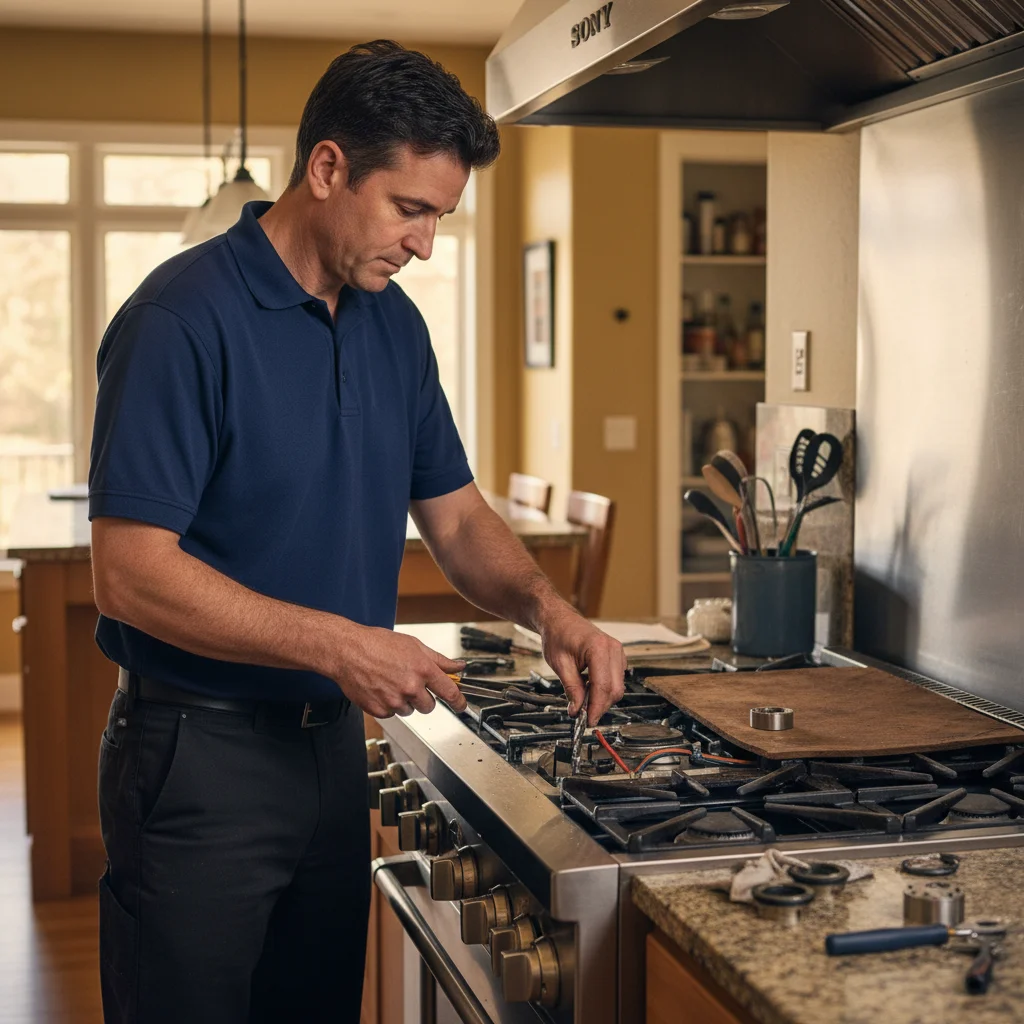
- Test under heat. Igniter, bake and broil elements, gas valve, convection motor, probe, and door latch — we check the components while the oven actually runs a cycle.
Why altitude and water shape the diagnosis
At about 5,280 feet the air holds roughly 15% less oxygen, so a gas burner or range oven set to a sea-level orifice burns rich — yellow flames, sooty patches, and heat that wanders in ways that mimic a broken part. On dual-fuel units the electric cavity then leans harder on its sensor and fan to compensate. We retune combustion for the elevation before condemning a component. Two more local factors stack on top: Lakewood’s very dry, high-UV air hardens door gaskets early, forcing the thermostat to overcorrect, and our hard water — commonly 150 to 250 ppm — scales the steam and self-steam systems on upscale ovens. We have weighed all three into every Lakewood diagnosis since 2012.
Units and brands we cover
We repair freestanding gas, electric, and dual-fuel ranges, built-in single and double wall ovens, stacked oven towers, and pro-style ranges across the major premium and standard brands found in Belmar condos, Green Mountain remodels, and West Colfax ranches alike. As an independent shop, we are not affiliated with, endorsed by, or sponsored by any manufacturer.
Book your Lakewood oven repair
Repairs run daily, 8:00 AM to 6:00 PM, and the phone is answered 24/7, so you can call the moment dinner goes sideways. Call (720) 770-4189 or book online, and a technician will be at your Lakewood door — Belmar loft or Green Mountain remodel — to find the true fault and quote it up front. The $89 service call covers the diagnosis and credits toward the repair.