Quick orientation: what to expect from a Lakewood visit
When a built-in refrigerator quits cooling or a pro range starts burning lazy flames in Lakewood, the worst thing a repair company can do is start swapping parts on a hunch. A Sub-Zero drifting warm is not one problem — it could be a stalled evaporator fan, a condenser packed with dust from a hillside lot’s wind-blown grit, a defrost circuit out of time, or a slow leak in the sealed system. Each of those is a different repair at a different price, and only one of them is the right one. So the first thing we do on site is figure out which.
That is the whole philosophy here: identify the genuine cause, explain it in plain language, and hand you a clear, up-front number before anyone touches the appliance. The $89 diagnostic service call pays for that inspection, and it is credited toward the repair the moment you approve the work. Nothing gets done without your sign-off, and nothing surprising shows up at the end. In a town where kitchens swing from modest ranch galleys to fully custom remodels, that honest diagnosis is what separates a one-trip fix from a string of return visits.
We have served the Denver metro since 2012, and the west side — Lakewood especially — is a core part of that work. Below is a fuller picture of why this particular suburb shapes the repairs we do, and what tends to go wrong in its kitchens.
Lakewood kitchens: ranches, Belmar, and the Green Mountain remodels
Lakewood sits on Denver’s western edge, the metro area’s gateway to the foothills, and its housing tells the story of how the west side grew. Roll through the neighborhoods and the contrast is immediate. Around Belmar — the redeveloped downtown core where Alameda meets Wadsworth, with its grid of walkable streets, lofts, and townhomes set against the green expanse of Belmar Park — you find newer, design-forward residences where the kitchen was treated as the showpiece. Climb west into the Green Mountain neighborhoods, the hillside grid wrapping up toward William F. Hayden Park, and the stock shifts to solid 1960s and 1970s ranches and split-levels on sloping lots, many of them gutted and reborn over the past two decades.
That range is the defining trait of Lakewood, and it matters for appliance repair. A single suburb gives us:
- Original mid-century ranch kitchens off West Colfax and along the older Wadsworth corridor — compact galleys built for a freestanding fridge and a 30-inch range, many now upgraded piece by piece.
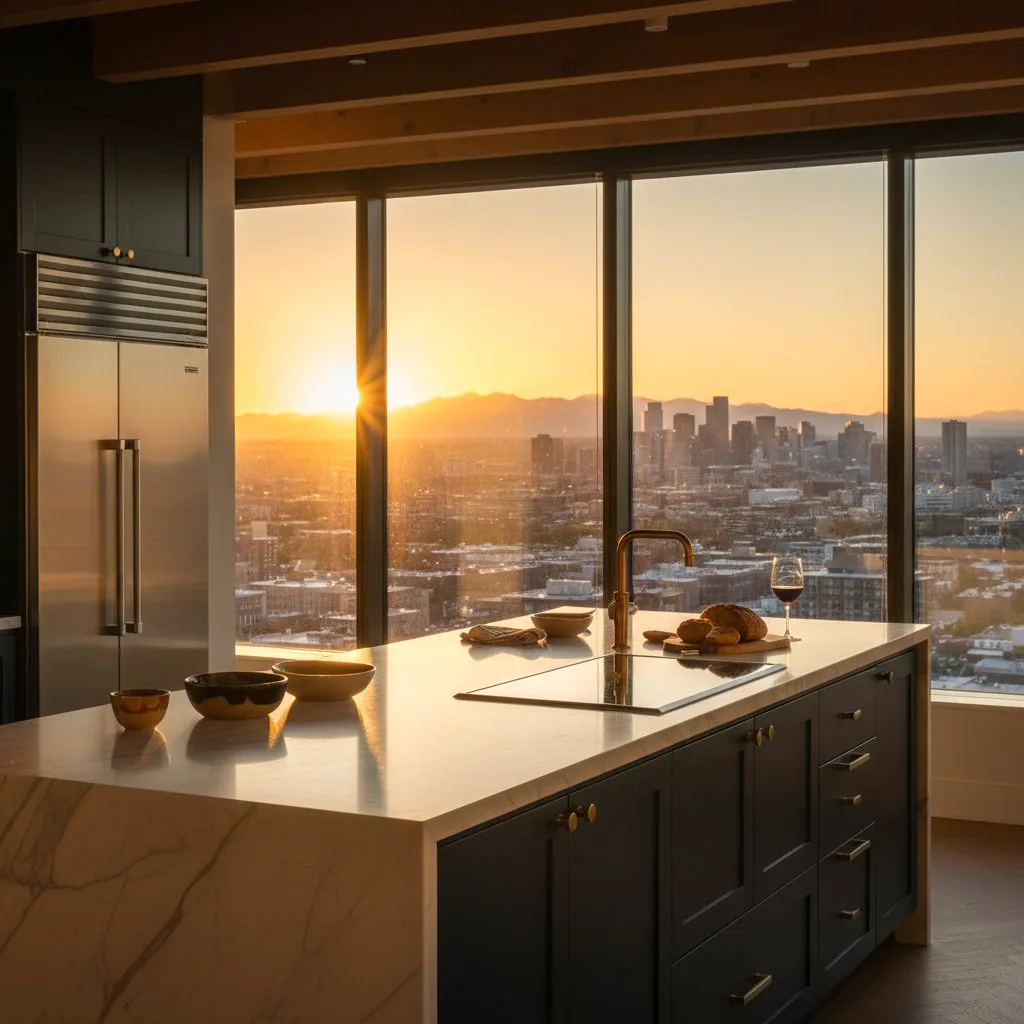
- Green Mountain hillside remodels, where an aging ranch has been opened up and rebuilt around a built-in Sub-Zero column, a pro gas range, and panel-ready cabinetry that hides the appliance entirely.
- Belmar-district modern homes and townhomes, designed from the start around integrated refrigeration, under-counter beverage drawers, and built-in dishwashers.
- Foothill-edge custom builds toward the mountains, where wine columns and dual-zone storage show up alongside high-BTU rangetops.
The common thread is that across all of it, premium, built-in equipment has become the norm — sometimes installed clean in a new build, sometimes retrofitted into a house that was never designed to hold it. Both situations are squarely our specialty, and both reward a technician who reads the installation as carefully as the appliance itself.
Most common faults we track down in Lakewood
Across Belmar’s modern kitchens and Green Mountain’s remodeled ranches, the same failures keep surfacing. Here is what we most often diagnose in the neighborhood:
- A built-in column slowly losing its chill. Usually a clogged condenser, a failed evaporator or condenser fan, a worn start relay, or a sealed-system refrigerant issue. In a flush-paneled remodel, airflow around the cabinet is already tight, so the condenser loads up and the unit overheats earlier than a freestanding fridge would.
- A wine column drifting off temperature or splitting between zones. Causes run from a failing thermistor or control board to a sealed-system fault. On dual-zone units the two compartments can fail independently — one holds while the other will not.
- Frost sheeting across the back wall of a freezer. Typically a defrost heater, a defrost sensor, or a control board mistiming the cycle.
- A compressor that runs and runs without ever cycling off. Often a dusty condenser, a weakening fan, or a door gasket that no longer seals — and Lakewood’s dry, windy hillside air is hard on gaskets, so seal failure shows up early here.
- An ice maker that slows, jams, or turns out small, cloudy cubes. Extremely common, and almost always scale-related thanks to the hard local water.
- A pro range or cooktop burning weak, yellow-tipped, or uneven flames. Frequently a combustion-and-altitude problem rather than a broken burner — more on that below.
- An oven that overshoots or will not hold its set temperature. Igniters, temperature sensors, and control boards are the usual suspects.
- Water pooling beneath a fridge, dishwasher, or wine unit. Often a blocked defrost drain, a cracked drain pan, or a scaled-up water line.
What we service across the neighborhood
Within Lakewood, we regularly handle:
- Built-in and integrated refrigerator repair — full-height columns, panel-ready units, and under-counter drawers, including retrofits in older ranch kitchens.
- Wine column and beverage center service, including dual-zone temperature and sealed-system diagnosis.
- Freezer and ice maker repair, with close attention to the scale-and-water problems that dominate locally.
- Professional range, cooktop, and rangetop repair — gas and dual-fuel, accounting for altitude-affected combustion.
- Wall oven and built-in oven repair — temperature accuracy, igniter, and control-board faults.
- Built-in and integrated dishwasher repair, where hard-water scale and drain issues lead the list.
If your specific symptom is not spelled out here, it still belongs on the phone with us. These are the patterns we see, not the limits of what we fix.
Parts and making the repair last
A premium appliance is engineered as one interdependent system: a sealed refrigeration loop, a precise control board, and a set of airflow and water paths that all rely on each other to behave. Fit a generic substitute into that system and you can be chasing the very same fault again within a year. That is why we use OEM-grade and manufacturer-compatible parts from verified suppliers, matched to your exact model and serial number.
The case for getting it right the first time is even stronger in Lakewood, where so many built-ins are wedged into remodeled ranch cabinetry. Pulling a paneled column back out of a tight Green Mountain cabinet run for a second visit means navigating the same awkward clearances all over again — and risking the same custom millwork twice. Sourcing the correct component up front is not only about reliability; in a rebuilt kitchen, it is about not disturbing the remodel more than once.
When the technician wraps up, you get a straight account of what failed, what was replaced, and why. If a part has to be ordered for an older or less common model, we tell you that on the first visit and set a clear expectation for the return — rather than leaving you wondering when your kitchen will be whole again.
The altitude and water angle — why west-metro physics matters
A lot of repair advice online is written for sea-level kitchens, and it quietly steers technicians wrong out here. Lakewood sits at Denver’s mile-high elevation, and in the foothill-edge neighborhoods around Green Mountain the ground actually climbs higher still. That is not a marketing line — it genuinely changes how these appliances behave, and three local realities shape nearly every diagnosis we make.
Thin air at 5,280 feet and up. The atmosphere here is roughly 15% less dense than at the coast, and refrigeration depends on moving air to shed heat. Condensers and cooling fans are pushing thinner air, so a built-in fridge or wine column that is even slightly dusty or short on clearance — precisely the case in a tightly fitted Lakewood remodel — struggles to reject heat sooner than the same unit would near an ocean. Refrigerant charge and compressor heat rejection are both sensitive to that thinner air, which is one reason a national service manual written for a humid lowland city can mislead a technician on a Green Mountain hillside.
Combustion shifts on every gas appliance. Thinner air carries less oxygen per cubic foot, and that changes how a gas range, cooktop, or oven burns. Orifice sizing and the air-to-fuel mixture dialed in at sea level can produce lazy, yellow-tipped, or sooty flames at this altitude. When a pro range in a Belmar-district kitchen suddenly burns unevenly, the cause is often combustion-and-altitude rather than a failed burner — and the right correction is an orifice or mixture adjustment, not a parts swap.
Hard water and very dry, UV-heavy air. Denver-area water tends to run hard, commonly in the 150 to 250 ppm range, and that mineral load is rough on ice makers, dishwasher internals, and the slim water lines feeding built-in refrigerators and wine units. It is the leading reason ice output drops off or cubes come out cloudy and undersized in Lakewood kitchens. On top of that, Colorado’s very dry climate and intense high-plains UV harden and crack door gaskets faster than a humid region would — and the wind that sweeps off the Green Mountain slopes only accelerates that wear. A gasket that no longer seals lets warm air seep in, the compressor runs longer, and the whole system labors. We check seals on every refrigeration diagnosis specifically because this climate ages them early.
These are the details a sea-level playbook skips, and they are built into how we approach every appliance in Lakewood.
Related repairs while we are already on site
Lakewood kitchens rarely have just one premium appliance, so once a technician is at your home, it makes sense to look at the others. Common companion jobs include a built-in freezer column standing next to the fridge, a second integrated dishwasher in a larger island, an under-counter beverage drawer in a bar area, and the wine storage tucked into a pantry or wine wall in the newer foothill-edge builds. If a range burner has been lighting slow, an ice maker has gone quiet, or an oven has been running hot, mention it when you book and we will plan the appointment to cover everything in a single trip instead of several.
How to book a Lakewood repair
Getting on the schedule is simple, and we have arranged it around how the west metro actually lives:
- Call (720) 770-4189. The phone is answered 24/7, so you can reach a real person whenever a problem comes up — late at night, first thing in the morning, or over a weekend.
- Or book online at any hour that works for you.
- Repairs are performed daily, 8:00 AM to 6:00 PM. We will confirm a window and check any access details — a steep Green Mountain driveway, a retrofitted built-in, custom cabinetry around the unit, or a parking note for a Belmar-district block.
- The $89 diagnostic service call covers a full on-site inspection and is credited toward your repair.
We have served the Denver metro since 2012, and Lakewood — with its mid-century ranches near West Colfax, its Green Mountain hillside remodels, and the modern kitchens around Belmar — is exactly the kind of work we are built for.
Ready to get a built-in fridge, wine column, pro range, or dishwasher back in service? Call (720) 770-4189 or book online today — same-day and next-day appointments are available throughout Lakewood and the west Denver metro.