Wine doesn’t fail loudly. A cooler that has drifted three or four degrees won’t trip an alarm or pool water on the floor — it just quietly cooks the bottles you were saving, and by the time the cork tells you, a stocked Hilltop cellar can be a five-figure loss. Catching the drift early is the whole game, so the fix starts the moment the set point stops holding: get a technician in front of the unit, find what actually slipped, and stop the slow bake before the rack pays for it.
What you are seeing
Around Hilltop the complaints cluster into a familiar handful:
- The cabinet won’t hold its set point, or one side of a dual-zone runs warm while the other stays dead-on.
- A new hum, rattle, or vibration that resonates through the surrounding millwork.
- Frost forming on the back wall, condensation sweating on the glass, or water collecting at the base.
- The display and interior lights work, but the cooling stage never kicks in.
- Short-cycling — the unit clicks on and off without ever pulling the cabinet down to temperature.
What it usually means
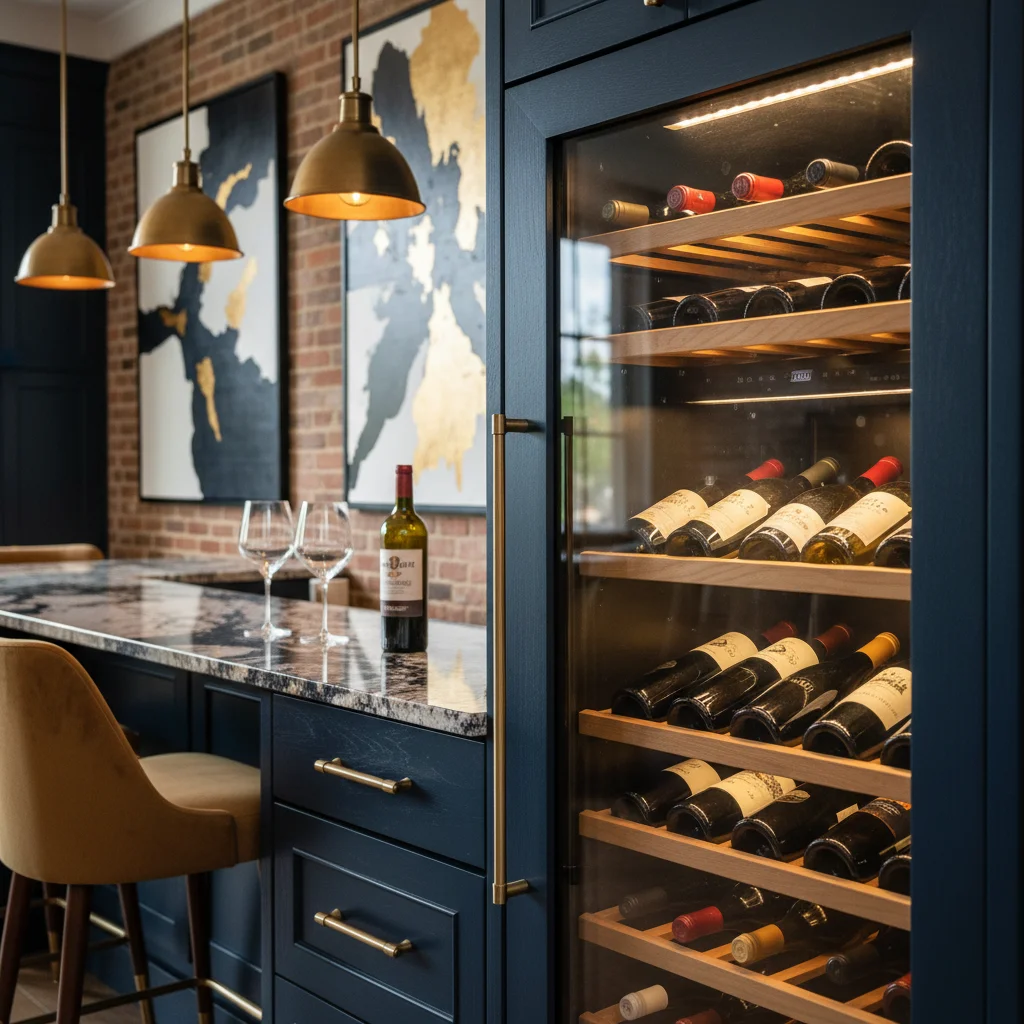
These homes change what those symptoms point to. In the mid-century estates near Cranmer Park and the new custom builds going up between them, the wine unit is rarely a freestanding box on a wall. It’s an integrated column or a bank of under-counter drawers, flush-set into cabinetry that was never designed around the cooler’s ventilation. So a “warm cooler” is often two questions: what failed inside, and what is the install doing to it.
At 5,280 feet the air is roughly 15% thinner, so every condenser sheds less heat than its maker assumed at sea level. In an open kitchen that margin disappears; in a column boxed into custom millwork with an inch of breathing room, it’s the difference between steady storage and a slow climb out of range. Denver’s dry climate hardens door gaskets early — that’s the usual culprit behind frost and sweating — and on water-fed beverage models the hard local supply (about 150–250 ppm) lays down scale worth checking.
Our approach
Read the install before the parts
We start by looking at how the unit lives in the cabinet — whether a too-tight alcove or a blocked front grille is choking the condenser before we ever blame a control board. In a Hilltop kitchen that finish work cost real money, so access gets planned around the panels, not forced through them.
Test it running, under load
Then we measure: actual zone temperatures, stored fault codes, and the compressor, condenser and evaporator fans, thermostat, thermistors, and control board working under load. For thermoelectric under-counter coolers we test the Peltier stack instead, since those fail nothing like a compressor unit.
Trace the sealed system and the seal
We follow the sealed refrigeration loop and inspect the door gasket — refrigerant leaks surface faster in thin air, and a dry-climate gasket is the single most overlooked cause of a cooler that won’t stay cold.
Coverage & brands
We’ve serviced Denver metro kitchens since 2012 and cover all of Hilltop — Cranmer Park, the estate blocks along Bellaire and Birch, and the new builds toward Holly and Colorado Boulevard. We work on built-in wine columns, integrated under-counter and drawer units, and freestanding single- and dual-zone coolers across the major luxury and mainstream brands, fitting OEM-grade, model-matched parts.
Get it fixed
Repairs run daily 8:00 AM–6:00 PM and the phone is answered 24/7, so same-day or next-day slots are usually open. Call (720) 770-4189 or book online anytime. The $89 diagnostic brings a technician to your Hilltop door, pinpoints the real cause, and goes straight toward the repair once you approve it.