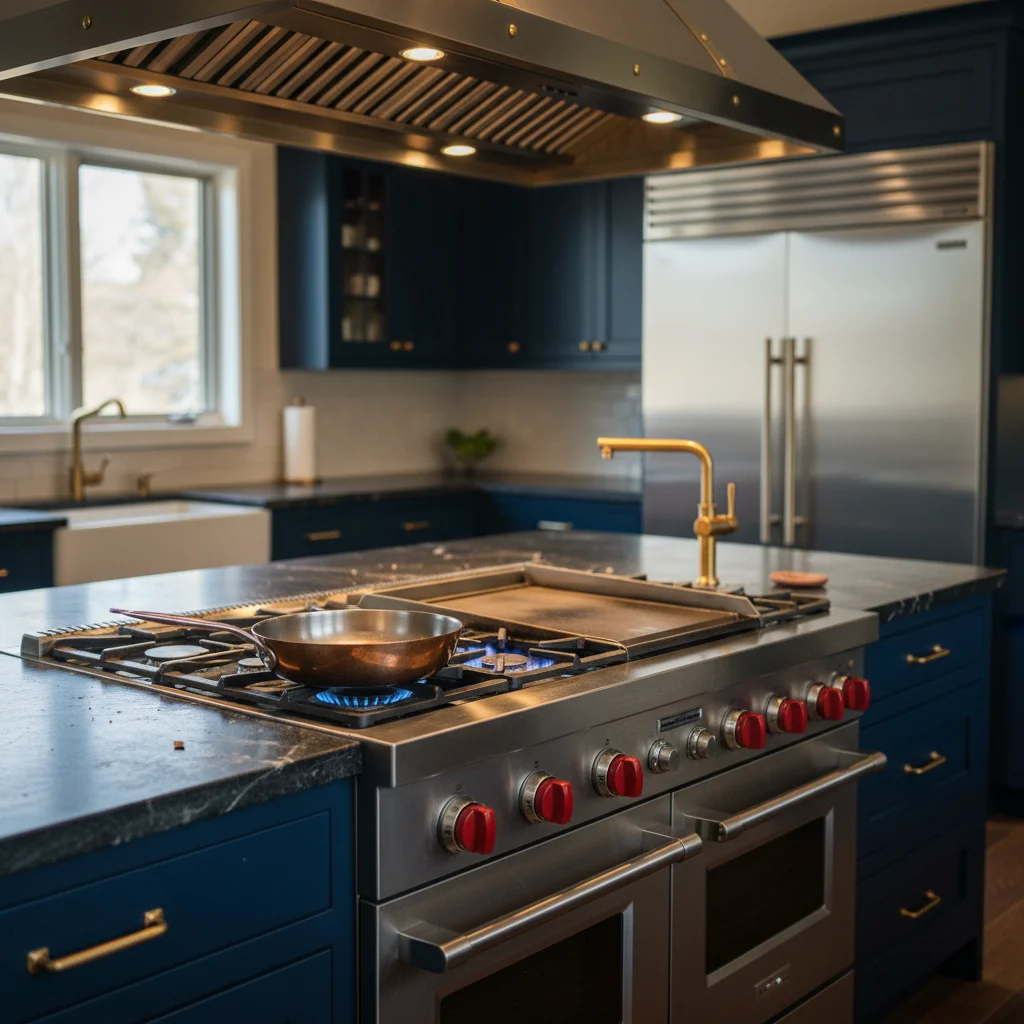
The range may be the loudest appliance in a Hilltop kitchen, but it rarely works alone. In the estates around Cranmer Park, a wide professional range sits in a room engineered around full built-in refrigeration and a dedicated wine cabinet — and when it falters, the whole kitchen feels off. Before we condemn a single part, we read the appliance the way it actually behaves at 5,280 feet and inside its custom surround.
Quick orientation
Hilltop spreads across east Denver around Cranmer Park, a pocket of mid-century brick estates and a steady run of new custom builds rising where older ranches once stood. What links them is ambition in the kitchen: large luxury layouts with built-in refrigerator columns, separate freezer drawers, wine storage, and a serious range as the centerpiece.
A range is really two appliances under one frame — a cooktop above, an oven below — and either half can wander out of spec while the other reads fine. So we diagnose the whole unit, not only the burner you called about. In a flush install we also check clearance and venting first, because trapped heat ages igniters and control boards long before the steel looks tired.
Most common faults
- Soft yellow flames and soot — usually air-fuel settings tuned for denser air, not a failed burner. At altitude the fix is often orifice and air-shutter correction.
- A burner that clicks but won’t light — a clogged port, a cracked electrode insulator, moisture, or a spent spark module.
- An oven that won’t hold its setpoint — typically a weak bake igniter, a drifting oven sensor, or a control board misreading the cavity.
- Uneven baking on a wide oven — frequently a slowed convection fan, an off-calibration sensor, or one heating element underperforming.
- A simmer that won’t stay low — a gummed gas valve or a burner cap seated slightly off true.
- Induction zones that won’t sense a pan — overheating coils, a fan fault, or a failing power module.
Parts & longevity
We fit OEM-grade and manufacturer-compatible parts from verified suppliers, matched to your exact model and serial. On the components that decide how long a repair holds — igniters, gas valves, oven sensors, spark modules, and control boards — we use the part the range was engineered around, never a generic stand-in.
Longevity also depends on chasing the fault to its root. An igniter that died because heat was trapped in a tight surround means a fresh one is simply next in line, so we follow the chain back rather than treating the symptom. As an independent shop, we’re not affiliated with any manufacturer — we just specialize in this equipment.
The altitude and water angle
Three local forces shape nearly every Hilltop range repair, and we weigh all of them before reaching for a part:
- Thin air rewrites combustion. Denver’s air carries about 15% less oxygen than at sea level, so a burner or gas oven tuned elsewhere runs rich and ignites harder here. Altitude tuning frequently solves what looks like a hardware failure.
- Hard water scales anything plumbed. The local 150–250 ppm supply builds scale in the valves and lines feeding steam ovens, griddles, and pot fillers — common features in these kitchens.
- Dry air and strong UV harden seals. Low humidity and intense Colorado sun stiffen oven door gaskets early, letting heat escape so the oven cycles harder to compensate.
We’ve built these factors into every diagnosis since 2012, which is why a Hilltop range can misbehave without an obviously broken component.
How to book
On-site repairs run daily, 8:00 AM to 6:00 PM, and the phone is answered 24/7, so you can call the moment a burner stalls or the oven drifts. Call (720) 770-4189 any hour or book online. The diagnostic is a flat $89 applied to the repair, you’ll have an up-front price before we begin, and most Hilltop visits land same-day or next-day.