A wine cooler in a Highland kitchen seldom dies with a bang — it just quietly stops holding the number it has held for years. The interior light still glows, the fan still turns, but the cabinet that read 55 now reads 62, and the bottles racked inside are slowly warming. In a stocked unit that drift is the entire problem, so the repair starts the instant the set point slips: put a technician in front of the unit, find what actually changed, and stop the slow bake before the rack pays for it.
Getting our bearings
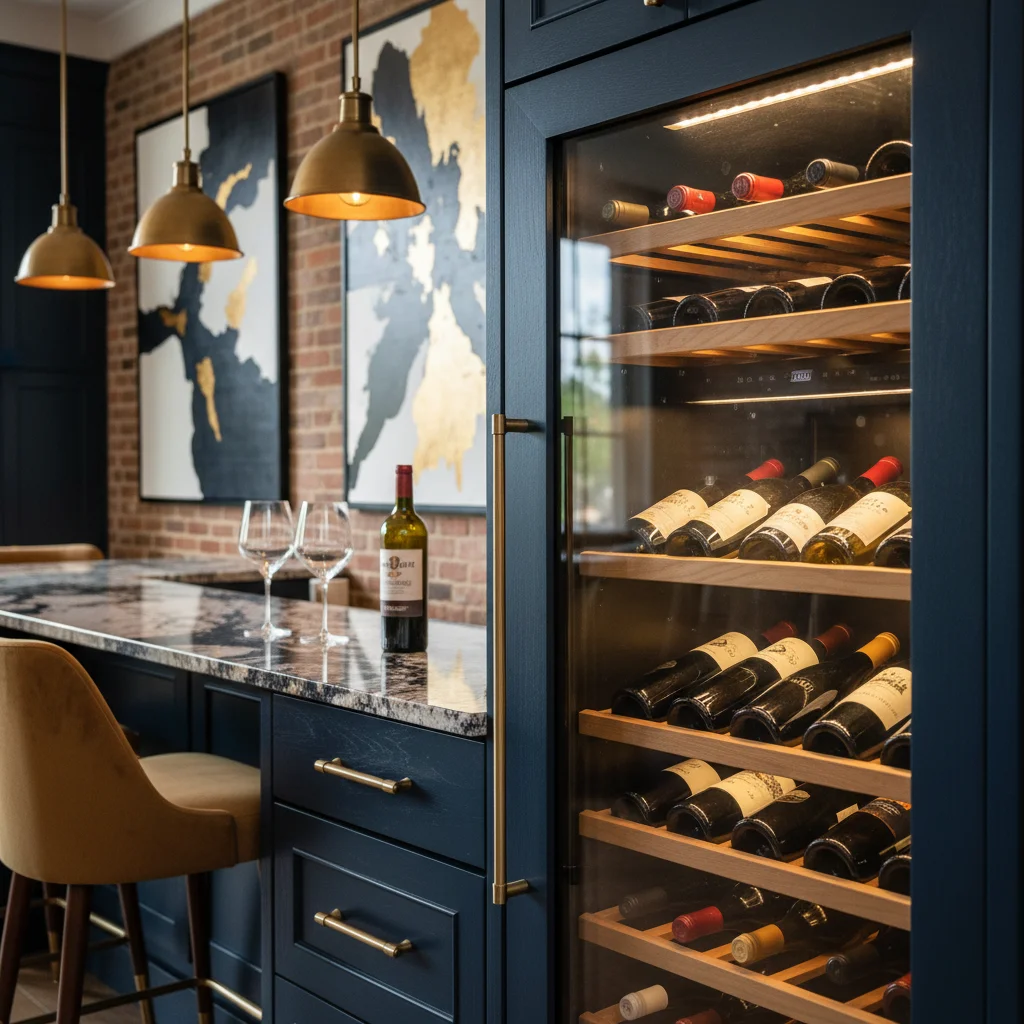
Highland sits on the bluff across the river in northwest Denver, and its housing tells two stories at once. There are the scrape-and-build moderns — flat-roofed, glass-fronted, dropped onto lots where a bungalow used to stand — and the restored Victorians around 32nd and Lowell that kept their bones but swallowed a full built-in suite inside. Both share a habit: the wine unit is rarely a freestanding box. It’s an integrated column flush with the cabinetry, a bank of under-counter drawers beneath a stone island, or a slim cooler wedged into a reframed Victorian pantry. So a “warm cooler” here splits into two questions — what failed inside, and what is the installation doing to it.
Faults we see most
- The cabinet won’t hold its set point, or one half of a dual-zone runs warm while the other stays put.
- A fresh hum, rattle, or vibration that telegraphs through custom millwork in an otherwise quiet kitchen.
- Frost on the back wall, condensation sweating across the glass door, or water pooling at the base.
- A thermoelectric under-counter drawer that powers up but never pulls down to temperature.
- Lights and display work, yet the cooling stage never kicks in — or the unit short-cycles without ever reaching its set point.
We trace these in order: confirm the real cabinet temperature against the set point, check the install’s grille clearance and airflow, test the sealed system and compressor under load, diagnose each zone separately on dual-zone units, then inspect the door gasket for dry-climate shrinkage.
Parts and how long the fix holds
What decides whether a repair lasts isn’t the visit — it’s what goes back into the unit. We diagnose down to a specific failed part and replace it with OEM-grade or manufacturer-compatible components matched to your model and serial: compressors, condenser and evaporator fan motors, thermistors, control boards, dampers, and door gaskets. On a flush column built into a Highland modern’s millwork, a generic part that almost fits is a callback waiting to happen; a piece spec’d to your cooler is the one that holds.
The altitude and water angle
At 5,280 feet the air is roughly 15% thinner, so every condenser sheds less heat than its maker assumed at sea level. In an open kitchen that margin quietly evaporates; in a column boxed into millwork or a cooler pressed into a renovated Victorian alcove — exactly how Highland tends to build — it can be the difference between steady cellar temperature and a slow climb out of range. Denver’s bone-dry climate hardens gaskets early, the usual story behind frost and a sweating glass door, and the strong UV off the bluff ages them faster still. Where a unit feeds a humidified cabinet, hard local water near 150–250 ppm scales the line before flow chokes. We read all three forces into the diagnosis from the first reading.
How to book
Repairs run daily from 8:00 AM to 6:00 PM, and the phone is answered 24/7, so same-day or next-day slots are usually open. Call (720) 770-4189 or book online anytime. The $89 diagnostic brings a technician to your Highland door, pinpoints the true cause, and credits straight toward the repair the moment you approve it — quoted up front, never padded later.