What you’re noticing
Picture a weeknight in your Highland kitchen: the oven you preheated for the roast still reads cold, or the front burner clicks and clicks but never catches. It is tempting to nurse it along for another week, but a delayed range repair rarely stays cheap or simple. A burner sparking against unburned gas is a real hazard in a sealed-tight new build. An oven straining at the wrong temperature wears its igniter and element faster. A simmer you cannot trust ruins food and pushes you toward takeout night after night. Naming the exact fault now — and fixing it once — beats babying a failing range until it strands you. The $89 service call covers a full inspection and comes off the repair when you approve it.
What it usually means
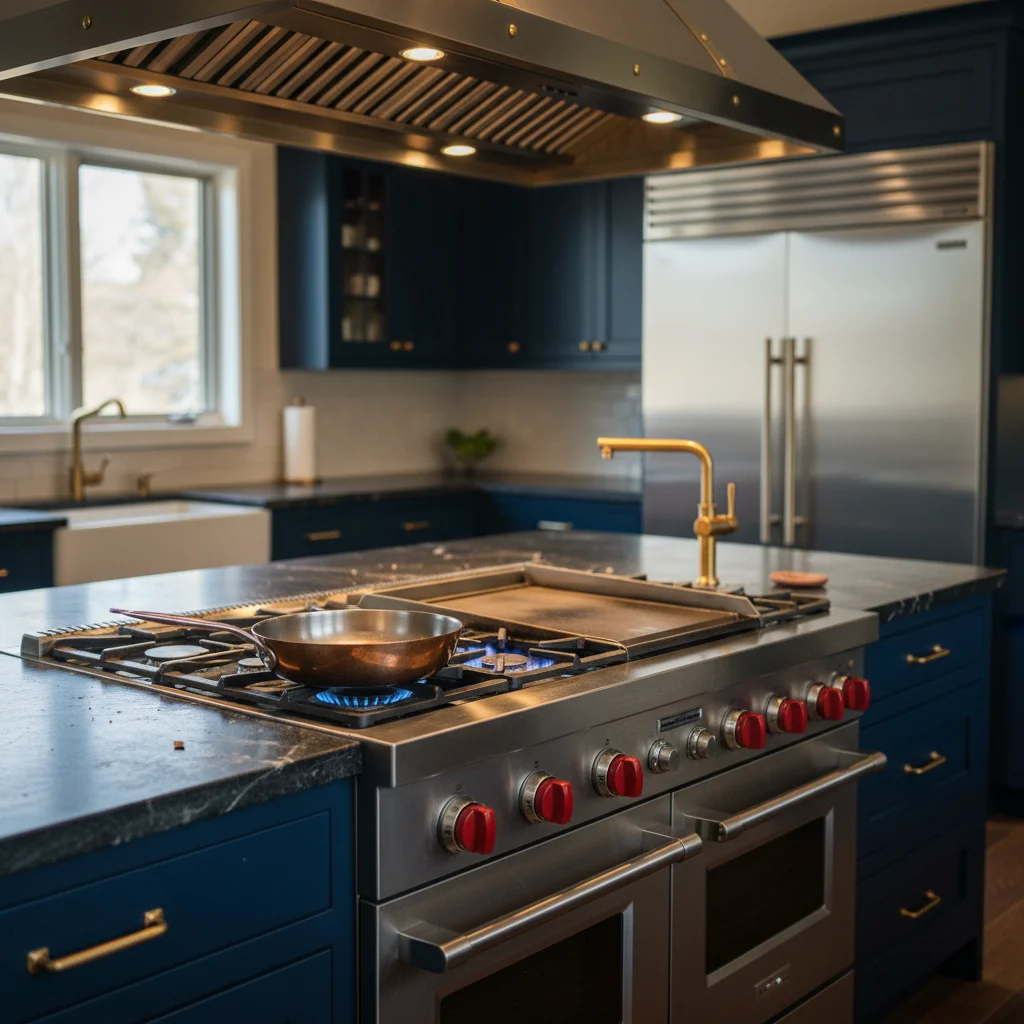
Highland is unlike most Denver neighborhoods, and its kitchens show it. Climb above the 16th Street viaduct and you find scrape-and-build moderns squeezed onto narrow lots sitting right next to Victorians that have been stripped back and rebuilt inside. Both ends of that spectrum tend to share one thing: a full built-in suite, with a pro gas or dual-fuel range flush against panel-ready refrigeration in a tight, photogenic run.
That layout shapes the failures we see. A range like this is really two appliances in one frame — a cooktop up top, oven cavities below — and either half can slip out of spec while the other looks perfect. Boxed into a compact custom alcove with little ventilation, the heat and constant thermal cycling have nowhere to escape, which slowly bakes the control electronics. Common culprits up here:
- Sealed gas burners — clogged ports, worn electrodes, or a valve that won’t hold a low simmer.
- Ignition — a dead spark module or a harness jarred loose when a heavy range was eased back into its slot.
- Oven heating — fatigued bake igniters, drifting temperature sensors, and spent bake, broil, or convection elements.
- Induction and electric — failed coils, worn infinite switches, or a power module that has lost its interface.
Our approach
Reading the real fault on site
We start by watching the failure happen, then check how the range breathes inside its run — a boxed-in install in a sealed new build can overheat its own controls and throw misleading codes.
Cooktop and oven, tested separately
On the cooktop we test the spark module, electrodes, valves, and flame quality, watching for the altitude-rich burn before pulling any part. In the oven we measure bake igniter draw, sensor resistance, and the elements under load, and we read stored fault codes where the model keeps them so a tired sensor isn’t mistaken for a dead board.
The Highland environment factor
Three local forces shape every diagnosis up here. The thin mile-high air leaves a sea-level burner running rich and a marginal igniter short of its firing point — often a tuning fix, not a replacement. The very dry, high-UV climate hardens oven door gaskets early, so heat leaks and the oven cycles harder. And on any water-fed range, Denver’s 150–250 ppm hard water scales the injector valves and supply lines. We weigh all three before reaching for a part, then hand you one plain-language cause and a firm price.
Coverage & brands
We cover Highland end to end — the moderns along Boulevard and Zuni, the restored Victorians off Tejon and 32nd, and the blocks running down toward LoHi. We service pro-style gas, dual-fuel, electric, and induction ranges, and we fit OEM-grade and manufacturer-compatible parts from verified suppliers, matched to your model and serial. Since these kitchens rarely have just one premium unit acting up, we can also look at your built-in refrigerator, freezer column, or integrated dishwasher in the same visit.
Get it fixed
Call (720) 770-4189 any hour — the phone is answered 24/7 — or book online. On-site repairs run daily 8:00 AM to 6:00 PM, the diagnostic is a flat $89 applied toward the repair, and you always get an up-front price before we begin. Independent and serving the Denver metro since 2012.