What’s actually going wrong
A range tends to quit at the worst moment in Golden — a dinner party in a canyon-mouth custom kitchen, a holiday roast in a home tucked under South Table Mountain. Letting it slide rarely saves money. A burner that clicks and clicks before catching dumps raw gas into the room every cycle; an oven that runs cold quietly ruins meal after meal; a surface igniter left arcing can scorch nearby millwork. Wait a week and a five-minute igniter swap can grow into a damaged valve or a fouled board.
So which of these are you living with?
- A burner that sparks over and over, lights late, or won’t light
- A flame that burns lazy and yellow and soots the bottoms of pans
- An oven that preheats forever and never quite hits temperature
- One dual-fuel cavity gone dead while the rest of the range still cooks
- An induction zone that drops power or cuts out mid-cook
- A surface igniter that ticks on its own with every knob off
The Golden and altitude factors first
Where your range sits on Golden’s terrain shapes the diagnosis. Down in the older streets near Washington Avenue and the creek, a clicking burner is usually a worn electrode, a cracked ceramic insulator, or a port clogged with years of boil-over. That weak yellow flame, though, is almost never a broken burner — it’s the elevation. Golden climbs above Denver’s 5,280-foot baseline, and on the higher foothills lots the air thins further, running roughly 15 percent leaner on oxygen than sea level, so a burner set for the coast burns rich until the air shutter or orifice is corrected.
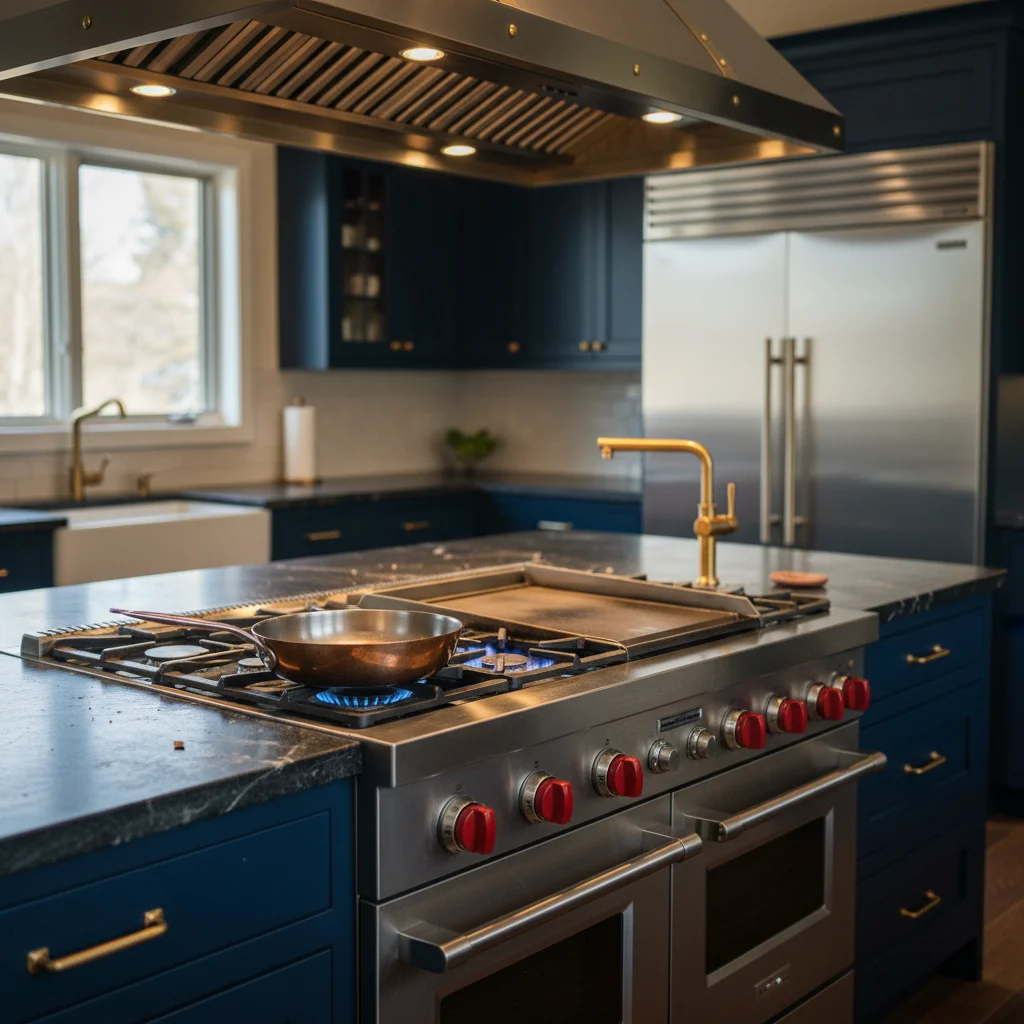
The custom homes climbing toward South Table Mountain fail differently. A pro range flush-set into cabinetry beside built-in refrigeration is two appliances in one frame, boxed into a run with almost no ventilation. Trapped heat and constant thermal cycling wear the electronics, so a dead cavity or a phantom igniter often traces back to the board, not the burner you’re watching. Golden’s bone-dry, high-UV foothills air also stiffens oven door gaskets early, leaking heat and skewing cavity temperature.
How we diagnose it on site
- Trigger the fault, then read the install. We reproduce the symptom first, then check how the range breathes inside its cabinetry — a boxed-in foothills build can overheat its own controls and mimic a part failure.
- Test the cooktop honestly. We check the spark module, electrodes, valves, and flame quality, watching for that altitude-rich burn before condemning anything. Most yellow-flame and slow-light calls end in tuning, not replacement.
- Measure the oven, don’t guess it. We read bake igniter draw, sensor resistance, and the elements under power, pulling stored fault codes where the model keeps them.
- Trace any water path. On steam-assist or pot-filler models we check valves and lines for the hard-water scale common out here.
- Quote one firm price. You get the cause in plain language and a single up-front number, millwork protected, before any work begins.
Components we service
We work freestanding and slide-in ranges, wide dual-fuel units, induction and electric cooktops, and pro-style gas built into custom Golden kitchens — burners and air shutters, orifices, spark modules and electrodes, gas valves, bake and broil igniters, elements, temperature sensors, door gaskets, and control boards. Parts are OEM-grade and manufacturer-compatible from verified suppliers, matched to your model and serial. As an independent shop running since 2012, we’re not affiliated with any manufacturer.
Same-day scheduling in Golden
Call (720) 770-4189 any hour — the phone is answered 24/7 — or book online. On-site repairs run daily 8:00 AM to 6:00 PM, the diagnostic is a flat $89 applied toward the repair, and you always have an up-front price before we start. From a canyon-mouth bungalow to a built-in under South Table Mountain, we find the real cause and quote it first.