The most common Golden call starts the same way: dinner is in, the oven was preheating, and then it just stopped — a fault code, a cold cavity, or a burner that clicks without catching. Before we name a cause, we read two things: the kitchen the oven sits in, and the thin foothills air around it. The $89 service call buys that full diagnosis and credits toward the repair once you say go.
What we’re looking at in Golden
Golden’s geography splits its kitchens neatly. Down on the valley floor near Clear Creek and Washington Avenue, the older housing stock leans toward freestanding gas ranges and the occasional wall oven dropped into a mid-century remodel. As you climb the canyon mouth and the slopes below South Table Mountain and Lookout, the newer custom builds favor flush-set wall ovens — often doubles, or an oven stacked with a steam unit — sealed into cabinetry with barely a finger of airflow to spare.
That elevation gradient matters. A range near the creek and a built-in hundreds of feet higher up the hill fail differently, because the higher you climb above Denver’s baseline, the less oxygen the burner has to work with.
Symptoms and what usually causes them
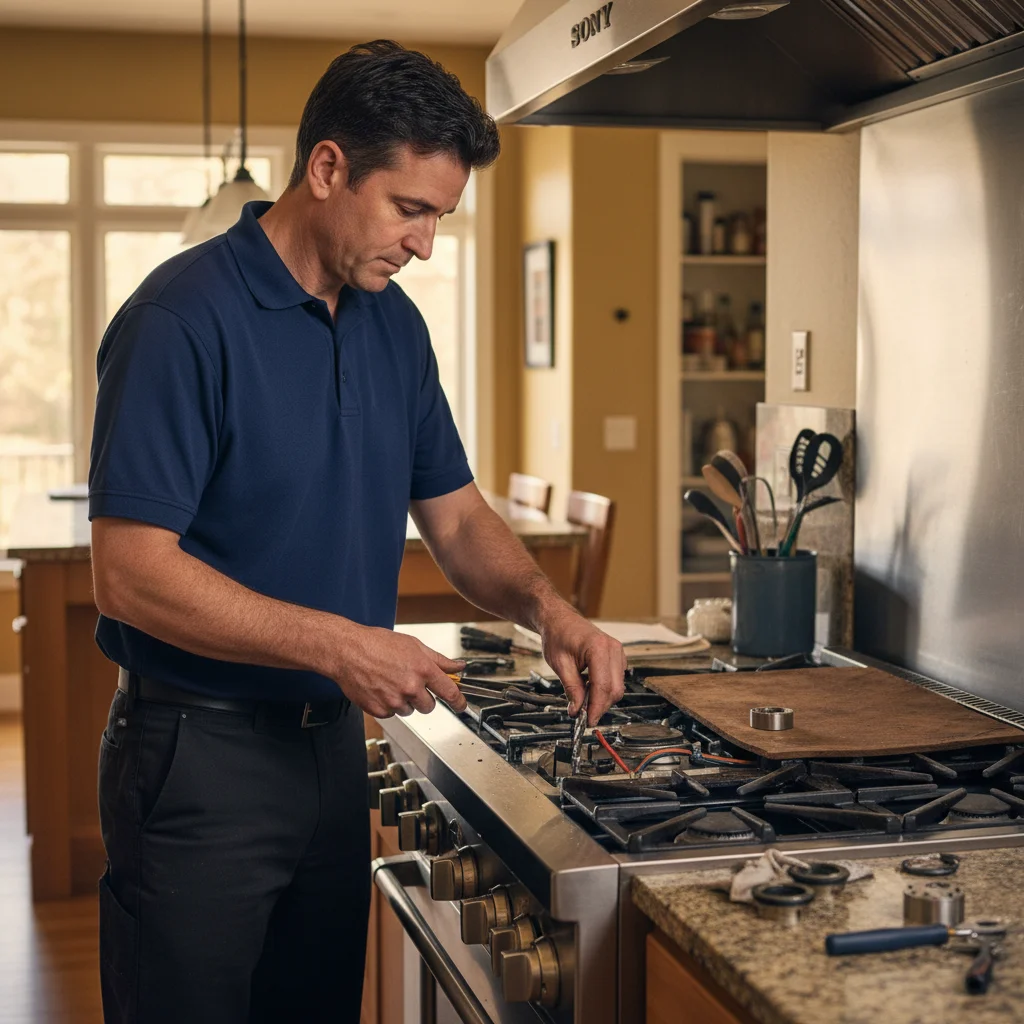
The complaint almost always points us at the part:
- Slow, late light with a whiff of gas — a fading bake igniter losing its grip on the safety valve
- One edge of the pan scorches, the rest stays pale — a drifting sensor, a tired convection fan, or combustion running rich for the altitude
- Cavity overshoots and bakes hot — a door gasket the dry climate has stiffened, leaking heat past the seal
- Self-clean locks and stalls halfway — a strained latch or thermal fuse, common in a flush, poorly vented foothills install
- A stored fault code you’ve learned to dismiss — often the first warning on a built-in below South Table Mountain
- Soft yellow flame instead of tight blue — the orifice burning rich for the elevation, not a broken valve
How we run the diagnosis
We don’t carry a part to the door and hope. The visit follows a fixed order:
- Confirm the symptom with you and pull any stored fault codes off the control board.
- Meter the live components — igniter draw against the gas valve, sensor resistance against temperature, element continuity.
- Check the install — on a flush foothills built-in, trapped heat and starved airflow climb the suspect list before any part does.
- Evaluate combustion on gas and dual-fuel units, because rich altitude burning imitates a half-dozen failures.
- Quote the repair up front, then fit the correct OEM-grade or manufacturer-compatible part matched to your model and serial.
You see the full price before anything comes apart, and it holds.
Why the foothills are hard on ovens
Three local conditions quietly wear an oven down. The thin air — Golden sits above Denver’s 5,280-foot line, with roughly 15% less oxygen — leans a sea-level burner rich, throwing soot, yellow flame, and drifting heat that all look like a dead sensor or valve. The very dry, high-UV climate ages door gaskets fast, so a flush built-in leaks heat and runs the thermostat ragged. And the hard local water, commonly 150 to 250 ppm, scales the reservoirs and feed lines on the steam-assist ovens common in foothills kitchens. We weigh all three before condemning a part.
Brands and related repairs
Serving the Denver metro since 2012, we work across the major built-in and pro brands — wall ovens, gas and dual-fuel ranges, and steam units. Since many Golden kitchens run the oven beside built-in refrigeration or a cooktop in the same cabinet run, we can also check a warm fridge, a scaled ice maker, or a misfiring cooktop burner on the same trip.
Book your Golden oven repair
Repairs run daily, 8:00 AM to 6:00 PM, and the phone is answered 24/7 — so call the moment the oven quits. Call (720) 770-4189 or book online today. A technician will reach your Golden door, valley bungalow near the creek or custom build below South Table Mountain, find the real fault, and quote it honestly with your $89 service call credited toward the repair.