Wine Cooler Repair in Country Club, Denver

Country Club packs more professional-grade wine columns and cellar units into a few tree-lined blocks than almost anywhere in the metro — built into estates that have stood along the golf course for a century. When one drifts off temperature, we diagnose the genuine cause first and put a real number in front of you before any work begins.

Wine Cooler Repair in Country Club, Denver

Quick Answers

Who repairs wine coolers in the Country Club neighborhood of Denver?
Denver Sub-Zero Repair is an independent service covering all of Country Club, from the estates fronting the Denver Country Club golf course to the brick mansions along Race, Vine, and Gilpin. We work on built-in wine columns, integrated drawer units, and freestanding dual-zone coolers. Call (720) 770-4189, answered around the clock, and most visits land same-day or next-day.
Why does my Country Club wine column keep climbing above 55 degrees?
In these century-old estates the cooler is almost always inset into custom millwork, so its condenser exhales through a slim grille. Add Denver's mile-high elevation, where air roughly 15% thinner carries away less compressor heat, and a unit built to hold cellar temperature can drift into the low 60s. We test the cabinet ventilation and the sealed system together rather than guessing at one in isolation.
How much does wine cooler repair cost in Country Club?
The on-site diagnostic is $89, and it comes straight off the repair if you go ahead. We quote the exact repair only after inspecting the unit, since a compressor-driven column and a thermoelectric under-counter cooler fail in completely different ways. The price you approve is the price you pay.

A wine cooler rarely fails in a way you can hear from across the kitchen. A column that has slipped three or four degrees won’t sound an alarm or leave water on the floor — it just quietly warms the bottles you were holding, and by the time a cork tells the story, a stocked Country Club cellar can be a serious loss. Catching the drift early is the entire point, so the repair begins the moment the set point stops holding: get a technician in front of the unit, find what actually changed, and stop the slow bake before the rack pays for it.

Quick orientation

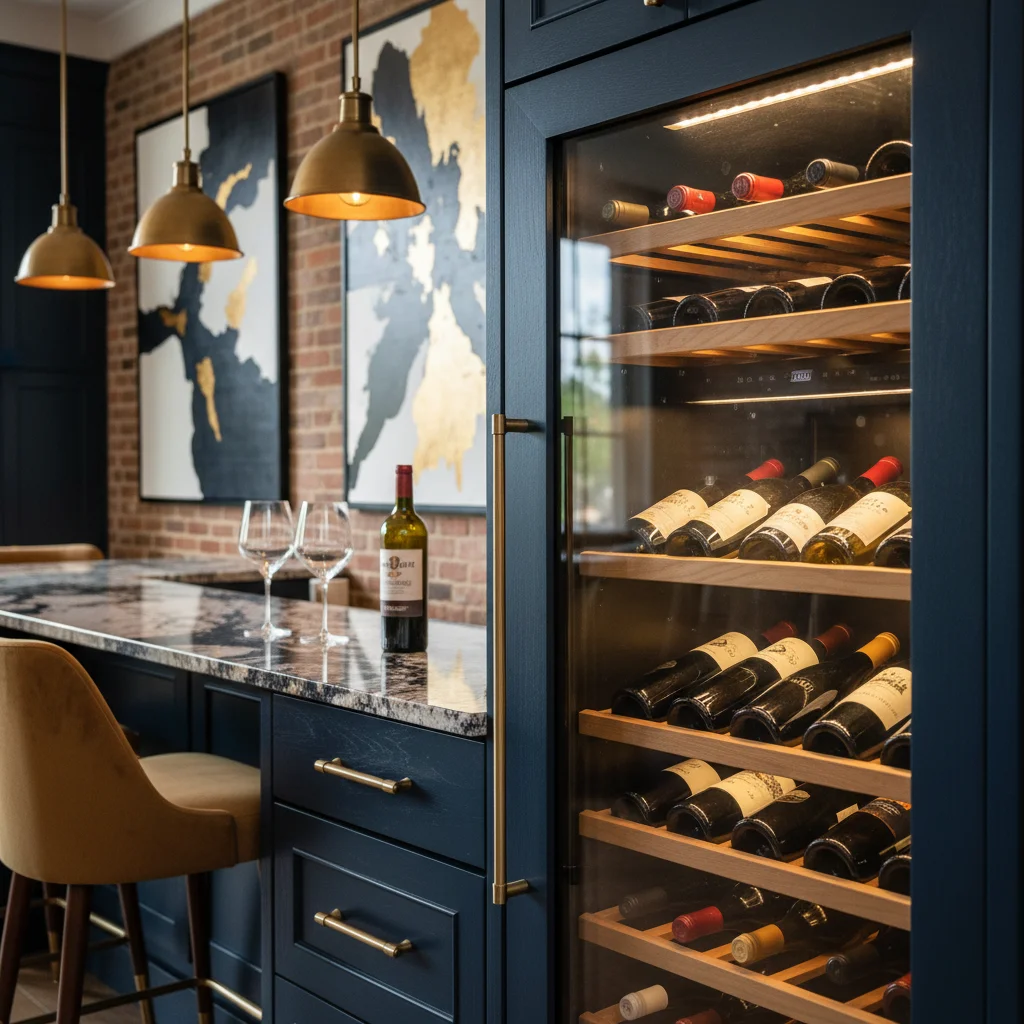
Country Club is unusual even by Denver standards. Within a handful of blocks — the estates lining the Denver Country Club golf course, the brick mansions along Race, Vine, Gilpin, and Downing — sits one of the metro’s heaviest concentrations of professional-grade Sub-Zero and Wolf kitchens. Here the wine unit is almost never a freestanding box parked against a wall. It’s an integrated column, a bank of under-counter drawers, or a finished basement cellar system, set into cabinetry that was often built before anyone thought about a condenser’s breathing room. So a “warm cooler” usually splits into two questions: what failed inside, and what is the installation doing to it.

Faults we see most in these homes

  • The cabinet won’t hold its set point, or one side of a dual-zone runs warm while the other stays exactly where it should.
  • A new hum, rattle, or vibration that resonates through original millwork in an otherwise quiet room.
  • Frost building on the back wall, condensation sweating across the glass door, or water pooling at the base.
  • Display and interior lighting both work, but the cooling stage never engages.
  • Short-cycling — the unit clicks on and off without ever pulling the cabinet down to temperature.

Parts and how long the fix lasts

What decides longevity isn’t the visit; it’s what goes back into the unit. We diagnose to a specific component and replace with OEM-grade or manufacturer-compatible parts matched to your model and serial — compressors, condenser and evaporator fan motors, thermostats, thermistors, control boards, and door gaskets. On a flush-set column in an estate kitchen, a generic substitute that almost fits is a repair you’ll be calling about again; a part spec’d to your cooler is one you forget you ever needed.

The altitude and water angle

At 5,280 feet the air is roughly 15% thinner, so every condenser rejects less heat than its manufacturer assumed at sea level. In a wide-open kitchen that margin quietly disappears; in a column boxed into custom cabinetry with an inch of clearance, it’s the difference between steady cellar temperature and a slow climb out of range. Denver’s dry climate hardens door gaskets early — the usual reason behind frost and a sweating glass door — and on water-fed beverage units the hard local supply, around 150–250 ppm, lays down scale in the lines worth checking before it restricts flow. We read those three forces — thin air, dry air, hard water — as part of the diagnosis, not as afterthoughts.

How to book

Repairs run daily from 8:00 AM to 6:00 PM, and the phone is answered 24/7, so same-day or next-day slots are usually open. Call (720) 770-4189 or book online anytime. The $89 diagnostic brings a technician to your Country Club door, pinpoints the true cause, and goes straight toward the repair the moment you approve it — no guesswork, no surprise line items.

Frequently Asked Questions

Do you service the integrated wine columns that are so common in Country Club estates?

Yes — the panel-ready, flush-set column is the unit we open most often in this neighborhood. Country Club has one of Denver's densest concentrations of professional-grade Sub-Zero and Wolf kitchens, and wine storage here is typically framed into bespoke cabinetry beside the refrigeration. We map the hidden service access first and protect the original woodwork and floors throughout the visit.

Can you reach a cooler built into a butler's pantry or a basement cellar?

Yes. Pantry-tucked drawers and finished basement cellar units are routine in these estates. We just need the surrounding cabinet faces openable, or enough clearance to draw the unit forward; in most Country Club installs there is a workable service path once we locate where the access was designed to live.

The cooler hums against the cabinetry — should I worry?

It can matter. Compressor coolers vibrate by nature, and in a built-in column that hum travels through the surrounding millwork and stands out in a quiet estate kitchen. It may be worn isolation feet or a loose fan blade, or it may be a condenser fan or compressor on its way out. We test it running and under load instead of diagnosing by ear.

Why is frost or condensation forming inside the unit?

Denver's very dry air stiffens and shrinks door gaskets faster than humid climates do, and a seal that no longer grips lets warm room air bleed onto cold glass. That moisture frosts the evaporator and keeps the compressor laboring. On glass-door coolers near Country Club's tall south-facing windows, strong high-altitude UV ages an already tired gasket even quicker.

Do you use genuine replacement parts?

We fit OEM-grade and manufacturer-compatible parts from verified suppliers, matched to your unit's model and serial. For the components that decide how long a repair holds — compressors, fan motors, thermostats, control boards, and door seals — we use parts spec'd to your cooler rather than generic stand-ins.

Is the $89 service call really applied to the repair?

Yes. The $89 buys a full on-site diagnosis, and if you approve the work that amount comes off the final total. You get an up-front price before anything is opened, and nothing new appears on the bill afterward.

Your Sub-Zero Deserves Better

Denver's experienced independent repair specialists are standing by. Same-day appointments available throughout the metro area.