The cost of letting it wait
A refrigerator problem in a Country Club estate rarely announces itself with a bang. It starts as a column reading two degrees warm, a freezer frosting heavier than usual, or a wine cabinet whose compressor never quite shuts off. Easy to ignore for a week. That week is exactly the problem.
The homes lining the Denver Country Club course and the mansion blocks along Downing, Race, and Humboldt carry one of the metro’s densest clusters of professional-grade Sub-Zero and Wolf refrigeration. These are sealed systems doing precise work, and a marginal fault left running tends to recruit a second: a strained compressor overheats, a slow leak empties further, a stocked wine cabinet quietly ruins a case of Bordeaux. Catching the drift early is almost always the cheaper fix. Call (720) 770-4189 and we will read the real fault before it spreads.
What you are noticing
In a freestanding fridge, “it’s warm” usually means one obvious thing. In a flush-set Country Club column, the same symptom can branch several ways, and the tight integrated install is often part of the story.
- A fresh-food column creeping warm — a heat-choked or dusty condenser, a stalled fan, a fading start relay, or a sealed-system fault.
- A wine cabinet that won’t hold its zone — typically a sensor, a cooling stage, a fan, or a gasket gone stiff in Denver’s dry air.
- Heavy frost on the freezer’s back panel — a defrost heater, its sensor, or a board mistiming the cycle.
- A compressor that never cycles off — trapped heat behind the panel front, a weak fan, or a door no longer sealing tight.
- Cloudy, hollow ice or a slowing dispenser — nearly always hard-water scale in the fill tube and inlet valve.
What it usually points to
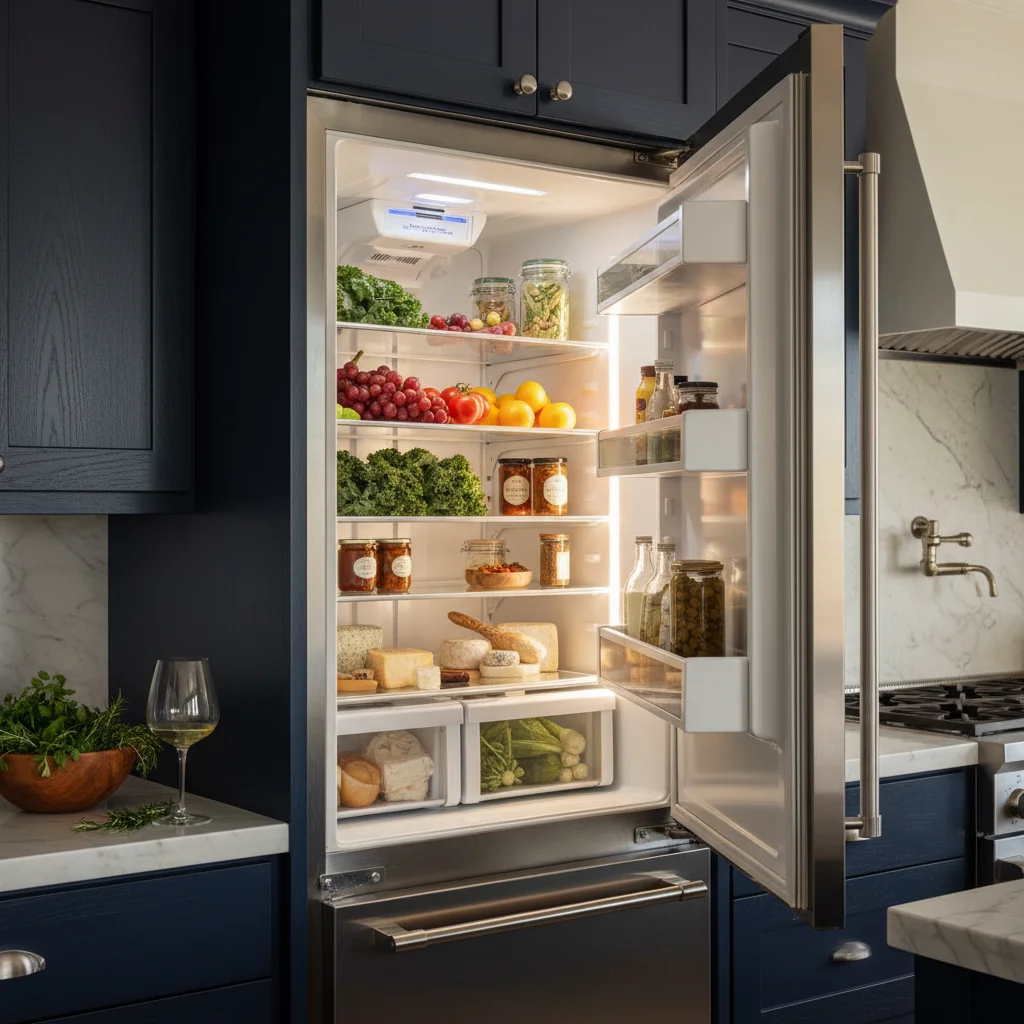
The install itself shapes the diagnosis here. A panel-ready column breathes through a narrow grille, and behind a custom front it sheds heat far less freely than a fridge in open air. Denver’s elevation compounds that: at 5,280 feet the air is roughly 15% thinner, so condensers and fans push less-dense air and reject less heat to begin with. A coil carrying a thin layer of dust, common where modern refrigeration meets century-old cabinetry, gives out here before the same unit would near the coast. That is why a warm column on these blocks usually traces to airflow and the sealed system together, not to a single part.
How we work it
A diagnosis built around the install
We start at the symptom and the cabinet. Real fresh-food and freezer temperatures get measured, then we check clearances and how the unit breathes inside its surround. On units that store them, we pull fault codes to tell a true cooling failure apart from a sensor feeding the board a bad number. From there we trace the condenser, evaporator, compressor, fans, and defrost parts as one path, and test the electrical components under load while the unit runs.
Reaching the unit without leaving a mark
Drawing a flush column forward in an estate kitchen is a planned operation, not a yank. We confirm the access route when you book, protect the millwork, plaster, and flooring, and pull the unit only as far as the repair requires. The water path and seals get checked too: inlet valve, fill tube, filter, and lines for scale, and gaskets for dry-climate hardening.
Coverage and brands
We service the integrated and pro-grade refrigeration that defines Country Club kitchens, professional-grade Sub-Zero and Wolf included, alongside standard freestanding fridges:
- Built-in fresh-food and freezer columns, paired or single
- Panel-ready integrated refrigerators
- Refrigerator and freezer drawers set into islands
- Dedicated wine cabinets in butler’s pantries
Many of these kitchens run several cooling units at once, each with its own compressor and board, so we diagnose each one separately and fit OEM-grade parts matched to your model and serial.
Get it fixed
Repairs run daily, 8:00 AM to 6:00 PM, while the phone is answered 24/7, so you can flag a drifting column the minute you spot it. The longer a warm built-in waits, the more it tends to cost. Call (720) 770-4189 or book online; the $89 diagnostic brings a technician to your Country Club door, pins down the cause, and goes toward the repair once you approve it.