Range Repair in Country Club, Denver

Country Club holds one of the metro's densest clusters of professional-grade Wolf and Sub-Zero kitchens, where a 48-inch dual-fuel range anchors an estate kitchen. When a burner sulks or the oven drifts cool, we read the real fault before quoting — and the price is up front.

Range Repair in Country Club, Denver

Quick Answers

Who repairs professional gas and dual-fuel ranges in Country Club, Denver?
Denver Sub-Zero Repair is an independent appliance service covering all of Country Club, from the estates fronting the golf course to the mansion blocks along Race, Vine, and Gilpin. We handle pro-style gas, dual-fuel, electric, and induction ranges, including 48- and 60-inch ranges with griddles and double ovens. Call (720) 770-4189 — answered 24/7 — and most visits land same-day or next-day.
Why does Denver's altitude affect a pro range in Country Club?
At 5,280 feet the air is roughly 15% thinner, so a high-BTU burner pulls less oxygen and a range tuned at sea level can run rich — lazy yellow flames and soot. The leaner air also costs a bake igniter its safety margin, so it may not glow hot enough to open the gas valve. On Country Club's big pro ranges we check orifice sizing and air-shutter tuning before swapping parts.
How much does range repair cost in Country Club?
The on-site diagnostic is a flat $89, credited toward the repair if you proceed. Because a built-in pro range set into estate cabinetry can hide a very different fault than a freestanding unit, the exact repair price is quoted only after an in-person inspection — never blind over the phone, and nothing added afterward.

Why a pro range gives out here

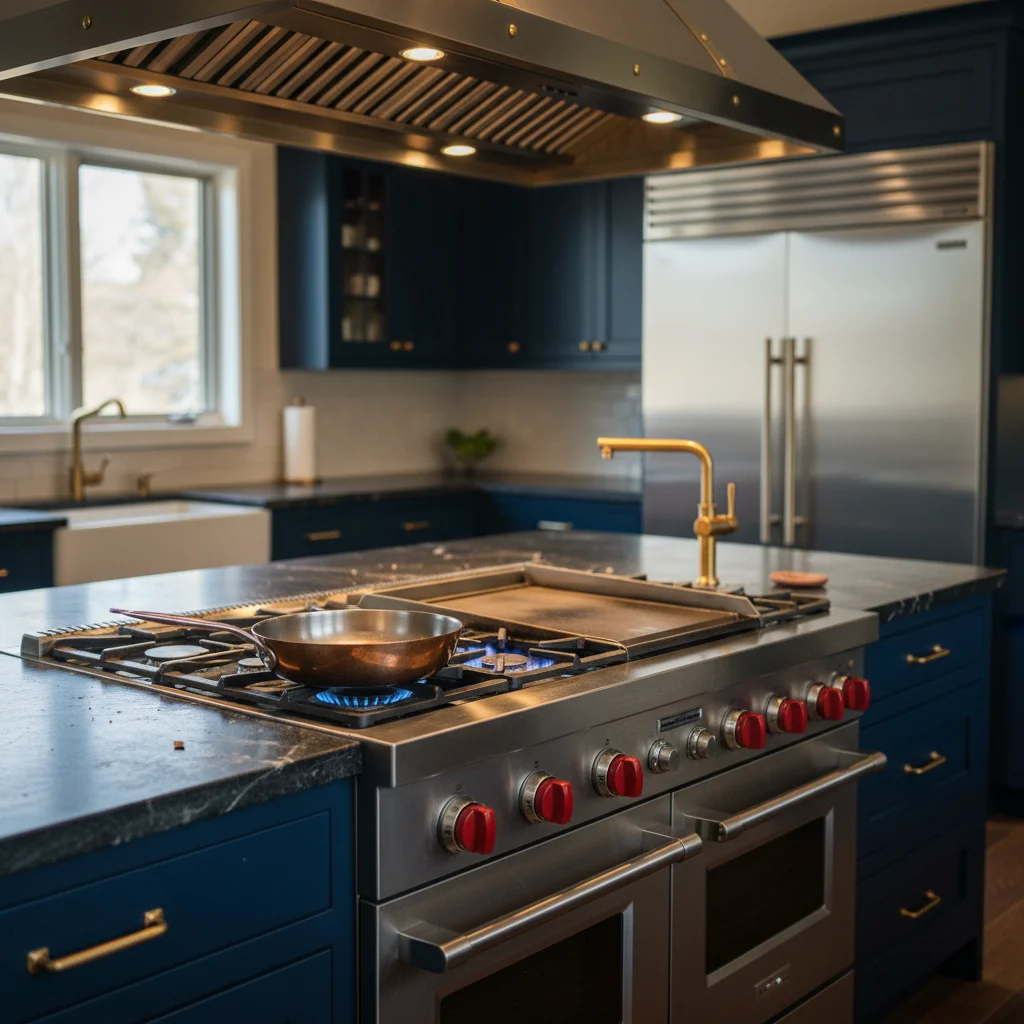
A range is really two appliances sharing a frame — a cooktop above, one or two ovens below — and on the wide pro models filling Country Club kitchens, either half can drift out of spec while the other looks fine. The neighborhood matters to the diagnosis. The estates lining the Denver Country Club course and the mansion blocks along Downing, Race, and Vine hold one of the metro’s highest concentrations of professional-grade Wolf and Sub-Zero installations, and those ranges live hard: high-BTU sealed burners, heavy cast grates, an infrared broiler that runs near a thousand degrees, all set flush into cabinetry milled for the home. Heat, gas, and constant thermal cycling are what wear these units, and a 48-inch dual-fuel range gives a fault more places to hide than a 30-inch freestanding one.

Denver’s air and water come first

Before we condemn a part, we weigh three local forces. At 5,280 feet the air is about 15% thinner, so a high-output burner draws less oxygen and a range set up at sea level can run rich — yellow, lazy flames and sooty pan bottoms — while a weak bake igniter loses the margin it needs to fire. The fix is often correct orifice or air-shutter tuning, not a swap. The very dry climate is the quiet one: it hardens oven door gaskets and dries seals early, letting heat leak so the oven cycles harder to hold temperature. And on any water-fed range, Denver’s 150–250 ppm hard water scales the injector valves and thin supply lines. We read all three before reaching for a replacement.

How we diagnose

  1. Confirm the symptom and the install. We watch the actual fault, then check clearance, the hood, and how the range breathes inside its cabinet run — a starved install cooks its own electronics.
  2. Test the cooktop. Spark module, electrodes, valves, and on dual-fuel models the air-shutter and flame quality, looking for the altitude-rich burn before any part comes off.
  3. Test the oven cavity. Bake igniter draw, sensor resistance, the broil and convection elements, and the control relay that fires them, measured under power.
  4. Pull stored fault codes. On models that report them, electronic diagnostics separate a true component failure from a sensor feeding the board a wrong number.
  5. Inspect the gas and water paths. Manifold and orifices for altitude tuning; any steam or humidity line for hard-water scale.
  6. Explain it and quote up front. You get the cause in plain language and one firm price, protected millwork included, before work begins.

Components we service

  • Sealed gas burners — clogged ports, worn electrodes, cracked ceramic insulators, or a gas valve that won’t hold a low simmer.
  • Spark and ignition — a failed spark module or a harness knocked loose when a heavy range was nudged back into its alcove.
  • Oven heating — fatigued bake igniters, drifting sensors, and burned-out broil, bake, or convection elements.
  • Griddle and charbroiler — infrared burners and their igniters on the pro ranges that carry them.
  • Electric and induction — failed elements, infinite switches, corroded terminal blocks, overheated coils, or a power module that’s lost its interface.
  • Control boards and relays — the electronics that time the oven and stop a surface spark from clicking on its own.

We match every part to your exact model and serial with OEM-grade, manufacturer-compatible components, and reseat and verify clearances afterward so a board or igniter in a boxed-in install doesn’t fail early from trapped heat.

Same-day scheduling

Country Club sits in central Denver just south of Cherry Creek, an easy reach for us, so we typically offer same-day or next-day appointments. Call (720) 770-4189 any hour — the phone is answered 24/7 — or book online. On-site repairs run daily 8:00 AM to 6:00 PM, the diagnostic is a flat $89 applied toward the repair, and you’ll always have an up-front price before we begin. Independent and serving the Denver metro since 2012.

Frequently Asked Questions

Do you service 48- and 60-inch pro ranges with griddles and dual ovens?

Yes — those wide pro ranges are the typical call on this block. Country Club kitchens routinely run Wolf and similar dual-fuel models with sealed burners, an infrared griddle or charbroiler, and two separate oven cavities. We diagnose each burner, the griddle, and both ovens individually, since one control board can drop a single cavity while the rest still works.

Can a technician reach a range built flush into estate cabinetry without harming the millwork?

Routinely. Many Country Club ranges sit between custom cabinet runs with a hood and trim built tight around them. We confirm the access path when you book, protect the surrounding woodwork and flooring, and draw the unit forward only as far as reaching the gas manifold or rear electronics genuinely requires.

Every burner clicks but none will light. Is that dangerous?

A burner that keeps sparking is releasing unburned gas until it catches, so stop using it. Turn every knob off, let the kitchen air out, and dry any moisture near the igniters. If the sparking continues on its own or you smell gas, shut the range off at the wall and call (720) 770-4189 so we can clear the spark module or ignition harness behind it.

My oven runs cool and food takes longer than the recipe says. What's wrong?

Usually a fatigued bake igniter that no longer glows hot enough to open the valve, a drifting oven sensor, or a control board misreading the cavity. Denver's thin air already makes a gas oven burn leaner, so an igniter that barely coped at sea level cycles the cavity cool here. We test igniter draw and sensor resistance together before replacing either.

Does hard water matter on a range, or only on dishwashers and ice makers?

It matters on any range with a water feature — steam-assist ovens, a dual-fuel humidity injector, or a pot-filler-fed setup common in these estate kitchens. Denver's 150–250 ppm water scales those valves and lines over time. We descale or replace the affected part and check the supply rather than just clearing a fault and walking away.

Do you use genuine range parts, and are you affiliated with the manufacturer?

We fit OEM-grade and manufacturer-compatible parts from verified suppliers, matched to your exact model and serial — igniters, gas valves, elements, sensors, and boards built to original spec. We are fully independent and not affiliated with, endorsed by, or sponsored by Sub-Zero Group, Inc., Wolf, or any manufacturer. We have served the Denver metro since 2012.

Your Sub-Zero Deserves Better

Denver's experienced independent repair specialists are standing by. Same-day appointments available throughout the metro area.